Hey there, college-bound students and families! We have some exciting news to share with you today. Starting in the 2024-2025 academic year, the Free Application for Federal Student Aid (FAFSA) is getting a major makeover to make the process simpler and more user-friendly.
The FAFSA Simplification Act, which was passed recently, aims to streamline the financial aid application process and reduce the burden on students and families. Gone are the days of filling out lengthy forms and struggling to understand complex questions. With the new changes, you can expect a smoother experience from start to finish.
Because of the changes, the new FAFSA won’t open as usual on October 1st this year but will be delayed until December.
So, what exactly can you look forward to with the simplified FAFSA for 2024-2025? Here are eight key highlights:
Fewer Questions: Say goodbye to the overwhelming number of questions. The new FAFSA will significantly reduce the number of questions from 108 to about 46. This means you can spend less time filling out forms and more time focusing on your college journey.
New Terminology: A new “student aid index” will replace the current “expected family contribution” terminology. Think of the student aid index as a yardstick measuring a student’s financial aid eligibility, rather than how much a family will pay.
Automatic Data Retrieval: The revamped FAFSA now uses a new IRS direct data exchange tool. This tool allows you to automatically transfer your tax information directly from the IRS database to the FAFSA form, reducing the chance of errors and speeding up the application process. (As a reminder, the 2024-2025 FAFSA will use income information from an applicant’s 2022 federal tax return.)
Enhanced Eligibility Assessment: The changes to the FAFSA will introduce a different measure of your ability to pay for college. This means that your eligibility for financial aid may be assessed differently than in previous years. Make sure to familiarize yourself with the updated guidelines to ensure you’re maximizing your eligibility.
Multiple Children in College: For parents with multiple children in college at the same time, the new FAFSA will no longer provide an advantage in the form of a reduced parent contribution. The current FAFSA divides the parent contribution by the number of children in college, but the new FAFSA does not. This change has the potential to significantly decrease aid eligibility for middle and high-income students.
Gift Reporting: Cash support and other money paid on a student’s behalf – for example a gift of money from a relative or a distribution from a grandparent-owned 529 plan – will no longer need to be reported.
Increased Income Shielding: The income protection allowance, which shields a portion of income from consideration, will increase by 20% for parents and by 35% for most students.
Pell Grant expansion: The new FAFSA will expand Pell Grants to more students and will link eligibility to family size and the federal poverty level.
These are just a handful of the key changes coming your way with the simplified FAFSA for 2024-2025. Navigating the world of financial aid can be overwhelming, but these modifications aim to make the process more accessible and less daunting.
Remember, the simplified FAFSA for 2024-2025 will be available for students applying for financial aid for the upcoming academic year. So, if someone in your family is planning to attend college during the 2024-2025 year, get ready to take advantage of these positive changes in December 2023.
We hope this news brings a sigh of relief and excitement as you embark on your college journey. Stay tuned for more updates as we approach the implementation of the simplified FAFSA for 2024-2025.
Contact your BlueSky advisory team if you’d like to discuss how these changes may impact your education planning or college savings strategy.
As a Wealth Advisor, Tom is responsible for managing client data, developing financial plans, implementing recommendations, and presenting information to clients. He assists in answering their daily and ongoing questions as well as managing their investments and other financial matters.
Tom earned a BS degree in Personal Financial Planning from Utah Valley University in 2018, received his Certified Financial Planner™ (CFP®) designation in 2019, and has a variety of industry licenses.
Tom joined BlueSky in 2022 and has experience working at a large broker-dealer where he assisted high-net-worth clients with placing trades in their retail accounts. He has experience working with many different people from everyday workers to high-net-worth tech employees to business owners. Tom is passionate about holistic planning to bring a client’s entire financial picture into focus.
Tom lives in Tri-Cities, Washington with his wife and children.
What do you enjoy most about being part of BlueSky?
So far, what I have enjoyed most about being part of BlueSky is the welcoming atmosphere of everyone I have met. Also, it is clear, even early on that we do what is best for the client in every situation. We have the discernment to read a client’s situation and adjust accordingly to do what is best for their financial picture.
What does “improving the quality of our clients’ lives” mean to you?
Improving the quality of our clients’ lives to me means allowing them to live the life they want, not just the life they need to live to pay for everything, but allowing them the financial independence to truly do what they want to do with their lives.
What keeps you busy when you’re not working?
I stay busy with my family life when not working; I have a wife named, Sarah and two kids ages two and four who certainly keep me on my toes. I enjoy spending time with my lovely wife and going on date nights. My hobbies include lifting weights, watching football with friends, and target shooting.
Johanna is a strategic member of the client advisory team. She helps to enhance client relationships, execute financial planning and investment tasks, prepare, gather, and organize client information for case design, scenario building, and plan development.
Johanna brings more than 14 years of experience providing solutions-based service and ensuring a high level of client satisfaction in the investment field. Johanna served high net-worth clients across the Bay Area as a Senior Client Service Associate at a wealth management firm in Cupertino, California. Prior to that, she worked at a large investment management firm for over 8 years in Chicago, Illinois.
Johanna holds a B.A. in Photography from Columbia College in Chicago and has received an Investment Foundations certificate from the CFA Institute. Johanna is also fluent in Spanish.
In her free time Johanna volunteers at the Humane Society of Silicon Valley and previously lent her time to PAWS Chicago, a no-kill animal shelter, as lead volunteer.
What do you enjoy most about being part of BlueSky?
I enjoy forming relationships with the clients, gaining their trust and helping them through life’s big transitions.
What does “improving the quality of our clients’ lives” mean to you?
Helping clients reach their financial goals whatever they might be, retirement, paying for their child’s education or buying a second home.
What keeps you busy when you’re not working?
My family here in California; my husband and two rescued pets as well as my family back in Chicago. I enjoy reading a good book, yoga, photography and traveling.
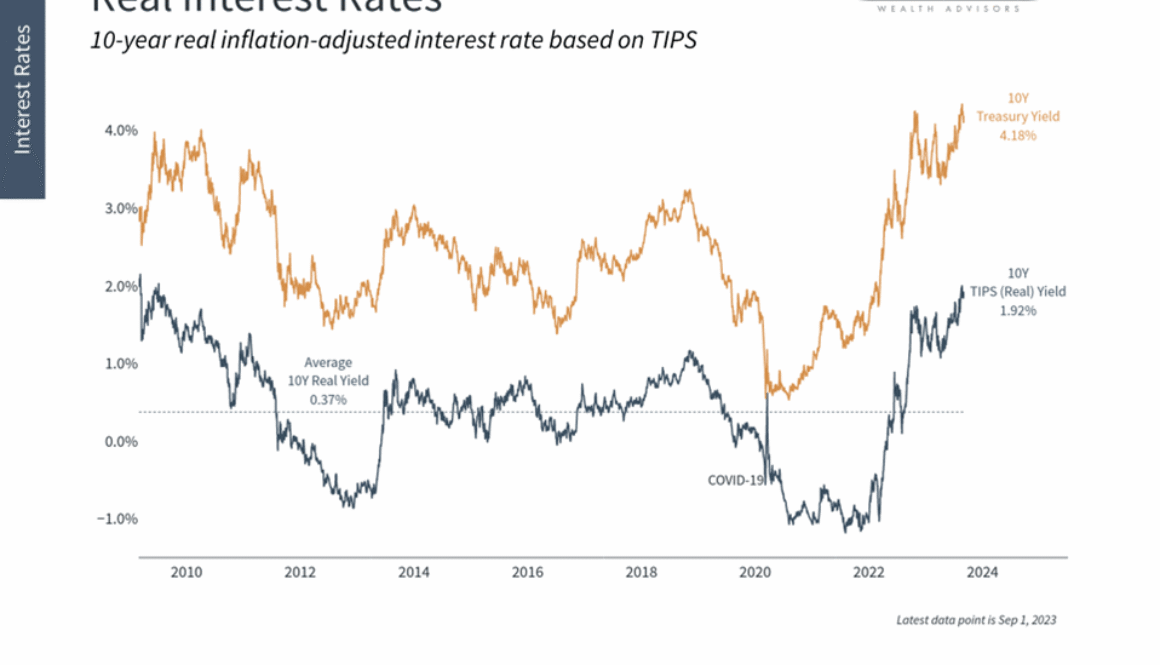
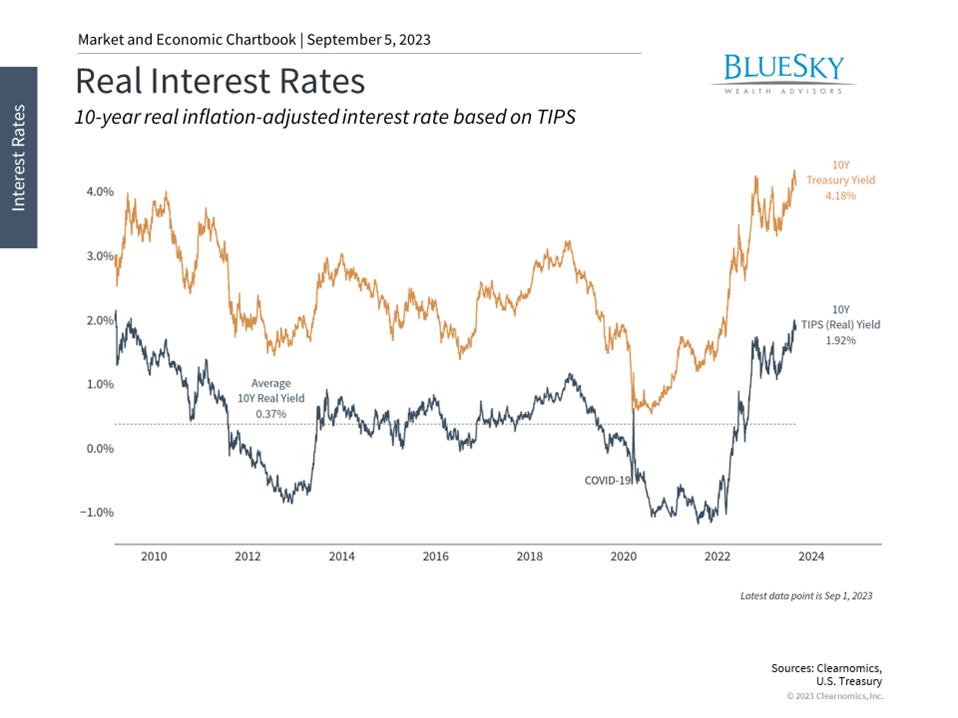
Interest rates have swung wildly over the past two years in response to inflation, economic concerns, and market volatility. After falling as low as 3.3% earlier this year, the 10-year U.S. Treasury is now yielding around 4.2%, back to where it was roughly a year ago. However, while today’s long-term yields look similar to last year’s on paper, they are quite different from an economic and market perspective. What are interest rates telling us today and how does this impact long-term investors?
Real long-term Treasury yields are at 14-year highs
An important concept in economics is the distinction between “nominal” and “real” values. The simplest way to understand the difference is that nominal values include the effects of inflation while real ones do not. In this way, the labeled prices of goods and services we see every day are nominal prices. For instance, the price of a gallon of milk at the grocery store is a nominal price since it changes based on inflation. The paychecks we receive are also nominal values since they are paid in dollars or other currencies whose purchasing power changes as the prices of goods and services fluctuate.
A real value, on the other hand, represents the actual amount of goods and services one receives, irrespective of the prices of those items. A gallon of milk, for instance, is still a gallon of milk whether it costs $3.97, as it does today on average across the country, or $2.84 as it did five years ago. If someone were to receive their paycheck not in a set amount of nominal dollars but in the real dollar equivalent of gallons of milk, i.e. an amount that allows them to buy a set number of gallons, they would receive more dollars today. In this way, their paycheck would be protected from inflation, at least in terms of milk.
Why does this matter? When prices are fluctuating, such as in times of high inflation, it’s helpful to understand what we’re actually getting for those prices. For example, getting an annual raise of 4.5% is great, but if inflation is rising at a faster pace, the value of those wages is declining in real terms. The same is true for the purchasing power of cash and anything else that is measured in nominal terms. This is also why economic growth is often measured in terms of “real GDP” since this focuses on the actual output of the economy rather than price movements.
The distinction between nominal and real values is important for investing as well. For example, the 4.2% yield on 10-year Treasury securities mentioned above is a nominal yield. When inflation rises faster than expected, the actual purchasing power of the interest payments an investor receives will be lower, and vice versa.
Thus, the real yield one receives depends on the level of inflation and, in some sense, this what should matter to long-term investors. Similarly, investing in stocks has been historically attractive because stock market returns have far outpaced inflation, resulting in positive real returns.
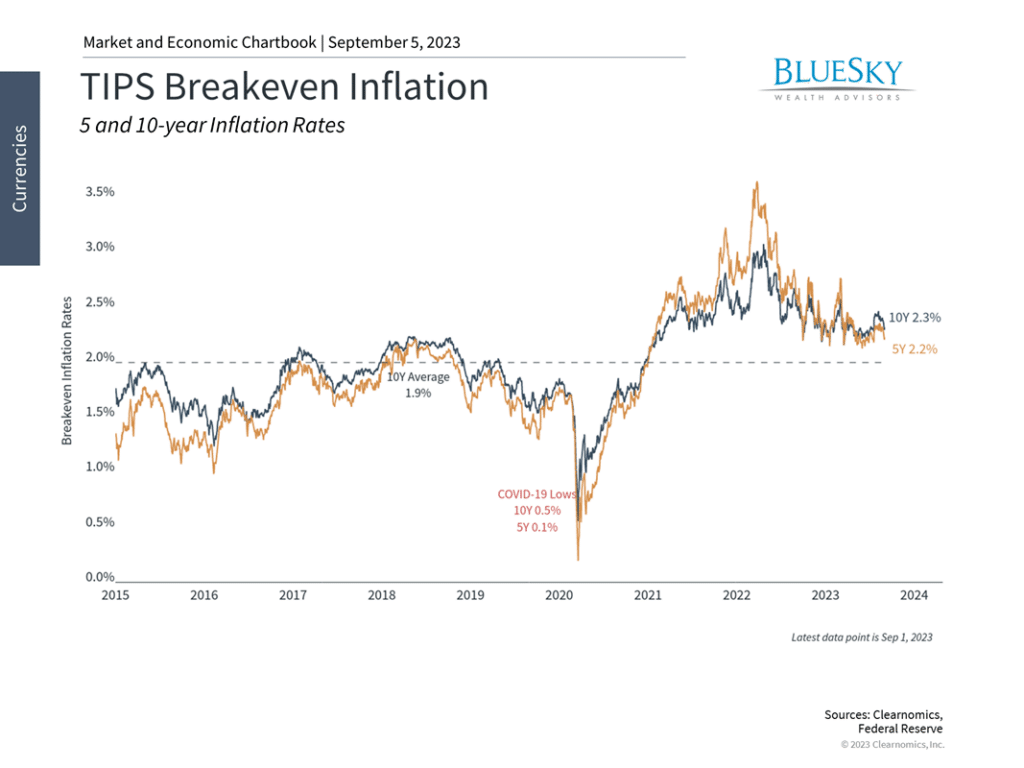
The expected inflation rates implied by TIPS have declined
Fortunately, even though the nominal yield on the 10-year U.S. Treasury appears to be the same as it was last year, the real yield is now at its highest level since 2009. This is because inflation expectations have improved dramatically, as shown in the accompanying charts, and economic growth has surprised to the upside. What’s more, the current real yield of 1.9% is far above the average since the global financial crisis of 0.37% when both nominal interest rates and inflation were low. This is another reason that bonds continue to be attractive and important components of diversified portfolios despite the significant volatility of the past two years.
It’s also important to note that there are bond instruments whose purpose is to generate real yields for investors. Treasury Inflation-Protected Securities (TIPS), for instance, adjust their nominal yields for inflation, thus providing a “guaranteed” real yield. This is similar to the example above where someone chooses to be paid in the real dollar equivalent of gallons of milk – regardless of how the price of milk changes, the real value stays the same. In general, the value of TIPS is the highest when inflation is high and rising, or when investors value the certainty of a specified real yield.
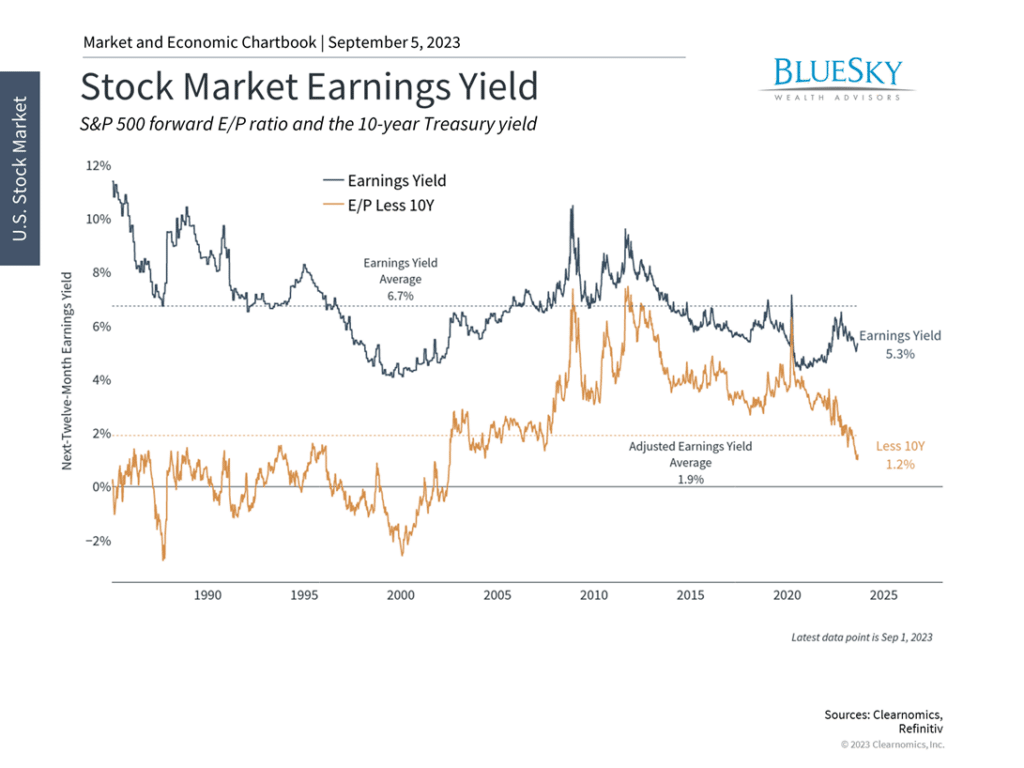
These concepts affect stock market valuations as well. When real yields on bonds are higher, investors may find it more attractive to invest in bonds than riskier stocks, at least on the margin. In other words, the bar for stocks is higher when investors can generate attractive real yields from bonds. Thus, there can be an inverse relationship between higher real rates and stock market valuations in the long run. In the short run, other factors can be more important such as the rally in tech this year. At the moment, the S&P 500 earnings yield of 5.3% is below its historical average of 6.7%, and is even lower when adjusted for the level of either real or nominal interest rates.
Stocks are more expensive relative to bonds as rates rise
Of course, this does not mean that the stock market is not attractive for other reasons or that investors should only hold bonds. As always, long-term investing is about building diversified portfolios that contain the proper allocations of stocks, bonds, and other asset classes depending on financial goals. The fact that real yields are at their highest level in 14 years is one factor for investors to consider as they structure their investment portfolios to increase the odds of financial success.
The bottom line? Investors should understand the difference between nominal and real rates as the economic and market outlook shifts. Real yields have jumped as inflation expectations have improved, providing a source of real income for portfolios.
Are you ready to grow your money but don’t know where to begin? The required rate of return is a crucial factor that can guide you toward financial success. It helps you chart your financial path and ensures you achieve your desired level of growth. In this post, we’ll simplify calculating the required rate of return and explain why it’s vital for successful investments. Get ready to take charge of your financial future!
What is Required Rate of Return (RRR)?
Are you getting the return on your investment that you expect? The required rate of return (RRR) is the key to finding out. Investors are willing to accept the minimum amount of money in exchange for investing their hard-earned cash. By considering factors like risk tolerance, market conditions, and potential rewards, investors can determine what kind of return they aim for.
When making investment decisions, keeping an eye on inflation expectations is crucial. Say you’re a daring investor who loves taking risks. You may be looking for a higher return on your investments, which means targeting a higher required rate of return. But if you’re more risk-averse, you might only be comfortable with a lower capital structure target rate of return. It’s all about finding the right balance between your investment goals and risk tolerance.
Steps to Calculate RRR
Calculating the rate of return formula is not a one-size-fits-all formula. There are various steps and factors to consider when determining the right return rate for an investment. To help you get started, here’s a quick summary of the main steps involved in calculating the required rate of return:
Determine the Risk-Free Rate (RFR)
Determining the risk-free rate (RFR) is the first and most important step in calculating the required rate of return. The RFR is the base rate investors can expect to receive without taking on additional risks. It is generally determined by examining government bonds and other debt instruments with very low default risk. For example, U.S. Treasury bills often indicate the zero risk rate. This helps investors determine how much they need to earn to take on additional risks. This rate is then used to calculate the minimum return on other investments.
Estimate an Equity Premium for the Market
The next step in calculating the required rate of return is to estimate an equity premium for the market. An equity premium is the amount by which a stock’s expected rate of return must exceed that of a risk-free investment, like a U.S. Treasury bill. The usual range for an equity premium is between 2% and 7%. Generally speaking, this percentage reflects investors’ expectations for the risk premium of holding stocks.
Consider market volatility, expected inflation rate, dividend discount model, and other macroeconomic indicators when estimating your equity premium. Many investors use historical data to estimate an equity premium reflecting current stock price performance trends. Understanding this concept thoroughly is important before deciding on a target return rate for any equity valuation.
Identify Your Project’s Beta or Expected Return
Investors must identify their project’s expected return or beta once the risk-free rate and equity premium have been considered. Beta is a measure of volatility that compares an asset’s performance to a benchmark index. Stocks with higher betas are generally considered more volatile than those with lower betas.
The expected return of your portfolio will depend largely on the individual assets within it. If you have less volatile stocks than the benchmark, your expected return may be lower than the overall stock’s present value. On the other hand, if you have stocks with higher betas, your expected return could be greater than that of the overall stock market.
Calculate the Expected Return of Your Portfolio
Once you’ve estimated an equity premium for the market, you’ll be on your way to calculating the expected return of your portfolio. It’s a straightforward process. Add up the expected returns from your investments, and don’t forget to consider any cash holdings, taxes, fees, or other associated costs.
This will give you a number that you can use to compare your portfolio with other investment products. But wait, there’s more! When estimating your portfolio’s expected return, we can’t ignore the effects of inflation and taxes. Inflation can slowly eat away at your returns over time, so it’s crucial to account for this if you want a clear picture of potential gains or losses. And let’s not forget about taxes – stocks, bonds, and mutual funds are all taxed differently. So make sure to factor in the relevant tax rates when making those all-important calculations.
Factors That Determine Your Portfolio’s Risk
When constructing a portfolio, it’s important to understand the risk factors associated with different assets. Some of the common risk factors that can affect the performance of your portfolio:
Market Risk
Market risk, also called systematic risk, is the overall risk of an investment that cannot be avoided through diversification. It is caused by macroeconomic events or broad market movements that impact all securities within a specific asset class. For instance, when the stock market drops, most stocks incur losses, regardless of their performance in other sectors. This type of risk affects all investors equally and cannot be mitigated through asset allocation. Therefore, it is crucial to consider your comfort level with market risk when constructing a portfolio.
Interest Rate Risk
Interest rate risk is a crucial aspect to consider when investing. Fluctuations in interest rates over time can impact different types of investments. For example, when rates rise, the value of fixed-income investments like bonds decreases, making them less appealing to investors.
As a result, bondholders may experience losses as the market adjusts to new rates. Additionally, fluctuations in interest rates can also affect other investments, including stocks and real estate, potentially leading to additional losses. Before making any investment decision, it is important to understand the potential impact of interest rate changes on your portfolio.
Credit Risk
It’s important to be aware of credit risk when investing. It refers to the possibility of an issuer being unable to meet its debt obligations. This risk is higher when dealing with high-yield and corporate securities, considered riskier than government bonds.
You can invest in credit instruments such as treasury bills, corporate bonds, and junk bonds to diversify your portfolio. Understanding the level of credit risk involved in any investment you’re considering for effective portfolio risk management is crucial.
Liquidity Risk
Liquidity risk happens when investors may face difficulty converting investments into cash promptly. This risk is typically highest with illiquid assets like private equity and venture capital, which are not freely traded on public markets. Before committing any funds, investors should carefully consider investment liquidity to prevent potential losses if they require quick access to their funds.
Economic Risk
Economic risk refers to the potential impact of macroeconomic factors on an investor’s portfolio, such as economic growth, inflation, unemployment, and exchange rates. Investors must grasp how economic changes might affect their investments before making decisions. Diversifying across different asset classes can help mitigate financial risk but may not provide complete protection against losses during a market downturn.
Political Risk
There are risks involved in investing in countries where the political climate can impact the value of assets. Political risk is particularly significant for international investments, where local governments may impose restrictions or regulations that could significantly affect an investment. It is important for investors to thoroughly research potential political risks before investing and to develop a strategy to manage these risks if needed, effectively.
Regulatory Risk
Regulatory risk is the risk that changes in government regulations could adversely affect an investment or business opportunity. Laws governing areas such as taxes, labor, and environmental standards can significantly impact the profitability of assets, so it’s important to understand how potential regulatory changes might affect investments before committing funds. Investors should also monitor developments in the regulatory landscape and adjust their strategies accordingly.
Liquidity Risk
Liquidity risk is when an investor needs investors to understand more time to sell assets to meet their expected dividend payment. Investors need to know how liquid their investments are to plan for potential market disruptions or liquidity problems. Investors should also consider investing in assets with relatively high liquidity to minimize the risk of being stuck with illiquid investments.
Currency Risk
Currency risk is the potential for exchange rate movements or changes in currency regulations to impact the value of investments in different currencies. Investors exposed to multiple currencies should ensure they understand the risks associated with those currencies and have a plan to manage any potential changes.
Payment Risk
Payment risk refers to the potential for delays or non-receipt of payments from counterparties like clients or suppliers. This can seriously impact business profitability. It’s crucial to grasp counterparties’ payment policies and implement measures to mitigate this risk.
Benefits of Knowing RRR
Knowing the risk-reward ratio can be a powerful tool for investors to understand the potential risks and rewards associated with any investments. Here are some of the key benefits of understanding RRR:
Helps Identify Risks
Understanding the risk-reward ratio can help investors identify specific risks in any investment, such as liquidity or currency risk, which are important to consider before investing. Knowing these risks can enable an investor to manage them more effectively and make better investment decisions. For example, suppose an investor is looking at a certain stock with high volatility. In that case, they can use the risk-reward ratio to decide whether the potential reward is worth taking on the higher risk. This knowledge will help investors make more informed decisions and protect their investments from undue risks.
Determines Appropriate Investment Allocation
Investors aware of the risk-reward ratio can use it to determine an appropriate portfolio allocation. By understanding the risk-reward of different investments, they can decide which ones to buy or sell and how much to invest in each one. For example, an investor may be more willing to take on higher risks if the potential reward is greater. As such, they can use the risk-reward ratio to decide whether a certain stock should be a bigger or smaller part of their portfolio.
Helps Monitor Performance
The risk-reward ratio can also be used to help investors monitor the performance of their investments. By understanding the risks associated with an investment, they can better assess whether it meets their expectations. For example, suppose a stock is exhibiting lower-than-expected returns or higher-than-expected volatility. In that case, the investor may benefit from reallocating their portfolio and investing in something with a lower risk-reward ratio.
Identifies Trends
Not only does the risk-reward ratio assist investors in monitoring their investments, but it also aids in identifying market trends. By tracking stocks with comparable risk profiles, investors can gain insights into the performance of specific asset classes or sectors. This information is valuable for those interested in building a diversified portfolio or investing in particular sectors.
Allows Comparison of Different Investments
The risk-reward ratio allows investors to compare various investments and determine the best fit for their needs. By comprehending each asset’s associated risks and rewards, investors can make informed decisions on which investments to buy or sell. This approach aids in constructing a portfolio that aligns with long-term objectives while minimizing overall risk.
Common Mistakes to Avoid When Calculating RRR
Although the risk-reward ratio is an important tool in investing, it could be better. Some common mistakes include the following:
Not Factoring in Taxes
Don’t forget about taxes when calculating the risk-reward ratio (RRR). Ignoring the tax implications of an investment can leave you with a completely different expected return than you expected. Let’s say you’re investing in a stock not held in a retirement account. Any forecasted dividend growth rate from that investment is subject to capital taxes. So when determining your RRR, you need to consider the amount of money you’d need to pay in taxes. Also, remember that federal and state taxes may differ depending on whether the investment is in a retirement account.
Neglecting to Consider Fees
When it comes to calculating the RRR for an investment, it’s essential to take the fees involved into account. These fees can vary significantly depending on whether you’re partnering with a financial advisor, broker, or any other entity, and it’s crucial to include them when estimating your expected return. If you decide to work with a financial advisor who charges a percentage fee based on your assets, that fee must be factored into your RRR calculation. Make sure not to underestimate the significance of these vital costs!
Not Taking Inflation Into Account
Did you know that inflation can significantly impact the growth rate of dividends? Considering the expected inflation rate when calculating your required RRR for your investments is crucial. A higher inflation rate means that when you eventually cash out, your investment will have less value in real terms. So, make sure to factor in inflation when calculating your return. It’s a crucial consideration!
Not Investing in the Right Asset Mix
Finding the right mix of assets is crucial for maximizing returns while managing risk. This means building a portfolio that includes various investment types like stocks, bonds, cash, real estate, and commodities. By diversifying, you’ll gain exposure to different parts of the market. So, if one asset class performs poorly, another can offset the losses and provide stability. It’s all about finding the right balance to achieve your financial goals and shield yourself from pitfalls.
Not Rebalancing Your Portfolio Regularly
Investing in the right mix of assets is crucial to maximizing returns while managing risk effectively. That means having a diverse capital asset pricing model portfolio with various investment types, such as stocks, bonds, cash, real estate, and commodities. This diversification ensures that you’ll have exposure to different parts of the market, so if one asset class experiences a downturn, another may provide stability and potential growth. By strategically diversifying your investments, you can confidently navigate the market and increase your chances of long-term financial success.
Conclusion
Making wise investments requires time and discipline, but it’s crucial to avoid common mistakes that can lead to poor investment decisions. To make informed choices and achieve your goals, consider seeking advice from a financial advisor or wealth manager. Educating yourself on different investment options and diversifying appropriately can mitigate risk and enhance long-term returns.
By creating a solid plan and being aware of potential pitfalls, you can maximize your investment returns and reach your financial objectives. Remember, no matter how experienced you are, there’s always something new to learn in the investment world. Stay updated with the latest trends in corporate finance and market changes to ensure you’re making well-informed investment decisions. Happy investing!
David L. Blain, CFA, CEO of BlueSky Wealth Advisors, and author of “Invest In Your Life, Not Just Your Portfolio,” shares the exciting news that four key BlueSky employees are now Partners in the company.
Transcription of video:
Hello everybody. Thanks for joining me today in this exciting video. I have a really important announcement to make regarding some key staff members that I’ve been looking forward to for a while, and we’ll get to that in a minute.
But first, just wanted to kind of walk a little history of BlueSky. For those of you don’t know, it’s been almost 25 years ago since I started this company in a small shared office of about 125 square feet in Fayetteville. And my objective in the beginning was to provide high quality expert advice for a transparent cost that was free of conflict and no product sales.
Now, today, it’s somewhat more common to see that, but 25 years ago, that was extremely rare to find, and it was my goal to try to help change the way that financial advice was delivered in America.
BlueSky Through the Years
(1:00) And so as we continue to grow through the years, it got to a point where I couldn’t do it all myself. I originally only wanted to have about 25 or so clients that I could work with. Well, that kind of went out the window.
What we did was very popular, and so I had to start hiring people. And some of those people have come into Blue Sky and made a contribution. Some are still here, some aren’t. But the reality is, we would not be here today if it were not for the contribution of several key people. You just can’t run a company by yourself. It takes other people to do it. And we have some really, really good ones here that have made tremendous contributions to our success as evidence.
For those of you that had a chance to take our recent client survey, I’ll be giving you the results of those here in a week or two, but it demonstrated what I always believe: that the overwhelming majority, you know, 98% of our clients are extremely happy with what we do.
They’re extremely satisfied with the service we provide and are happy to recommend us to other people. And this, along with the staff here, has made us one of the leading RIAs in the country. Certainly one of the largest flat fee organizations.
There’s still some firms out there that charge assets under management that are certainly much larger than us, but in terms of quality and other metrics that aren’t necessarily just specific to size, we continually win awards. And like I said, the client survey that we recently did bears that out.
So that’s the first thing: we grew from very humble beginnings to where we are today thanks to some of our wonderful staff members.
Second thing is, as much as I would like to, I cannot defy the laws of nature and I am growing older. As much as I would like to think that I’m still 28 years old, I’m not. And just like we help you guys envision the future and help you plan for life beyond your careers, I need to think about that too. Not just for myself, but in this unique position, I have to think about all of you as clients and what happens when David is not here anymore.
We have to ensure that the company can still grow and prosper and serve you all for as long as you want with the same high quality advice, the same attention to detail, the same highly refined processes, and the same forward-looking innovation that we have exhibited over the past 25 years.
BlueSky’s Succession Plan
(03:57) And so, as part of that, obviously I’ve been thinking about my succession plan. Now, I’m not planning to go anywhere anytime soon, but this is just the beginning of it. So for those two reasons – number one, to recognize the contribution of several key employees and number two, to start that process of a succession plan for Blue Sky – we want to make sure there are other people involved to be able to take over and run the company.
I’m very excited to announce I’m so proud that we now have four new partners. Four employees have been invited to become partners in BlueSky, and they all have accepted effective April 1, 2023:
Madeline Valente, Senior Wealth Advisor who works out of our California office
John Gjertsen, Senior Wealth Advisor who works out of the Atlanta area
Christie Bonacci, Senior Wealth Advisor who works out of our New Bern office
Ayasha Jones, Director of Operations who works out of our New Bern office
All four of them have made tremendous contributions over the years to the success of the company. I’m just so proud of them and so excited to have them as a partner with me in this endeavor. Now they are minority partners and I am still firmly the majority partner and in control, but they are now going to be part of the exclusive club as partners at BlueSky.
So, I hope that as you see them and you interact them, please take a moment to congratulate them on this great accomplishment. We’re all excited for them and I hope you’ll share in that excitement with them. So that’s it, that’s my big announcement for the day. I hope you have a great week.
David L. Blain, CFA, CEO of BlueSky Wealth Advisors, and author of “Invest In Your Life, Not Just Your Portfolio,” dives into the details behind why Silicon Valley Bank collapsed last week and what it means for you and your portfolio.
Good morning. This is David Blain, CEO of Blue Sky Wealth Advisors. I wanted to come today to you with a message about what’s going on in the markets and the collapse of Silicon Valley Bank last week. As you may have heard, unless you’ve been on vacation in Bora Bora or something last week, depositors tried to withdraw almost $42 billion from Silicon Valley Bank, and the bank collapsed and had to be taken over by the regulators.
This run on the bank was caused by Silicon Valley Bank announcing their fourth quarter earnings. They lost a lot of money and they attempted to sell some of their assets, which kind of created a panic amongst a lot of their customer base. A lot of their customer base, hence the name Silicon Valley Bank, are a lot of startups in Silicon Valley, and the word went out in the tech community to get your money out of the bank — the classic sign of a run on a bank. And they just didn’t have the money to meet the redemption requests of their customers.
Shortly thereafter, Signature Bank, a New York based bank, also failed. Signature Bank, did a lot of work in the crypto arena. Ironically, Signature Bank, one of the board members is a guy by name Barney Frank, who used to be a senator or Congressman Barney Frank from New York, and who helped author the Dodd-Frank Bill after the 2008 crisis, which was designed to prevent some of the problems in 2008. Well, obviously he did not take his own advice, and as a board member of that bank, they also failed.
That’s causing this morning, the markets are down in general, banks especially. Any of the mid-size regional banks are just getting really massive declines, 20, 30, 40% declines in these bank stocks. There’s actually probably a buying opportunity there, but we’ll talk about that a little bit later.
So first of all, why did this happen?
As I’ve said famously many years, I was talking to some people around here this morning at Blue Sky and I forget, to me, 2008 seems like just yesterday, and I was talking to some people this morning and I said, “How old were you in 2008?” And they said, “Oh, I was 12.” Or “I was a junior in high school.” And I forget that that’s a long time ago. And a lot of people didn’t live through that, and maybe the institutional memory is not there.
But we’ve been through this before. In 2008, Washington Mutual was then the largest bank in America to collapse, Silicon Valley Bank last week now the second-largest, Signature Bank the third largest. So I’ve always said, the bank is the worst place to keep your money. And I know that’s funny if you think about it, but the bank does not have your money. Banks operate on what’s called a fractional reserve system, meaning when you put a dollar in the bank, they loan it out.
Not all of it. Depending on the bank and the tier capital, it gets kind of confusing, but suffice to say, they have maybe 10 cents on the dollar of your money. The rest of it is loaned out or they invest it into different businesses. They loan it to businesses. In Silicon Valley Bank’s case, they loaned it to a lot of startups. But they don’t have your money. And so what happens is, what they did with your money, if those loans start going bad or the investments that they made in companies or other bonds start going bad, then they don’t have the capital they need to meet the reserve requirements for when people want their money out, and so they’re forced to sell assets.
If it’s a bad time and they’re selling assets, they may be taking a loss. And that’s what happened with Silicon Valley Bank. The tech sector as a whole started slowing down, a lot of the cash that these companies kept in the Silicon Valley Bank they started needing the cash. They started withdrawing the cash from the bank. Normal business. Tech sector slowing down, taking the money out. Silicon Valley Bank proceeded to sell some of its assets. Ironically, a lot of the assets it had were long-term treasuries and mortgage backed securities.
Now, there’s a huge lesson in here why we don’t invest in long data treasuries. Silicon Valley Bank management failed to match the duration of their investments to the duration of when they would need the money. They were exposed to long-term interest rates, investing in mortgages which are more long-dated. They should have been invested in short-term treasuries, but in their quest to maximize profits, they grabbed for yield. They were stretching for yield, and it burnt them.
So when interest rates started going up, the value of their bonds went down. Then when customers started wanting their money back, they were forced to sell these bonds when the price was down. We talk about this all the time. If you’re investing in bonds, as long as your time horizon, meaning the amount of time at which you may need that money, is longer than the duration or the maturity of your bonds you’ll be fine. In Silicon Valley Bank’s case, they got it backwards. The duration of their bonds was much further out than the timeframe at which their customers needed the money. Hence, the bank failed.
In Signature Bank’s case, well, they were loaning to people in the cryptocurrency industry. I don’t know that I need to say anything more than that was a really dumb thing to do with the money. Cryptocurrency is a nascent industry still trying to figure out its place in the world. It’s not an appropriate place for a bank who’s supposed to be safeguarding the money for the people that put the money into the bank is not a reasonable thing for them to do. So that’s why we got in this situation. Then when Silicon Valley Bank announced that they were losing money, that’s when the panic took place, and that’s always when banks fails, people panic. People were wiring millions and millions of dollars out. I read this morning that there were 37,000 accounts over the FDIC limit of $250,000 per business.
People had millions of uninsured dollars in the bank and they were just yanking it out, billions and billions of dollars on Thursday. Once that starts happening, once the run on the bank, there’s nothing they can do. The regulators step in, hold all withdrawals and have to take over the bank. Now the good thing is on Sunday, the US Treasury announced that they will backstop all deposits, even people that were over the $250,000 limit. While I understand why they did this, and that’s great for all those small businesses that had all their money in there, that sets a really dangerous precedent. We’ll have to explore what that means in the future. But as of right now, it looks like everyone will get their money back, even for people that were not smart and put all the millions of dollars into one bank.
Let’s talk a little bit about protection of someone’s money that they put into a bank.
So there’s something called FDIC insurance, Federal Deposit Insurance Corporation, and that ensures deposits in a bank, a federally insured bank, up to $250,000 per person, per institution. Now it gets really complicated when you start talking about joint accounts and different types of accounts and trusts and things like that. But just suffice to say, basically a business has $250,000 worth of deposit insurance at a bank. Beyond that, as I said, the bank doesn’t have your money. They’ve loaned it out and they don’t have your money. If you go there and everybody tries to withdraw their money at once, that’s what collapses the bank. So $250,000.
Now, what’s neat with technology today, probably some of the same startups that had their money in Silicon Valley Bank, there’s some really cool features out there, services you can sign up for that will automatically move your money around to various banks to make sure that you never go above the FDIC limit. One of them is for individuals called Maximize My Interest. And there are some same things for businesses, treasury management, where you manage the cash balances of your company. And look, some of these companies need a lot of money. You need a place to put money. If you have millions of dollars of payroll, you have to have some place to put that cash. So it’s a big problem.
Next, let’s talk about the brokerage world.
We custody our client’s money at Schwab Institutional. Charles Schwab, very solid company, not caught up in this contagion at all. But money in a brokerage account is completely different from a bank. Now, Schwab does have Schwab Bank. They automatically sweep cash balances into the Schwab Bank. Generally speaking, we never let someone keep more than $250,000 in cash. We’re going to move it into a money market fund. We’re going to move it into a US Treasury. We’re going to move it into an institutional CD, something like that.
But all the investments that someone has is stocks, bonds, mutual funds, things like that held in a brokerage account like Schwab are completely different. You don’t need to worry about the $250,000 limit. That money is yours. They can’t loan your money out without your permission, called a margin account.
Also, there’s something called SIPC, Security Investor Protection Corporation that is for brokerage firms.That is a $500,000 per account insurance, and Schwab in particular has a Lloyds of London excess policy that’s up to like, I don’t know, $150 million in account or something ridiculous like that.
That is in case the brokerage firm fails and your money goes missing. But unlike a bank, that would have to be fraud in order for that to happen. The brokerage firm is not allowed to take your investment that you made and take that and give it to somebody else. It’s supposed to be kept separate, your customers. So there is protection against fraud, but it’s a completely different system than the banking system.
I prefer to keep my large cash balances in Schwab, and I recommend that other people do as well.
Keep it in a brokerage firm where they’re not loaning your money out. Plus, you can make a lot more money, invest in some treasuries, invest in a high quality money market fund. You can make a lot more money, and in my opinion it’s safer. It’s not part of the fractional banking system.
Let’s rewind the clock back to 2008. For those of you weren’t around or weren’t paying attention or don’t remember, Lehman Brothers was a brokerage firm. It was, I don’t know, the fifth or sixth something like that, largest brokerage firm in America. And they had customer accounts just like a Schwab, but they also had their own money. The profits they made from being a brokerage firm they took and they made a bunch of risky investments. A lot in the housing market and things like that.
And so the holding company, Lehman Brothers Holding filed for bankruptcy, went out of business. They did a poor job managing their investments, and they went bankrupt. Their subsidiary Lehman Brothers Brokerage, not a single customer lost a dime. Now, repeat that. Not a single customer in the Lehman Brothers bankruptcy lost a dime. It’s simply other brokerage firms took over those customer accounts were they securities, were they invested in a mutual fund or stocks or bonds or whatever were held in those accounts and no one lost any money.
It’s really, really important. Now, it looks like in this case with Silicon Valley, the federal government is going to backstop all the depositors, but the reality is it’s important that you understand the difference between a bank and a brokerage firm.
So what are the lessons here?
Number one, if you’re running a bank, make sure that you don’t forget your primary purpose is to be a place where you store customers’ money safely. Don’t invest in risky things. Don’t mismatch your duration. The same thing for individual investors. Don’t get out of control searching for yield. Don’t get out of control searching for return.
Here at Blue Sky we like to stick with tried and true methods of earning long-term steady returns. In the bank’s case they did not do that. They were going after crypto. They were trying to maximize the earnings. So that’s number one. Pay attention to your liabilities, meaning when do you need the money compared to what it’s invested in? If you’re going to buy a house or a car this year, it should not be invested in the stock market. Same thing, the bank they made that mistake.
Number two is to diversify. Silicon Valley Bank was mostly concentrated in startups in Silicon Valley. Now, not all their customers, but they had a heavy concentration in one particular client. Signature Bank in New York had a heavy concentration in cryptocurrency type of firms. So diversify, don’t get overly concentrated.
And the last lesson from this is just remember the difference between the banking sector and the brokerage sector. They’re different. Don’t panic if you have your money in a Schwab or Fidelity or Vanguard or something like that. They are not like the bank. But do keep an eye on your cash balances at Schwab. Schwab sweeps your cash balances in a brokerage account over to the Schwab Bank.
So we’ll keep you updated on this. Like I said, we’re looking closely at any opportunities here. The market’s definitely down. We like it. It gives buying opportunities. When other people are panicking that’s when I like to perk up. I got that from Warren Buffet. He says, “Be greedy when others are fearful and be fearful when others are greedy.” And people are really fearful right now.
So we want to make sure that we’re staying strong and looking for those opportunities. If you have any questions, feel free to reach out to me or your advisory team here at BlueSky and I hope you have a great rest of the week.
David L. Blain, CFA, is the Founder and CEO of BlueSky Wealth Advisors and the author of “Invest in Your Life, Not Just Your Portfolio.”
As we continue to see volatility in cryptocurrencies, namely Bitcoin, BlueSky CEO David L. Blain, CFA, straightens the narrative. Outlining the definitions of investing, speculating, and legal tender, in his recent video, David explains his philosophy on digital currency and BlueSky’s method of evidence-based investing.
0:27 – 2:37 | History of Currency, Cryptocurrency, Bitcoin
2:38 – 7:50 | Cryptocurrency as a Legal Tender, Security, Questionable Stability, Realizing the Purpose of a Currency, Functionality of Value
7:51 – 11:58 | Cryptocurrency as an Investment, Speculating vs. Investing, Classic Definition of an Investment
11:59 – 14:08 | Experienced Investing, the Purchase Price Parity, Currency as a Closed System
14:09 – 15:46 | Closing Summary
Transcript:
Good morning. This is David Blain here. I just wanted to talk to you today a little bit about Bitcoin. Unless you’ve been Rip van Winkle, asleep for the past few years, everyone has heard of Bitcoin. And I don’t want to go into the complete story behind Bitcoin today, but just to talk a little bit about why you would invest in it or why you wouldn’t, why we’re currently not here at BlueSky.
Cryptocurrency as Legal Tender
So, Bitcoin is a cryptocurrency, and so, I’ll kind of use those terms interchangeably, but there are other cryptocurrencies, Ethereum being one of the other larger ones. And there are other smaller ones that have been created, and they’re designed to be an alternative type of currency. And, as you know from your basic economics class, all currency is a medium of exchange. You know, back when, before fiat currency, you know, you had a farmer and a hunter, and instead of trading deer meat for corn, they decided that, hey, we’ll use these rocks or these shells, or some other medium of exchange to roughly equate. It’s a lot easier to transport. You know, maybe the farmer doesn’t need a whole deer or a bear or whatever. And so, it made the exchange of goods and services a lot more simple, and that’s how currencies arose. And, of course, now we have, they used to be backed by some sort of gold, but really, if you think about it, currencies are a fundamental value of labor, that they equate someone’s intellectual expertise, physical labor, something like that, and it’s converted into a readily transportable, exchangeable medium. It just makes commerce a lot easier, and it’s really kind of a revolutionary concept. We take it for granted today, but it certainly has made the world able to function a lot easier. So, anyway, that’s the point of a currency. And when we look at Bitcoin, you know, my take is that it’s not stable enough to use as legal tender.
So, legal tender, meaning a country or group of people agree that, hey, I will trade, you know, this product or service, my labor, for this product or service, and we’ll agree to use a certain medium of exchange. And countries allow legal tender. In the U.S., obviously, it’s the dollar, the Euro, the yen, you know, Chinese Yuan, things like that are legal tender. And it’s interesting, the first country in the world to accept as their official legal tender was El Salvador, and the dollar has been the official currency there.
But when we look at that, right now, as you probably heard, all the ransomware attacks, the pipeline, the schools, health systems, things like that are generally done in payment in Bitcoin. So, the good part is it allows for very secure transaction. Doesn’t allow the government to keep an eye on what you’re doing, which is a good thing in some instances, but it does facilitate, you know, the flip side of that is that it does facilitate criminal activity. Not that the dollar doesn’t, but it makes it very difficult to track down. Although I will say, the FBI did a fabulous job on that Colonial Pipeline hack in tracking that down. But anyway, the point is, as a legal tender, frankly, the cryptocurrencies are not, they’re just not stable enough to do that.
I’m going to share a chart real quick here with you. This is a price chart, a one-year price chart of Bitcoin. And so, at the beginning of the year, it was worth, or I’m sorry, last year, July of ’20, it was worth about $9,000. Now, in April, you can see here, it got up to about $63,000, and that’s pretty, we’ll talk about the investment thesis here in a minute, but remember, we’re talking about a currency that you should be able to exchange for goods and services. And then, of course, as we sit here today, it’s worth about, $34,000 a Bitcoin. Now, of course, the hidden little secret of all this is that it’s priced in dollars. So, to get into the market of Bitcoin, you need dollars, and while there are certainly things that you can buy in Bitcoin today, most famously, Tesla just announced they’re not going to accept Bitcoin anymore, one of the big promoters, Elon Musk. So, in order to get your money back out of that system, you got to reconvert it to dollars. But anyway, that volatility of that price of Bitcoin does not make it a good legal tender.
You want the value of your currency to be stable. If your currency’s fluctuating all around, nobody knows what it’s worth, and so they’re going to be reluctant to trade it for goods and services. You know, if you at your employer said, “Hey, I’d love to take Bitcoin as my salary.” Hey, that’s great if the price of Bitcoin went up, but what if it went down like it did from April to today, and all of a sudden you made 44% less money if you accepted Bitcoin as a salary? And once again, we’re talking about the purpose of a currency. The purpose of a currency is to provide a stable value mechanism for people to exchange goods and services, labor, you know, things like that. And under that standard, right now, it fails. It doesn’t mean that someday it won’t, it doesn’t mean that someday we won’t all be trading in cryptocurrency, but right now, as a currency, it fails to do that.
And so, maybe the dollar goes away and something else rises. And I’ll tell you if the dollar goes away as a valid currency, there’s going to be a lot of pain, and I don’t care how much Bitcoin you own, that pain is going to be felt by every human being on earth, if the dollar, all of a sudden, goes away as a stable currency. Maybe it’ll fade away. Maybe it’ll be replaced by crypto at some point. You know, that’s fine. I hope not. But the point is if it’s some sort of orderly transition, but the reality is if Bitcoin all of a sudden becomes the hot thing, the dollar does not, or other fiat currencies, you’re going to see a massive, massive problem. And Bitcoin won’t be much of an analgesic in that case.
All right, so as a currency, right now, it is not functioning well enough. Just think about an emerging market currency. You know, would you want the currency issued by, say, Rwanda or something like that? No, because it fluctuates too much. That’s why people trade dollars around the world because it’s been a stable store of value. Now, we’re kind of doing our best, it seems like, to destroy that, but the reality is it’s still the world’s currency.
Cryptocurrency as an Investment Vehicle
So, let’s talk about the second point, as an investment. Wow, you know, one year, from $9,000 to $60,000. Why didn’t you invest in that BlueSky? And I’ll tell you why. I subscribe to the definition of an investment as an enterprise that
You can reasonably estimate the rate of return
Provides potential cashflow,
And some degree of safety of principal.
And that is sort of paraphrasing Benjamin Graham, the father of value investing, Phil Fisher, Warren Buffett, some of the sort of modern investors. That’s how we approach investing. Now, if you go buy a Bitcoin, it’s speculating. Nothing wrong with that, if you understand what you’re doing, or if you understand that you’re speculating and not investing. Investing is something that meets those three criteria, reasonably estimate the rate of return, provides potential cash flow, and some degree of safety of principal.
Now, safety, you know, can have a wide spectrum. Some people would say, you know, oh, well, stocks, that’s not safety. Well, the market itself, unless you think the whole world is going to collapse, does provide some degree of safety. It does vary in value, and occasionally, like, you have massive declines, sure. I can also reasonably estimate the rate of return. As you lengthen your time horizon, years, the rate of return of the stock market is somewhat easy to estimate. Now, not every year or what it’s going to do tomorrow, but as you stretch the timeframe out, it’s related to the growth in the economy and inflation and interest rates, and it’s reasonable, we have models to estimate those long-term rates of return, and they’re pretty, pretty accurate. The same thing with bonds, bonds are very easy to estimate the rate of return, especially if you hold them to maturity. When you buy them, you know what the yield to maturity is, and that will be your rate of return. Provides potential cashflow, there’s no cash flow from Bitcoins. With stocks, at least dividend stocks, you have some potential dividends. Bonds, of course, have income, real estate has income, things like that.
And the other thing is the terminal value of Bitcoin is so volatile that we would call it a speculative venture and not an investment as defined by the classic definition of investment. Once again, that’s fine if you want to speculate in it or you think it’s a good deal, but it’s not an investment. And in fact, we’ve talked about, or I’ve read a lot, I’ve theorized a lot about if Bitcoin were to take over, I mean, one of the advantages of Bitcoin is there’s a fixed number of Bitcoin that will ever be produced. Now, it can be subdivided into, I think, hundreds of thousands, or millions or something, of Bitcoin. It’ll be subdivided, but essentially, if you think of the world’s economy and a fixed number of Bitcoin, if Bitcoin or crypto would become a medium of exchange, it would be related to the value of all the goods and services in the world. But just the same as, while Bitcoin may have a fixed number of coins that will ever be produced, there’s nothing that prevents somebody from creating another cryptocurrency, as is the case right now. There are tons of other cryptocurrencies, so to say that there’s a limited number is true for an individual currency like Bitcoin, but not for the concept of cryptocurrencies. So, before you know it, you’ll be back into the same situation the governments have of being able to print money. All you got to do is create a new cryptocurrency.
And by the way, we don’t invest in regular currencies either. I have in the past, for those of you who don’t know, I’ve probably invested in every different possible thing you can imagine out there, currencies, options, futures, Bitcoin, gold, stocks, bonds, real estate, all types of real estate, things like that. Not only, I think experience one of the best teachers, and practical knowledge is a really good way to get experience. And so, I’ve invested in just about everything you can imagine that’s legal, and currency being one of them.
And if you don’t know this, there’s this thing called the purchase price parity, which basically means, in the world, the dollar is worth a certain amount of Euro and is worth a certain amount of yen, and it’s all based on the value of interest rates in that particular country and inflation. And so, when you’re trading with the Japanese and you’re trying to get into that economy and yen, you know, you’re taking into account, or the currency valuation between the dollar and the yen takes into account the differences in the economic growth of the countries, the difference in the inflation rates, and the difference in the interest rates. But it’s what we call a closed system, meaning that, for every winner, if the dollar goes up, it went up against something else, the yen, the Euro, whatever. And stocks, you know, all stocks can go up or all stocks can go down, but currency’s what’s called a closed system. And if you do the math on that, the mathematical expected return of trading in currencies is zero, okay? There’s no dispute about that. The expected return of trading in currencies is zero. And so, you know, I try not to invest in anything where the mathematical expected return is zero. And so, that’s for regular currencies, of course. Bitcoin is a little bit different, but it’s still the same principle, if you’re getting into it and out of it in the dollar.
So, anyway, that’s kind of our take on Bitcoin. There’s nothing wrong with it. It’s just a speculative type thing. It’s not functioning as a currency the way you would want a currency to function. And number two, as an investment, it fails my three basic points, but it is a speculative investment. I do think there’s some, I think it’s here to stay, the concept of cryptocurrencies. I think governments will probably, as you see in China already, governments will probably adopt digital currency. The U.S. Treasury is looking into that, but I do think the concept of Bitcoin is here to stay, and maybe someday, when it becomes a less of a speculative thing, maybe a little bit better legal tender, I think you’ll see more widespread adoption, but for right now, we’re not adopting it into our mainstream portfolios. We are looking at it for some alternative high-risk-type things, but for our main portfolios, we are not planning on adding it anytime soon.
So, if you have any questions on that, feel free to reach out to your advisory team or to me directly. I love talking about this stuff. I do a lot of research. I love learning about different types of things and studying how they may or may not fit into our client portfolios. So, feel free to ask questions, or if you have any comments of your own, please let us know. Happy to talk about it. Okay, that’s it for today’s message. Thanks for listening.