When even a brilliant mind like Albert Einstein found income taxes perplexing, as he reportedly confided to his accountant, it’s clear that navigating the tax system requires careful attention. As we approach the April 15 tax deadline, it’s worth remembering that effective tax management extends far beyond annual filing requirements – it’s a fundamental component of comprehensive financial planning.
Success in tax planning starts with organization. Maintaining detailed records of tax documents – including W-2s, 1099s, and charitable donation receipts – creates a foundation for both compliance and strategic planning. This organizational discipline facilitates collaboration with financial advisors and tax professionals while enabling the exploration of tax optimization opportunities.
Understanding the role of taxes in your broader financial picture can help prevent missed opportunities. While tax strategies can be intricate, their impact on long-term financial outcomes makes them worthy of careful consideration. However, it’s essential to recognize that tax planning isn’t one-size-fits-all, making professional guidance invaluable.
Let’s examine five critical tax considerations that deserve attention throughout the year.
Strategic Tax Planning for Retirement
Tax-efficient retirement planning requires continuous attention and should be integrated into your overall financial strategy. While retirement accounts offer valuable tax benefits, optimal utilization involves balancing multiple factors including current and projected income levels, life events, and strategic timing of contributions and investments.
Effective retirement tax planning encompasses both contribution and distribution strategies. Understanding the distinctions between retirement vehicles – such as 401(k)s versus IRAs – and their respective deadlines is crucial. For example, while IRA contributions can be made until tax day, potentially reducing your previous year’s taxable income, 401(k) contributions must be completed by year-end. Those over 50 should also consider catch-up contribution opportunities.
The retirement phase introduces additional tax considerations, particularly regarding Social Security benefits and Required Minimum Distributions (RMDs). Early planning for RMD obligations helps avoid penalties and optimize withdrawal strategies, especially given recent regulatory updates.
Leveraging Tax-Advantaged Options
Several powerful tax planning tools merit consideration in your financial strategy.
Health Savings Accounts offer unique triple tax advantages: deductible contributions, tax-free growth, and tax-free qualified medical expense withdrawals.
Roth accounts can benefit those anticipating higher future tax rates, offering tax diversification and tax-free inheritance benefits.
Roth conversion strategies may provide long-term tax advantages by transitioning traditional IRA assets to Roth status.
Backdoor Roth IRA strategies remain viable for high-income earners, though careful execution is essential.
Professional guidance is crucial in determining which strategies align with your specific circumstances.
Legacy Planning Considerations
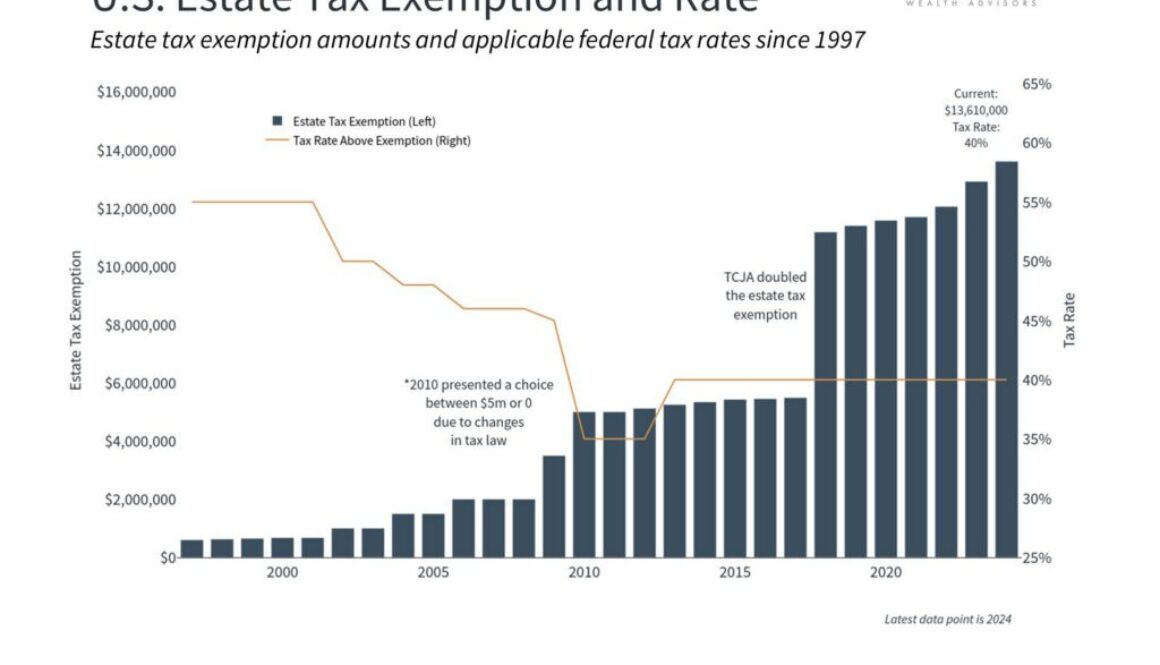
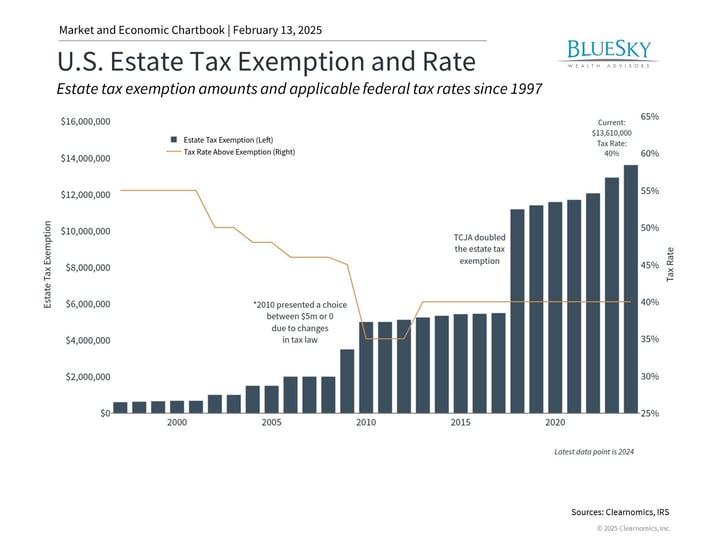
Modern wealth transfer planning has become increasingly sophisticated, particularly given the dynamic nature of tax policy. Current federal estate tax exemptions – $27.22 million for married couples and $13.61 million for individuals – create significant planning opportunities, though these represent just one aspect of comprehensive legacy planning.
A thorough wealth transfer strategy integrates estate planning, tax efficiency, and generational wealth preservation objectives. This may include charitable giving considerations. Proactive planning can help optimize tax outcomes while ensuring your legacy wishes are fulfilled.
The available tools range from basic estate documents to complex trust structures. Given varying state regulations and tax frameworks, professional guidance is essential for developing and maintaining effective strategies.
Tax-Aware Investment Strategy
While year-end tax management often focuses on capital gains and loss harvesting, early-year planning presents distinct opportunities. A comprehensive approach considers both timing windows to enhance tax efficiency while maintaining portfolio balance.
Various investment vehicles carry unique tax implications. For instance, RSUs become taxable upon vesting, regardless of sale status. Mutual fund distributions, municipal bonds, cryptocurrencies, real estate, and collectibles each present distinct tax considerations requiring professional review.
Forward-looking tax planning should account for anticipated expenses, charitable intentions, and estate planning needs. This includes evaluating tax-efficient funding sources and reviewing portfolio diversification across asset classes and business interests.
Adapting to Tax Policy Changes
While President Trump’s return suggests potential extension of the Tax Cuts and Jobs Act, significant tax reforms require Congressional action. Long-term political shifts can influence tax policy, making flexible planning approaches essential when making extended financial decisions.
The bottom line? Successful financial planning requires ongoing attention to tax considerations throughout the year. By integrating tax strategy into your comprehensive financial plan, you can better position yourself to achieve your financial objectives.
BlueSky Disclosures
Copyright (c) 2025 Clearnomics, Inc. All rights reserved. The information contained herein has been obtained from sources believed to be reliable, but is not necessarily complete and its accuracy cannot be guaranteed. No representation or warranty, express or implied, is made as to the fairness, accuracy, completeness, or correctness of the information and opinions contained herein. The views and the other information provided are subject to change without notice. All reports posted on or via www.clearnomics.com or any affiliated websites, applications, or services are issued without regard to the specific investment objectives, financial situation, or particular needs of any specific recipient and are not to be construed as a solicitation or an offer to buy or sell any securities or related financial instruments. Past performance is not necessarily a guide to future results. Company fundamentals and earnings may be mentioned occasionally, but should not be construed as a recommendation to buy, sell, or hold the company’s stock. Predictions, forecasts, and estimates for any and all markets should not be construed as recommendations to buy, sell, or hold any security–including mutual funds, futures contracts, and exchange traded funds, or any similar instruments. The text, images, and other materials contained or displayed in this report are proprietary to Clearnomics, Inc. and constitute valuable intellectual property. All unauthorized reproduction or other use of material from Clearnomics, Inc. shall be deemed willful infringement(s) of this copyright and other proprietary and intellectual property rights, including but not limited to, rights of privacy. Clearnomics, Inc. expressly reserves all rights in connection with its intellectual property, including without limitation the right to block the transfer of its products and services and/or to track usage thereof, through electronic tracking technology, and all other lawful means, now known or hereafter devised. Clearnomics, Inc. reserves the right, without further notice, to pursue to the fullest extent allowed by the law any and all criminal and civil remedies for the violation of its rights.
In our previous article, we introduced the “5 D’s” — death, disability, divorce, disagreement, and distress — the key disruptors that can threaten a family or business. Today, we’re taking a closer look at the first and often most difficult to discuss: death.
No one likes to think about death, but the reality is unavoidable—life is unpredictable. While we focus on building a secure future for ourselves and our loved ones, we often overlook the importance of preparing for what happens after we’re gone. Whether you are the head of your household, a business owner, or both, your absence could leave a significant void. Without a plan in place, the emotional loss could quickly be compounded by financial uncertainty, unresolved responsibilities, and even conflict among those you care about most.
The Burden Left Behind
Beyond the emotional grief, death brings an overwhelming amount of administrative tasks for those left behind. Your loved ones may need to:
File for death certificates and manage funeral arrangements.
Navigate complex legal processes like probate and estate settlement.
Identify and distribute assets, debts, and business interests.
Handle taxes, life insurance claims, and outstanding financial obligations.
Decide what happens to your home, business, and other responsibilities.
If your wishes aren’t clearly documented, these tasks can become even more stressful, leading to delays, financial hardships, and disputes among family members.
How Estate Planning Makes It Easier
While death is inevitable, the chaos it can bring is not. A well-structured estate plan can significantly reduce the burden on your loved ones and ensure that everything is handled smoothly.
Document Your Wishes Clearly
A legally binding will or trust provides clear instructions on how your assets should be distributed, reducing confusion and preventing family disputes. If you own a business, a succession plan ensures a smooth transition of leadership.
Avoid Probate Delays
Probate—the legal process of distributing your estate—can be long and expensive. A properly structured estate plan, including trusts, can help bypass probate, allowing assets to be transferred more quickly and efficiently to your beneficiaries.
Secure Life Insurance for Immediate Financial Support
Life insurance provides much-needed liquidity to cover funeral costs, outstanding debts, or replace lost income for your family. For business owners, it can also fund buy-sell agreements and keep the company running.
Organize Important Documents
Having all key documents—such as wills, insurance policies, account details, and passwords—stored in a secure but accessible location can significantly ease the administrative burden for your family. Consider creating a digital and physical “In Case of Emergency” file with all essential information.
Communicate with Your Family and Partners
Difficult conversations today prevent confusion and hardship later. Make sure your loved ones and business partners know where to find key documents and understand the plan in place.
Get Organized and Prepared Ahead of Time
Losing a loved one is already difficult, but adding a mountain of legal and financial uncertainty makes it even harder. Estate planning isn’t just about protecting your financial legacy—it’s about making sure your family isn’t left with overwhelming responsibilities during an already painful time.
At BlueSky Wealth Advisors, we help you get organized and prepared ahead of time, so that when the unexpected happens, everything is already in place. From estate planning and document organization to business succession strategies, we provide the guidance and structure you need to ensure a smooth transition for your loved ones.
Take control of your future today—because planning ahead is the best way to protect those who matter most. Let’s start the conversation.
As the 2024 presidential election draws near, the tax plans proposed by candidates Donald Trump and Kamala Harris present distinct approaches that could significantly influence the decisions investors make.
Understanding these differences is crucial for investors looking to navigate the economic landscape effectively, as both plans offer different benefits, risks, and more. Let’s explore how Trump’s tax strategy compares to Harris’ and what the implications are for investors.
Comparing the Differences
Donald Trump’s Tax Plan
Former President Donald Trump’s tax plan primarily focuses on reducing the tax burden for individuals and corporations. Some key features of his tax plan include:
Corporate Tax Rate Reduction: Trump proposes to lower the corporate tax rate from 21% to 15%. This reduction aims to cultivate economic growth by encouraging companies to reinvest their profits.
Capital Gains Tax Stability: Trump’s plan maintains the current capital gains tax rate at 20%, allowing investors to realize profits without facing increased taxation. This stability can create confidence surrounding equity investments and encourage more investors to partake in active trading.
Elimination of the 3.8% Medicare Surtax: Trump has suggested removing this surtax on investment income for high earners, which would enhance after-tax returns for wealthy investors and potentially incentivize them to pursue riskier investments.
Kamala Harris’ Tax Plan
Vice President Kamala Harris’ tax plan takes a different approach, focusing on wealth redistribution and addressing economic inequality. Some of the most important components of her tax plan proposal include:
Increased Tax Rates for High Earners: Harris proposes raising the top marginal income tax rate to 39.6% for individuals earning over $400,000. This change is intended to ensure that high-income earners contribute a bigger share to the economy.
Higher Capital Gains Tax Rates: Harris aims to increase the capital gains tax rate for high-income individuals, creating a similar tax plan to ordinary income tax rates. This change could see capital gains taxed at the same rate as wages, potentially reaching as high as 39.6% for top earners.
3.8% Medicare Surtax: Similar to President Joe Biden’s plan, Harris’ proposal includes maintaining the 3.8% Medicare surtax on investment income for high earners, which could further impact after-tax returns for wealthy investors.
Implications for Investors
These contrasting tax plans have many significant details that can easily get lost in the shuffle, but BlueSky Wealth Advisors is here to help walk you through the implications of each plan! Here is what you should know:
After-Tax Returns
Trump
By maintaining a lower capital gains tax rate and eliminating the Medicare surtax, Trump’s plan would enhance after-tax returns for investors, particularly those in higher income brackets. This could encourage more aggressive investment strategies and a focus on equity markets.
Harris
Conversely, Harris’ proposed increases in capital gains tax rates could lead to reduced after-tax returns for high earners. Investors may reconsider their strategies, opting for longer holding periods to minimize tax burdens or seeking more tax-efficient investment vehicles.
Investment Behavior
Trump
The stability of capital gains tax rates under Trump’s plan may encourage investors to engage more actively in the market, realizing profits without the fear of impending tax hikes. This could lead to increased volatility as more trades occur.
Harris
With higher capital gains taxes, Harris’ plan may encourage a more cautious approach among investors, particularly those in higher income brackets. They might prioritize investments with lower taxable events or seek to defer gains through retirement accounts or other tax-advantaged vehicles.
Corporate Investment and Growth
Trump
The reduction of the corporate tax rate could incentivize businesses to reinvest profits, leading to increased economic growth and potentially higher stock prices. Investors may benefit from improved corporate earnings as companies seek to expand.
Harris
While Harris’ focus on wealth redistribution may promote social equity, the increased tax burden on corporations and high-income individuals could result in lower overall investment in the economy. This may lead to slower growth rates and could impact stock performance negatively.
Get Tax Planning Assistance from BlueSky Wealth Advisors
As the 2024 election nears, the tax plans of Donald Trump and Kamala Harris present vastly different visions for the economy and investors. Trump’s focus on lowering taxes and stimulating growth could create a favorable investment climate, encouraging activity in equity markets. In contrast, Harris’ emphasis on higher taxes for the wealthy aims to address economic inequality, but it could lead to more cautious investment behavior among high earners.
It’s imperative for investors to stay informed about any updates or future potential changes to accurately consider how the plans align with their financial strategies.
Don’t worry; the team at BlueSky Wealth Advisors has you covered. For assistance navigating the complexities of these plans and configuring your tax planning strategies accordingly, give us a call today. We’re more than happy to answer any questions.
With less than two months until the presidential election, the policy platforms for President Donald Trump and Vice President Kamala Harris are gradually forming. Through speeches and debates, each candidate is laying out what they stand for and how they would change existing policies. For investors, perhaps the most scrutinized area is taxes, and there are concerns over how changes to tax rates could impact both Wall Street and Main Street. How can investors maintain perspective as we approach November 5?
It’s important to maintain perspective this election season
Tax policy is an extremely complex subject, so it’s always important to work with a trusted advisor. In addition, both candidates’ platforms are still subject to change despite the short timeline until election day. While it’s impossible to cover all the details here, many of the key differences on taxes between the candidates and their parties come down to the future of the Tax Cuts and Jobs Act (TCJA).
Before discussing the details, it’s important to maintain perspective around tax policy since these issues can be politically heated. Taxes are intertwined with politics and reflect our polarized political climate. Regardless of which side of the aisle we might be on and what our personal preferences may be, it’s important to stay objective so we can clearly focus on our financial goals.
While taxes have a direct impact on households and companies, they do not always have a straightforward effect on the overall economy and stock market. This is because taxes are only one of the factors that influence growth and returns, there are many deductions, credits, and strategies that can reduce the statutory tax rate, and spending and investment patterns often adjust to work around taxes. In other words, lower taxes do not automatically result in an economic boom and higher tax rates do not necessarily result in a crash.
Additionally, election rhetoric and actual policies can be quite different. Candidates often make promises based on their political leanings that may not fully materialize once in office. Even once a candidate is elected, Congressional partnership and approval is still required to pass new tax laws. Historically, the president’s party tends to lose seats in Congress in their second term, and their approval rating tends to decline. This process can alter or water down initial proposals.
For example, during the 2016 presidential campaign, President Trump promised a complete overhaul of the tax system. While the Tax Cuts and Jobs Act was a significant change to the tax code, it also retained many existing elements. Similarly, President Biden criticized the TCJA during the 2020 election cycle and discussed raising taxes on high income earners and corporations. While the Inflation Reduction Act of 2022 did impose a 15% minimum corporate tax rate, this is far from the sweeping changes discussed during the election.
The future of the Tax Cuts and Jobs Act and national debt is uncertain
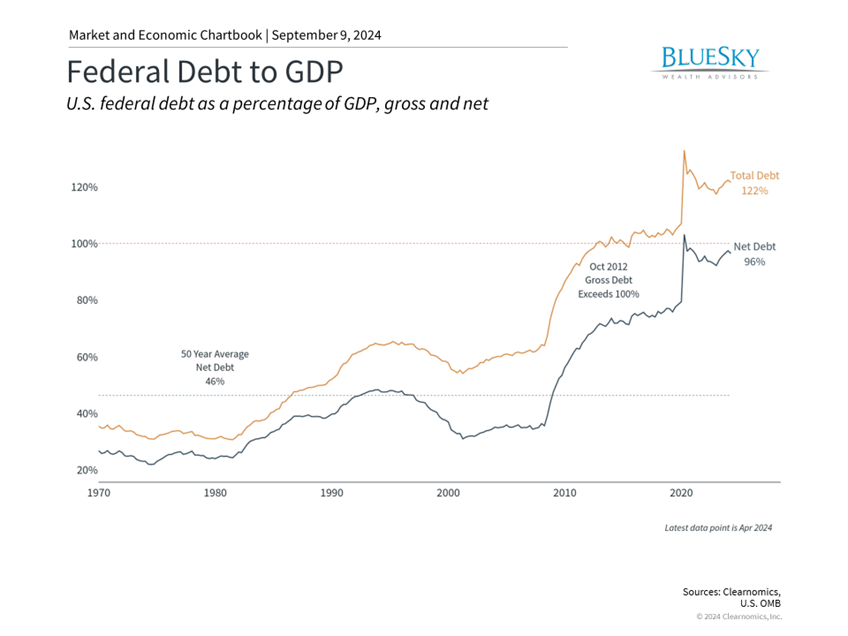
The truth is that tax rates have been quite low by historical standards for decades. Even if there are no changes in the next presidential term, with the federal debt continuing to expand, many economists worry that taxes will have to rise to close the gap in the future.
The TCJA took effect in 2018 and included reducing individual income tax rates with the highest rate declining from 39.6% to 37%, nearly doubling the standard deduction, dropping the corporate tax rate from 35% to 21%, and implementing a territorial tax system for corporations. The TCJA also lowered estate taxes, eliminated personal exemptions, and adjusted several other deductions and credits.
As discussed above, the Inflation Reduction Act of 2022 introduced a 15% minimum tax on large corporations with annual profits over $1 billion. It also implemented a 1% excise tax on stock buybacks for publicly traded companies.
Unless action is taken by the president and Congress, many provisions of the TCJA will expire for the 2026 tax season, creating a so-called “tax cliff.” This makes taxes especially contentious this election season. Here are some of the items the candidates are discussing:
Trump proposes cutting corporate taxes further from 21% to 15% for some companies, including manufacturers who make their products domestically. Harris is in favor of increasing the corporate tax rate to 28%, in line with President Biden’s position.
Trump has discussed extending the TCJA’s individual tax rates, but specifics are still unclear. Harris supports allowing the top marginal rate to revert to 39.6%.
Harris proposes raising the capital gains rate from 20% to 28%. Along with an increase in the “net investment income tax” introduced with the Affordable Care Act, the top capital gains rate would rise to 33%, the highest since 1978.
Both candidates propose new enhanced child tax credits and not taxing tips. Trump has discussed eliminating taxes on Social Security for seniors.
Harris proposes expanding the startup expense deduction from $5,000 to $50,000 and $25,000 in support of first-time homebuyers making down payments.
Harris proposes a new tax on unrealized capital gains for those worth $100 million or more. Such a tax would be historic. The recent Moore v. United States case in the Supreme Court loosely touched on this by allowing a provision in the TCJA that imposed a one-time tax on unrepatriated foreign earnings.
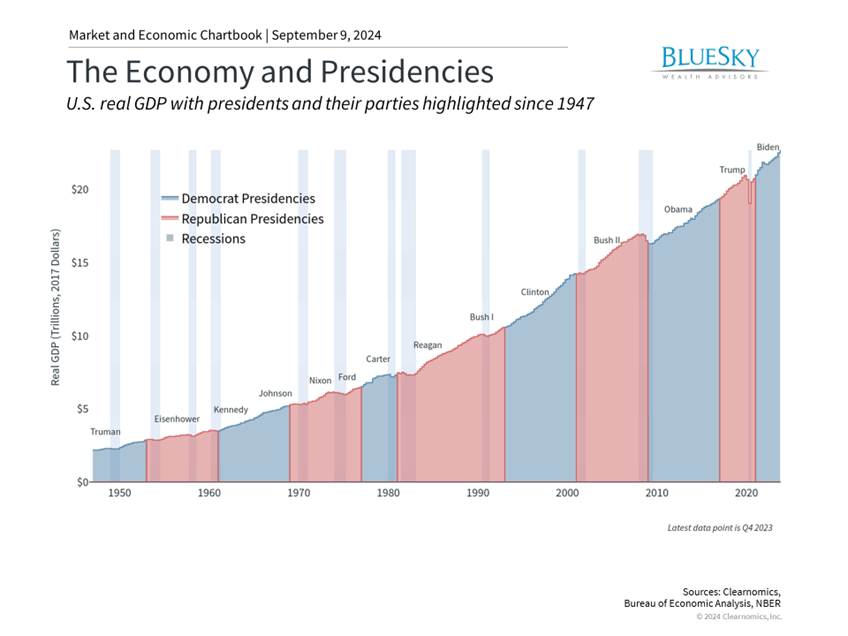
The economy has grown under both parties
Unfortunately, the annual budget deficit remains high and the national debt is likely to grow regardless of who occupies the White House. While studies on the matter differ and should be taken with a grain of salt, many suggest that either candidate would add trillions to the debt in the coming years.
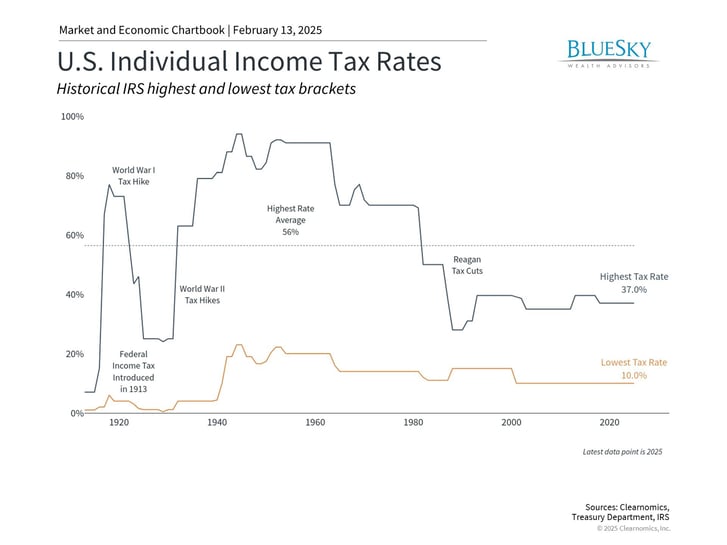
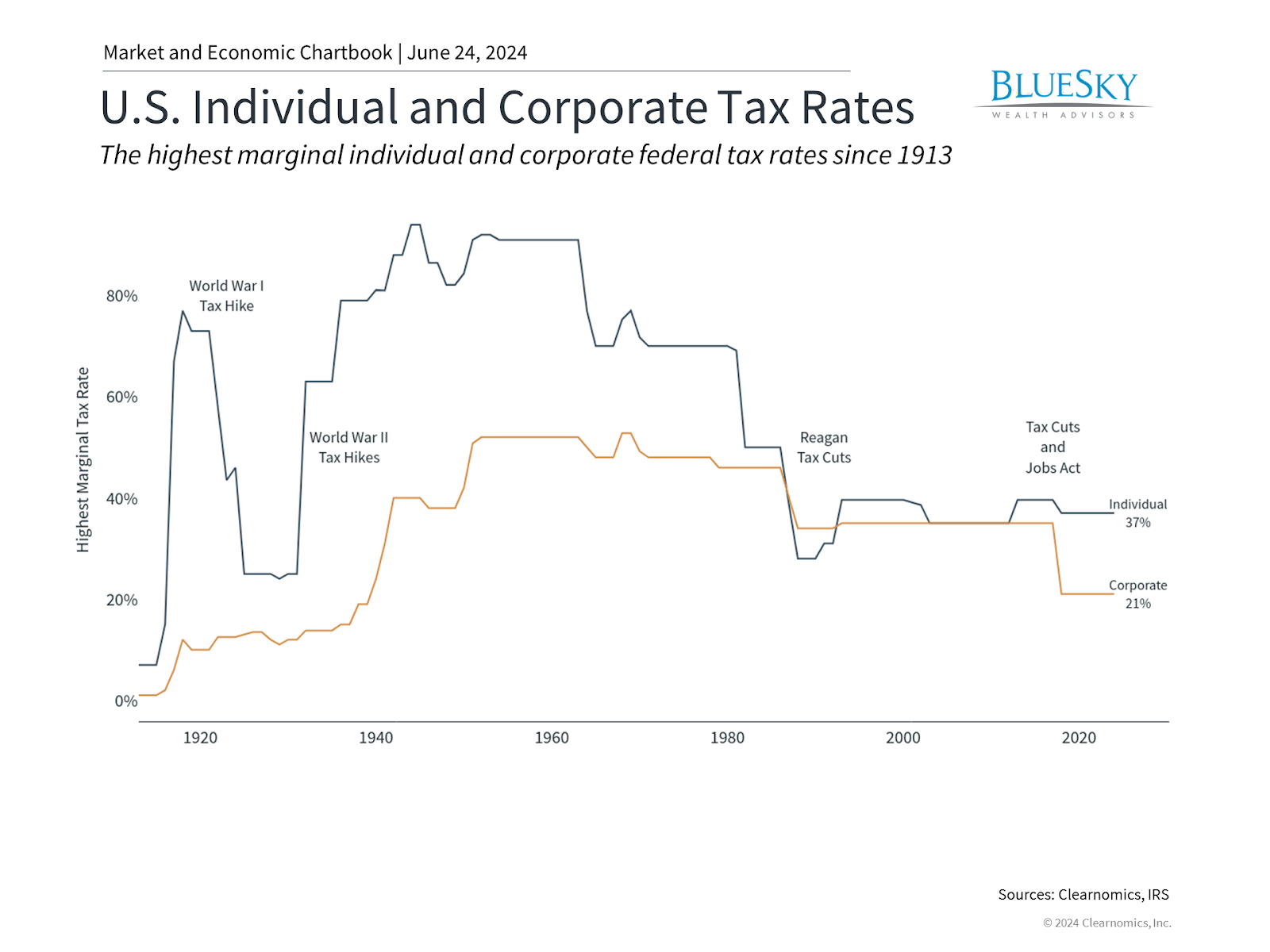
However, it’s also the case that the economy has grown over history under both political parties. As discussed earlier, it’s important to remember that who occupies the White House is not the most important factor for the economy and markets, regardless of how counterintuitive that may seem. Policy changes tend to be gradual due to checks and balances in our political system. Perhaps more importantly, neither candidate is proposing a return to pre-Reagan era tax levels when the top marginal rates reached as high as 94%.
So, while taxes do play an important role in financial plans, they do not necessarily impact investment portfolios and economic growth the way some might imagine. Investors should continue to work with a trusted advisor and focus on their long-term goals this election season. By maintaining a balanced perspective and avoiding politically driven decisions, investors can better position themselves for success across the evolving political landscape.
The bottom line? As the election season heats up, it’s important for investors to maintain perspective amid heightened political rhetoric and divergent economic proposals from the candidates. While Trump and Harris may propose changes to the tax code, it’s important to maintain objectivity when crafting financial plans.
Copyright (c) 2024 Clearnomics, Inc. All rights reserved. The information contained herein has been obtained from sources believed to be reliable, but is not necessarily complete and its accuracy cannot be guaranteed. No representation or warranty, express or implied, is made as to the fairness, accuracy, completeness, or correctness of the information and opinions contained herein. The views and the other information provided are subject to change without notice. All reports posted on or via www.clearnomics.com or any affiliated websites, applications, or services are issued without regard to the specific investment objectives, financial situation, or particular needs of any specific recipient and are not to be construed as a solicitation or an offer to buy or sell any securities or related financial instruments. Past performance is not necessarily a guide to future results. Company fundamentals and earnings may be mentioned occasionally, but should not be construed as a recommendation to buy, sell, or hold the company’s stock. Predictions, forecasts, and estimates for any and all markets should not be construed as recommendations to buy, sell, or hold any security–including mutual funds, futures contracts, and exchange traded funds, or any similar instruments. The text, images, and other materials contained or displayed in this report are proprietary to Clearnomics, Inc. and constitute valuable intellectual property. All unauthorized reproduction or other use of material from Clearnomics, Inc. shall be deemed willful infringement(s) of this copyright and other proprietary and intellectual property rights, including but not limited to, rights of privacy. Clearnomics, Inc. expressly reserves all rights in connection with its intellectual property, including without limitation the right to block the transfer of its products and services and/or to track usage thereof, through electronic tracking technology, and all other lawful means, now known or hereafter devised. Clearnomics, Inc. reserves the right, without further notice, to pursue to the fullest extent allowed by the law any and all criminal and civil remedies for the violation of its rights.
As the presidential debate season kicks off, the current and former presidents’ divergent approaches to taxes will be on display. Naturally, this is a controversial topic fueled by strong political views on our nation’s priorities, government spending, entitlement programs, fairness around taxation, and much more. While taxes affect all parts of our financial lives, their impact on the stock market is not what many might guess. As the rhetoric from both sides of the aisle heats up, how can investors stay level-headed and stick to their long-term financial plans?
Tax rates have fluctuated throughout history
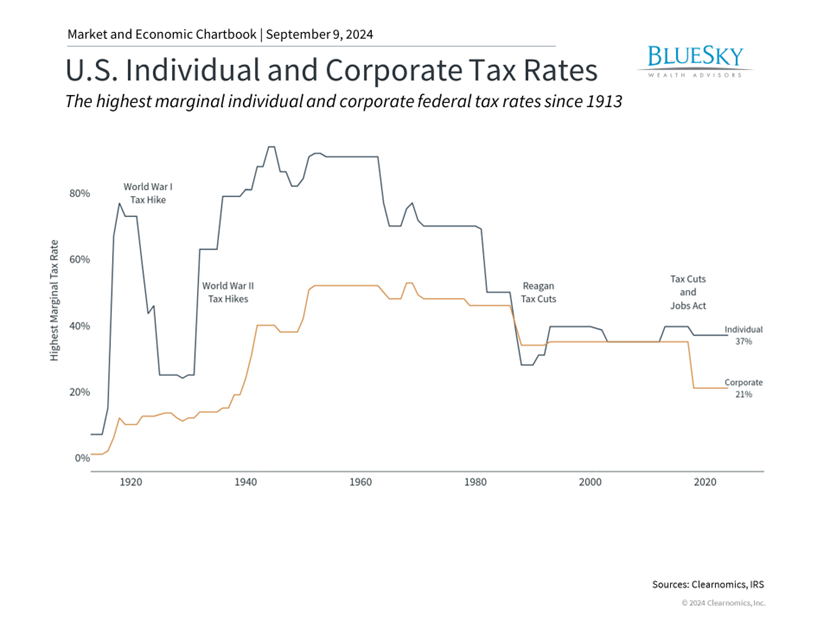
Investors often focus on corporate tax rates because they can directly affect the profitability of large companies and thus their share prices. However, tax rates and the nation’s philosophy around taxes have both fluctuated throughout history. As the accompanying chart shows, corporate and individual tax rates were higher for much of the 20th century before declining during the Reagan era. The stereotype of each party is that Republicans favor lower taxes while Democrats support higher rates, particularly for corporate income taxes. Of course, the exact priorities and proposals of each party have evolved over the decades, especially around balancing the budget.
The cornerstone of President Trump’s tax policy was the 2017 Tax Cuts and Jobs Act, which reduced the corporate tax rate from 35% to 21%. To put that in context, the U.S. previously had the highest corporate tax rate of any OECD country, and the reduction puts us just below the OECD average. The corporate tax rate peaked at 52.8% in the late 1960s, although changing tax brackets make historical corporate tax comparisons challenging. Also, what corporations actually pay can differ significantly from statutory rates.
Unlike individual tax rates, the 2017 corporate tax cut is not set to expire, but can be changed by the party in power. While it is still early in the election cycle and the candidates’ platforms may change, President Biden has proposed raising the corporate tax rate to 28% and the corporate alternative minimum tax rate (CAMT) to 21% from 15%. CAMT, created as part of the Inflation Reduction Act of 2022, is intended to ensure that large profitable companies pay at least a minimum amount of taxes. While President Trump’s proposals are not yet clear, he has suggested to business leaders that he would cut the corporate tax rate to 20%.
Corporate taxes have become less important over time
Politics aside, there is unfortunately no simple economic answer as to how taxes impact growth and markets. One important concept is known as the “Laffer curve” – the idea that tax receipts rise as tax rates do, but only up to a point. Ideally, tax policy balances societal priorities with economic growth.
Proponents of cutting the corporate tax rate argue that lower taxes give companies long-term incentives to invest in productivity and can boost global competitiveness. In theory, corporate taxes are really taxes on individuals including shareholders, workers, customers, etc. On the other hand, given the ever-growing federal deficit and debt, proponents of raising corporate taxes argue that it is an important way to raise needed revenue.
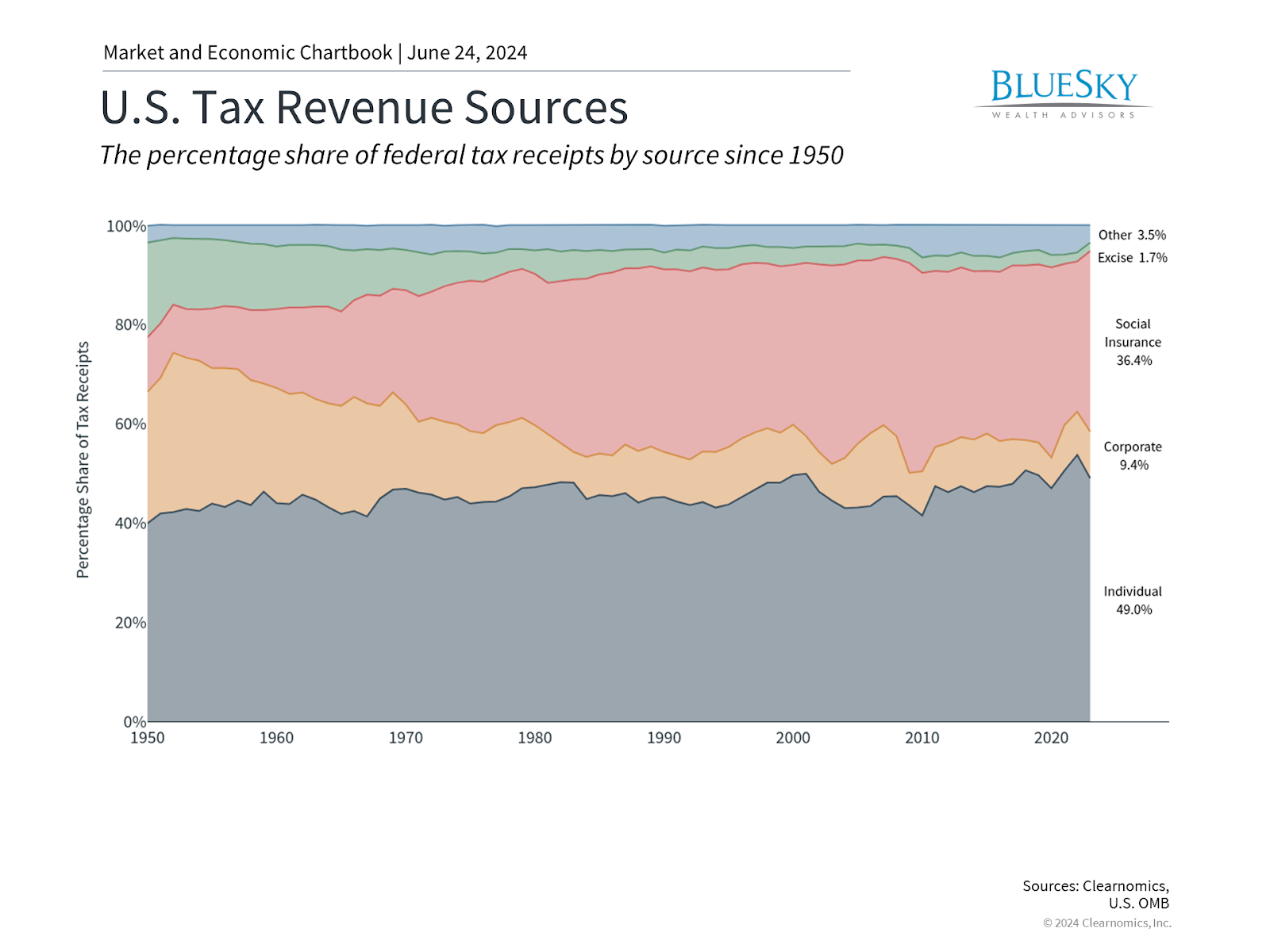
As the accompanying chart shows, the share of revenue from corporate taxes has declined dramatically from 27% in 1950 to just 9.4% today. In contrast, individual income taxes have remained an important share of government receipts, growing from 40% to 49% over the same period. Social insurance and retirement receipts have helped to make up the difference, rising to 36.4% from 11.0%, as other taxes including excise taxes have declined in importance as a source of government funding.
Thus, although corporate taxes receive significant attention from investors, the reality is that they make up a relatively small fraction of total tax revenues today. While it may seem counterintuitive, history shows that the stock market has performed well across different tax regimes. This is partly because corporations adapt to new tax rules quickly and minimize their tax bills through a variety of strategies. It’s also because recent presidents have tended to maintain existing tax policies to avoid raising tax burdens.
With that said, the other side of the tax coin is the level of government spending. Today, there is no clear path to reducing spending to lower the debt and deficit. In fact, the Congressional Budget Office has revised their estimates for the cumulative deficit from 2025 to 2034 up by $2.1 trillion dollars, roughly 10%. The growing national debt and mounting interest payments make it likely that additional revenue will be needed to plug this gap in the future.
Growth happens under both parties
Ultimately, when it comes to market performance, investors should not overreact to broad tax policy changes or political outcomes. The chart above shows that the stock market has performed well under both parties across a variety of tax regimes and other policies. This is because market returns depend far more on business cycles which typically last many years and decades, making them less sensitive to individual policy changes. The idea that markets will crash solely because of the outcome of an election or a change in tax policy is not supported by history.
Of course, achieving our financial goals is not just about market returns. When it comes to our personal financial plans, tax and estate planning could not be more important. Investors concerned about the impact of specific tax policies are encouraged to seek the advice of a trusted financial advisor.
The bottom line? While tax policies will be at the center of the upcoming election, investors should maintain a broader perspective. Staying invested is still the best way to achieve financial goals across different political outcomes.
Copyright (c) 2024 Clearnomics, Inc. All rights reserved. The information contained herein has been obtained from sources believed to be reliable, but is not necessarily complete and its accuracy cannot be guaranteed. No representation or warranty, express or implied, is made as to the fairness, accuracy, completeness, or correctness of the information and opinions contained herein. The views and the other information provided are subject to change without notice. All reports posted on or via www.clearnomics.com or any affiliated websites, applications, or services are issued without regard to the specific investment objectives, financial situation, or particular needs of any specific recipient and are not to be construed as a solicitation or an offer to buy or sell any securities or related financial instruments. Past performance is not necessarily a guide to future results. Company fundamentals and earnings may be mentioned occasionally, but should not be construed as a recommendation to buy, sell, or hold the company’s stock. Predictions, forecasts, and estimates for any and all markets should not be construed as recommendations to buy, sell, or hold any security–including mutual funds, futures contracts, and exchange traded funds, or any similar instruments. The text, images, and other materials contained or displayed in this report are proprietary to Clearnomics, Inc. and constitute valuable intellectual property. All unauthorized reproduction or other use of material from Clearnomics, Inc. shall be deemed willful infringement(s) of this copyright and other proprietary and intellectual property rights, including but not limited to, rights of privacy. Clearnomics, Inc. expressly reserves all rights in connection with its intellectual property, including without limitation the right to block the transfer of its products and services and/or to track usage thereof, through electronic tracking technology, and all other lawful means, now known or hereafter devised. Clearnomics, Inc. reserves the right, without further notice, to pursue to the fullest extent allowed by the law any and all criminal and civil remedies for the violation of its rights.
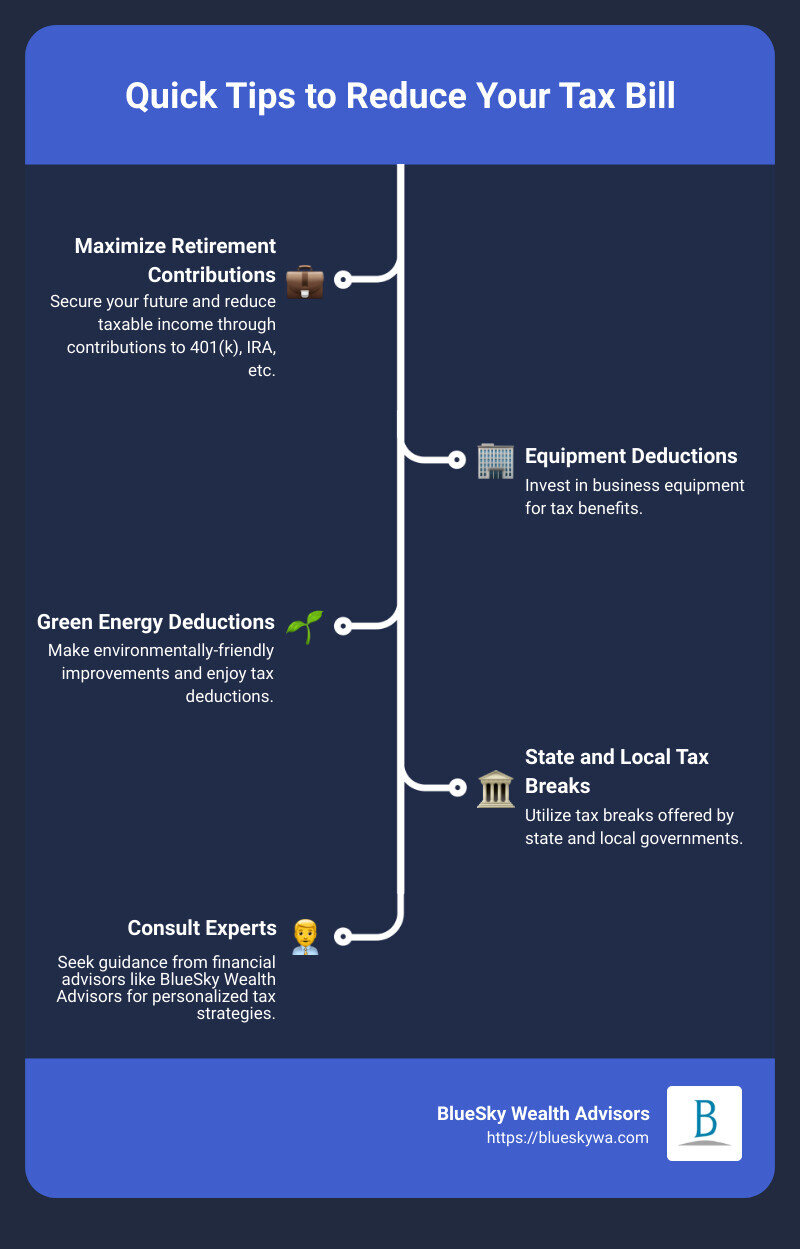
Looking to save on your taxes? Smart tax reduction strategies can significantly lower your tax bill and enhance your financial well-being. Here are some quick tips:
Maximize retirement account contributions
Take advantage of equipment and green energy deductions
Utilize state and local tax breaks
Managing your tax liability is essential for protecting your wealth and achieving financial independence. While paying taxes is inevitable, how much you owe isn’t set in stone. Effective tax planning helps you keep more of what you earn by using legal methods to reduce your taxable income.
For example, setting up or contributing to a retirement savings plan not only secures your future but also reduces your taxable income. Additionally, if you invest in new equipment or green energy improvements for your business, you can benefit from significant deductions.
The goal of tax planning is to be proactive, not reactive. By consulting with experts, like those at BlueSky Wealth Advisors, you can navigate intricate tax laws and leverage strategies tailored to your financial situation. Let’s dive into the details and explore how you can make the most of these opportunities.
Minimize Taxable Income
One of the most effective ways to reduce your tax liability is to minimize your taxable income. Let’s explore some key strategies to achieve this.
Max Out Retirement Accounts
Contributing to retirement accounts is a powerful way to lower your taxable income. Here are some options to consider:
401(k) and 403(b) Plans: These employer-sponsored plans allow you to make pretax contributions, which directly reduce your taxable income. For 2023, you can contribute up to $22,500, or $30,000 if you’re 50 or older. For example, if you earn $100,000 and contribute the maximum amount to your 401(k), your taxable income drops to $77,500.
Individual Retirement Accounts (IRAs): You can also save on taxes by contributing to a traditional IRA. The annual contribution limit is $6,500 for 2023, with an additional $1,000 catch-up contribution if you’re 50 or older. Contributions to a traditional IRA are tax-deductible, reducing your taxable income for the year.
SEP IRA and SIMPLE IRA: If you’re self-employed or own a small business, consider a SEP (Simplified Employee Pension) IRA or SIMPLE (Savings Incentive Match Plan for Employees) IRA. These plans allow for higher contribution limits compared to traditional IRAs. For 2023, you can contribute up to 25% of your net earnings from self-employment, up to a maximum of $66,000 for SEP IRAs.
Contribute to Health Savings Accounts (HSAs)
An HSA is another excellent tool for reducing taxable income, especially if you have a high-deductible health plan (HDHP).
Health Savings Accounts (HSAs): Contributions to an HSA are tax-deductible, and the funds grow tax-free. For 2023, the contribution limits are $3,850 for individual coverage and $7,750 for family coverage. If you’re 55 or older, you can contribute an extra $1,000. Withdrawals for qualified medical expenses are also tax-free, providing a triple-tax advantage.
Flexible Spending Accounts (FSAs): FSAs allow you to set aside pretax dollars for medical expenses. For 2023, you can contribute up to $3,050. However, keep in mind that FSAs have a “use-it-or-lose-it” rule, meaning you must use the funds within the plan year or forfeit them.
Example: Sarah, a 35-year-old employee with an HDHP, contributes $3,850 to her HSA in 2023. This contribution reduces her taxable income by $3,850, and she can use the funds tax-free for medical expenses.
By maximizing contributions to retirement accounts and HSAs, you can significantly lower your taxable income while securing your financial future. Next, let’s explore how to maximize deductions to further reduce your tax liability.
Maximize Deductions
Charitable Donations
Charitable donations can be a powerful way to reduce your tax liability while supporting causes you care about. When you donate to a qualified charity, you can itemize these contributions on your tax return, which may lead to significant tax savings.
One effective strategy is to donate appreciated property, such as stocks or real estate. By doing this, you can deduct the fair market value of the property and avoid paying capital gains tax on the appreciation. For example, if you bought a stock for $1,000 and it’s now worth $5,000, donating it allows you to deduct $5,000 without paying tax on the $4,000 gain.
Another option is to set up a donor-advised fund. This allows you to make a large charitable contribution in one year (and take the deduction) while spreading out the actual donations to charities over several years. This can be particularly beneficial if you have a high-income year and want to maximize your deductions.
Case Study: John, who had a significant income boost in 2023, decides to donate $50,000 to a donor-advised fund. This contribution allows him to itemize his deductions and potentially lower his taxable income for that year. He can then allocate this fund to various charities over the next few years.
Review Interest Expenses
Interest expenses can also impact your tax liability, but not all interest is created equal when it comes to deductions.
Deductible Interest: Certain types of interest are deductible, which can help reduce your taxable income. For example, mortgage interest on your primary residence can be deducted if you itemize your deductions. Similarly, interest on home equity loans may be deductible, provided the loan is used to buy, build, or substantially improve your home.
Non-Deductible Interest: On the other hand, interest on personal loans, credit card debt, and auto loans is generally not deductible. If you have significant non-deductible interest expenses, consider paying off these debts to improve your financial situation and reduce your overall interest burden.
Example: Emily has a $10,000 credit card debt with a high-interest rate. By paying off this debt, she eliminates non-deductible interest expenses, freeing up more of her income for savings or investments.
Home Equity Loans: If you have a home equity loan, make sure the interest is deductible by using the loan for qualified expenses. If not, you might want to explore other financing options that offer tax benefits.
Tip: Keep detailed records of all interest expenses and consult with a tax professional to ensure you’re maximizing your deductions.
By carefully managing your charitable donations and interest expenses, you can make the most of your itemized deductions and reduce your tax liability. Next, let’s explore how investing in tax-advantaged accounts can further benefit you.
Invest in Tax-Advantaged Accounts
Municipal Bonds
Municipal bonds, or “munis,” are a great way to invest while reducing your tax liability. These bonds are issued by local or state governments to fund public projects like schools and roads. The interest you earn from municipal bonds is generally tax-free at the federal level. If you live in the state where the bond is issued, you might also avoid state and local taxes.
Here’s why investing in municipal bonds can be beneficial:
Tax-Free Interest: The interest you earn is usually exempt from federal taxes, and sometimes state and local taxes.
Lower Default Rates: Municipal bonds have historically lower default rates compared to corporate bonds. For example, from 1970 to 2022, the default rate for municipal bonds was just 0.08%, compared to 6.9% for global corporate issuers.
Tax-Equivalent Yield: The higher your tax bracket, the more attractive the tax-equivalent yield of municipal bonds becomes.
However, be aware of exceptions. If you buy a municipal bond at a discount greater than 0.25%, the interest and gains from the discounted amount can be taxed as regular income. Always check the specific bond details to ensure you understand the tax implications.
Long-Term Capital Gains
Investing in assets like stocks, bonds, or real estate can help you grow wealth, especially when you focus on long-term capital gains. If you hold an asset for more than one year before selling, any profit you make is considered a long-term capital gain. These gains are taxed at a preferential rate of 0%, 15%, or 20%, depending on your income level.
Benefits of long-term capital gains:
Lower Tax Rates: Long-term capital gains are taxed at lower rates than short-term gains, which are taxed as ordinary income.
Tax-Loss Harvesting: If you sell an investment at a loss, you can use that loss to offset your capital gains. You can deduct up to $3,000 of excess losses from your other income, and any remaining losses can be carried forward to future tax years.
For 2024, the zero-rate bracket for long-term capital gains applies to taxable income up to $94,050 for married couples filing jointly and $47,025 for single individuals. This makes it crucial to plan your asset sales strategically to take full advantage of these lower tax rates.
By investing in municipal bonds and focusing on long-term capital gains, you can significantly reduce your tax liability while growing your wealth. Next, we’ll discuss how starting a business can offer additional tax benefits.
Start a Business
Starting a business can be an effective way to reduce your tax liability. From deducting business expenses to hiring family members, there are several strategies to help you save.
Deduct Business Expenses
Running a business involves many expenses, and many of these can be deducted from your taxable income. Here are some key areas to consider:
Home Office Deduction: If you use a portion of your home exclusively for business, you can deduct related expenses. For example, if your home office is 20% of your home’s total area, you can deduct 20% of your rent or mortgage, utilities, and insurance. Just remember, the space must be used exclusively for business purposes.
Utilities and Internet: Expenses like electricity, water, and internet that are necessary for running your business can also be deducted. If you work from home, calculate the portion of these utilities that are used for business purposes.
Vehicle Costs: If you use your vehicle for business, you can deduct related expenses. This includes gas, maintenance, and even depreciation. You can choose between the actual expense method or the standard mileage rate. For 2023, the standard mileage rate is 65.5 cents per mile.
Self-Employed Health Insurance: Premiums paid for health insurance for yourself, your spouse, and dependents are fully deductible. This includes medical, dental, and qualifying long-term care insurance.
Hire Family Members
Hiring family members can provide significant tax benefits. Here’s how:
Lower Marginal Rate: Paying wages to your children or spouse can shift income to a lower tax bracket. For instance, if your child earns less, their income will be taxed at a lower rate, reducing the overall family tax burden.
FUTA Exemption: Wages paid to your children under 18 are exempt from Social Security and Medicare taxes. Additionally, wages paid to your spouse are not subject to the Federal Unemployment Tax Act (FUTA).
Justifiable Earnings: Ensure that the work done by family members is legitimate and the compensation is reasonable. The IRS requires that wages be justifiable and consistent with industry standards to avoid scrutiny.
By leveraging these tax reduction strategies, you can make significant savings while running your business efficiently. Next, we’ll explore how claiming tax credits can further reduce your tax liability.
Tax credits are one of the most powerful tax reduction strategies available. Unlike deductions, which lower your taxable income, tax credits reduce the amount of tax you owe dollar-for-dollar. This makes them extremely valuable. Let’s dive into two of the most commonly claimed tax credits: the Child Tax Credit and the Earned Income Tax Credit (EITC).
Child Tax Credit
The Child Tax Credit is a significant benefit for U.S. taxpayers with children. For the tax year 2022, this credit was worth up to $2,000 per qualifying child. To qualify for the full credit, your income must be below $200,000 for single filers or $400,000 for married couples filing jointly. If your income is slightly above these limits, you might still qualify for a partial credit.
Qualifying Child: To be eligible, your child must be younger than 17 at the end of the tax year. They must also have lived with you for more than half the year and should not have provided more than 50% of their own financial support. Stepchildren, siblings, and descendants can also qualify as long as you claim them as dependents on your tax return.
Earned Income Tax Credit (EITC)
The Earned Income Tax Credit (EITC) is designed to assist low- to lower-middle income families. This credit can substantially reduce the tax burden and even result in a refund. The EITC is especially beneficial if you have children, but you can also qualify without them if your income is very low.
For the tax year 2023, the maximum EITC amounts are as follows:
$7,430 for families with three or more qualifying children.
$6,604 for families with two qualifying children.
$3,995 for families with one qualifying child.
$600 for individuals with no qualifying children.
Income Cap: The EITC has income limits that vary based on your filing status and the number of qualifying children you have. You must have some earned income, and there are also caps on unearned income.
Qualifying Children: A qualifying child must meet specific criteria, including age, relationship, residency, and joint return tests. You must also have a valid Social Security number and be a U.S. citizen or resident alien.
Claiming these tax credits can significantly lower your tax liability. Next, we’ll address frequently asked questions about tax reduction strategies to help you further understand how to minimize your taxes.
Frequently Asked Questions about Tax Reduction Strategies
How can I reduce my taxable income?
Reducing your taxable income can be simpler than you think. Here are some key strategies:
1. Maximize Retirement Contributions Contributing to retirement accounts like a 401(k) or an IRA can significantly lower your taxable income. These contributions are made pre-tax, meaning they reduce your gross income before taxes are calculated. For instance, if you contribute $19,500 to your 401(k) in 2023, that amount is deducted from your taxable income.
2. Health Savings Accounts (HSAs) If you have a high-deductible health plan, you can contribute to an HSA. Contributions to HSAs are tax-deductible, and the funds can be used tax-free for qualified medical expenses. For 2023, you can contribute up to $3,850 for individual coverage and $7,750 for family coverage.
3. Flexible Spending Accounts (FSAs) FSAs allow you to set aside pre-tax dollars for medical and dependent care expenses. Contributions reduce your taxable income, and you can use the funds for a variety of expenses, from medical bills to childcare.
4. Charitable Donations Donating to qualified charities can also reduce your taxable income. You can deduct the fair market value of donated goods or the cash amount you give. For example, donating appreciated property can allow you to avoid capital gains tax while still getting a deduction for the full market value.
What are the best ways to lower taxable income?
1. Max Out Retirement Accounts Make the most of your retirement plans. Contribute the maximum allowed to your 401(k), 403(b), IRA, SEP IRA, or SIMPLE IRA. For example, in 2023, you can contribute up to $22,500 to a 401(k), with an additional $7,500 if you’re 50 or older.
2. Contribute to HSAs and FSAs As mentioned, HSAs and FSAs are powerful tools for reducing taxable income. Use them to cover medical and dependent care costs with pre-tax dollars.
3. Itemize Deductions If your deductible expenses exceed the standard deduction, itemize them. This includes mortgage interest, state and local taxes, and medical expenses. Timing your expenses to bunch them into a single year can help you exceed the threshold for itemizing.
How do high-income earners reduce taxes?
High-income earners have several strategies to minimize their tax liability effectively:
1. Maximize Contributions to Retirement Plans High-income earners should take full advantage of tax-deferred accounts like 401(k)s and IRAs. These contributions reduce taxable income now and grow tax-deferred until retirement.
2. Invest in Tax-Efficient Funds Consider investing in municipal bonds or index funds. Municipal bonds offer tax-free interest income, which can be especially beneficial if you’re in a high tax bracket. Index funds typically generate fewer capital gains due to lower turnover.
3. Charitable Donations Donating appreciated stock or other assets to charity can provide a double tax benefit: a deduction for the full market value and avoidance of capital gains tax. This strategy is particularly useful for high-income earners with significant investments.
4. Tax Loss Harvesting Selling investments at a loss to offset gains can help manage taxable income. This strategy can be particularly beneficial in years when you have high capital gains.
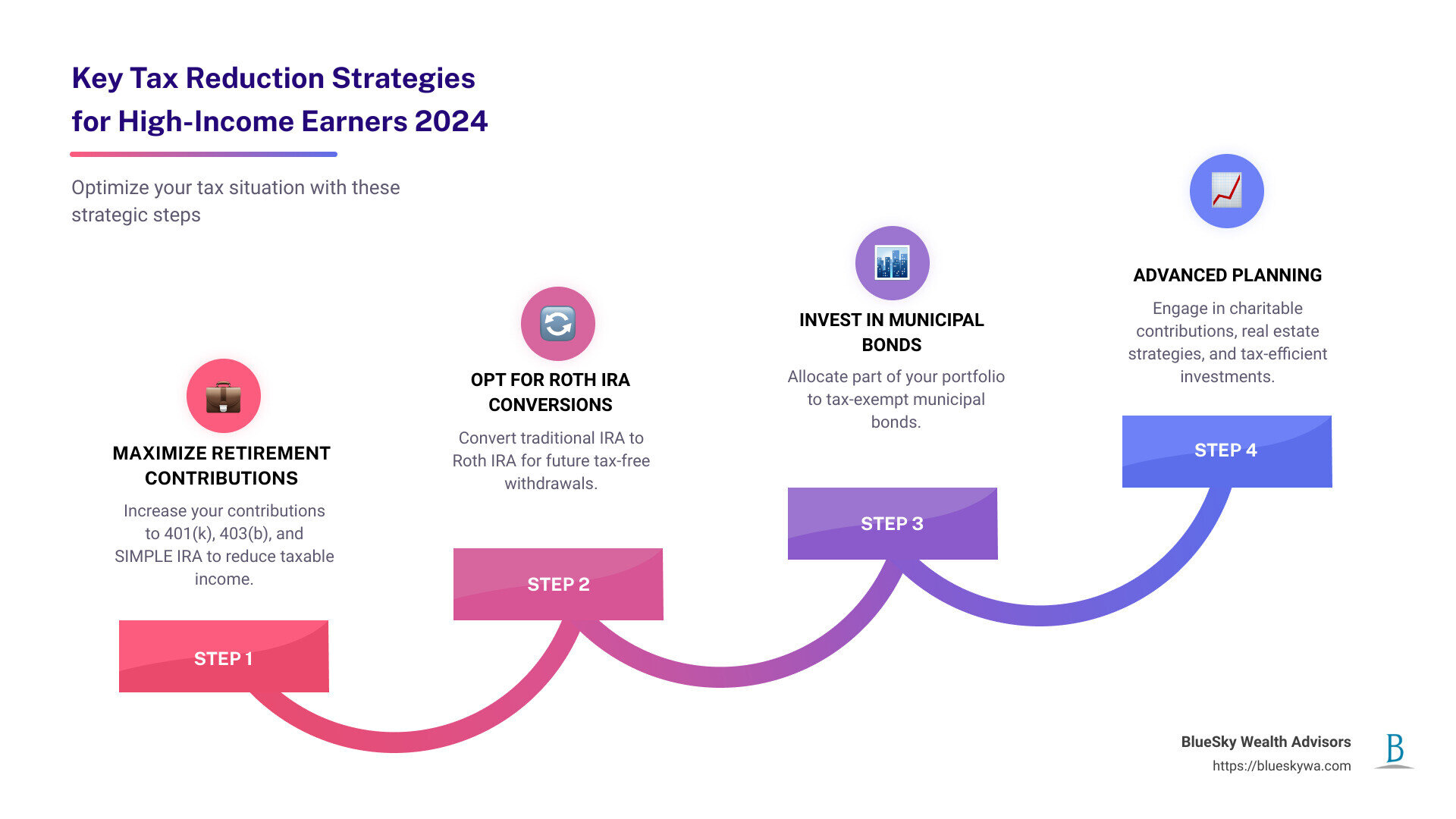
5. Roth IRA Conversions Consider converting traditional IRA funds to a Roth IRA. While you’ll pay taxes now, the funds will grow tax-free and can be withdrawn tax-free in retirement. This can be a smart move if you expect to be in a higher tax bracket in the future.
By implementing these strategies, high-income earners can effectively reduce their taxable income and manage their overall tax burden.
Conclusion
At BlueSky Wealth Advisors, we understand that tax planning can be complex and overwhelming. Our goal is to simplify this process for you with personalized financial solutions and proactive tax strategies designed to meet your unique needs.
Why Choose BlueSky Wealth Advisors?
We believe in building strong partnerships based on trust, transparency, and mutual respect. Our dedicated advisors are committed to understanding your financial vision and working closely with you to achieve it. This personalized attention ensures that our tax reduction strategies are not only comprehensive but also deeply aligned with your personal and business goals.
Proactive Tax Strategies
Tax planning shouldn’t be a last-minute scramble. By being proactive, you can take advantage of various strategies throughout the year to reduce your tax liability. Whether it’s maximizing your retirement contributions, investing in tax-advantaged accounts, or starting a business, our advisors will guide you through every step of the process.
For instance, contributing to a Health Savings Account (HSA) can offer triple tax benefits: tax-deductible contributions, tax-free growth, and tax-free withdrawals for medical expenses. Similarly, investing in municipal bonds can provide tax-free interest income, which can be particularly beneficial for high-income earners.
Customized Financial Plans
No two financial situations are the same. That’s why we tailor our advice to fit your specific circumstances. From reviewing your financial activities over the past year to planning for future tax liabilities, we ensure that you’re making informed decisions that align with both your short-term needs and long-term goals.
Consult BlueSky Wealth Advisors
Navigating the complexities of tax planning alone can be daunting. Engaging with a trusted advisor ensures that you are making the most informed decisions and taking full advantage of all available strategies to reduce your taxable income and increase your savings.
At BlueSky Wealth Advisors, we are here to help you develop a proactive plan that not only aims to reduce your tax liabilities but also enhances your overall financial well-being.
Ready to take control of your financial future? Contact us today to schedule a consultation and start your journey towards smarter tax planning.
By following these strategies and working with BlueSky Wealth Advisors, you can effectively manage your tax burden and secure a prosperous financial future.
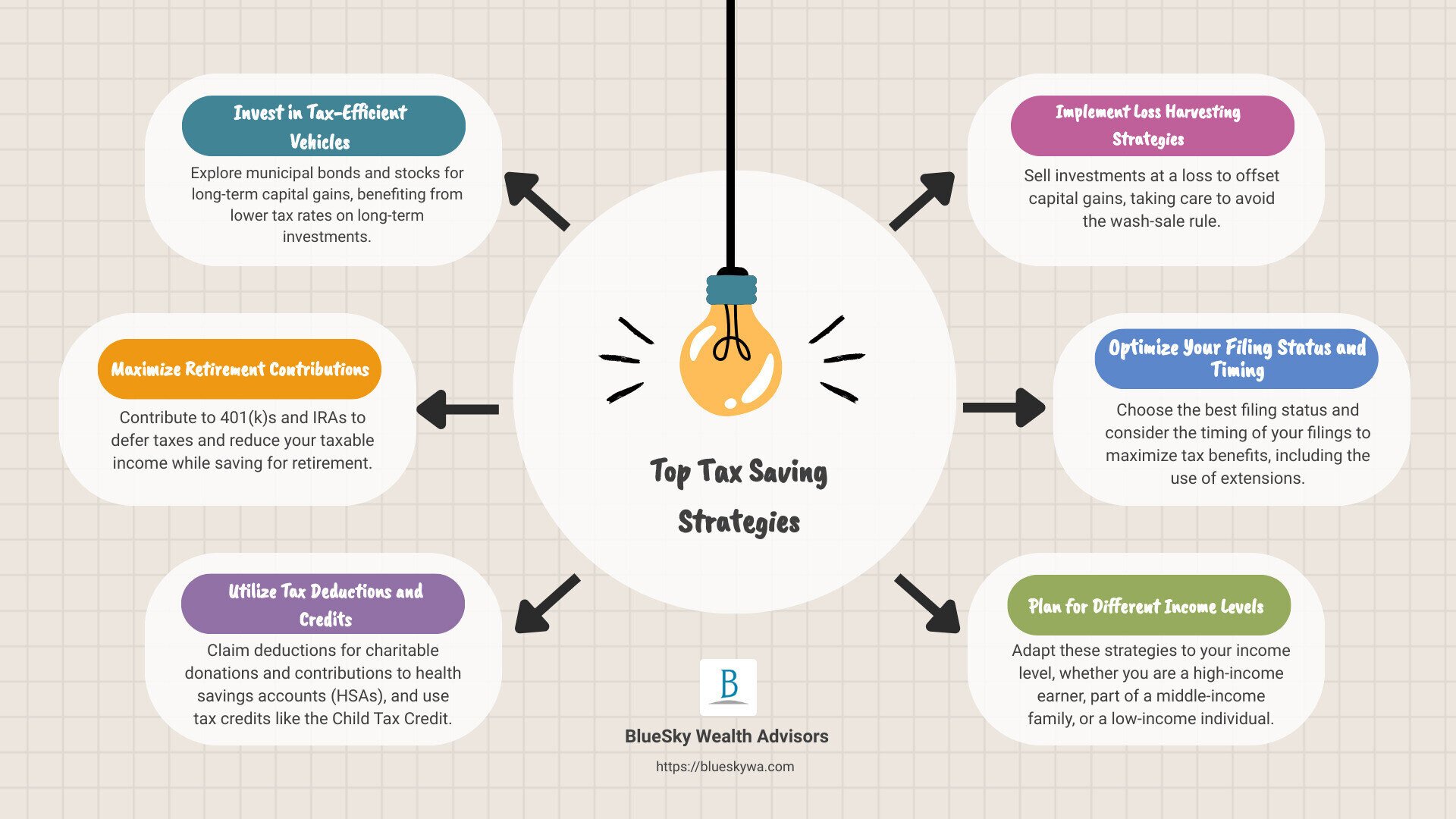
Tax saving strategies are essential for anyone looking to optimize their financial situation and reduce the amount they owe to the government each year. Quickly, here are six effective strategies you can consider:
Invest in Tax-Efficient Vehicles: such as municipal bonds and stocks for long-term capital gains.
Maximize Retirement Contributions: take full advantage of 401(k)s and IRAs.
Utilize Tax Deductions and Credits: such as charitable donations and health savings accounts (HSAs).
Implement Loss Harvesting Strategies: utilize capital losses to offset gains.
Optimize Your Filing Status and Timing: make strategic decisions about when and how to file.
Plan for Different Income Levels: tailor strategies to suit various financial situations.
Tax planning is not just about compliance, but also about maximizing your financial efficiency in a way that aligns with your long-term goals and lifestyle. Engaging in proactive tax planning can lead to substantial savings which can be redirected towards investments, retirement savings, or even creating a financial legacy. By understanding and utilizing the right tax strategies tailored to your specific financial situation, you can not only minimize your tax liability but also enhance your wealth accumulation over time.
Invest in Tax-Efficient Vehicles
When it comes to protecting your income from taxes, investing in tax-efficient vehicles is a smart strategy. Let’s explore three key options: Municipal Bonds, Capital Gains, and Tax-Deferred Accounts. Each of these can help you save on taxes while potentially growing your wealth.
Municipal Bonds
Municipal bonds, often called “munis,” are issued by local or state governments to fund public projects like roads and schools. The interest you earn from these bonds is usually tax-free at the federal level. This can be especially beneficial if you’re in a high tax bracket.
Investing in munis not only lowers your taxable income but also supports community development. However, be cautious as some munis might be subject to taxes if purchased at a significant discount, known as the “de minimis” tax rule. Always check the specific bond’s tax implications before investing.
Capital Gains
Capital gains are the profits you make from selling assets like stocks or real estate. Long-term capital gains, which are gains on assets held for more than a year, are taxed at lower rates than short-term gains (assets held for less than a year). These rates are 0%, 15%, or 20%, depending on your income level.
To benefit from these lower rates, plan the timing of your asset sales carefully. Holding onto investments for over a year can significantly reduce the taxes you owe on gains. Understanding the difference between long-term and short-term capital gains is crucial for effective tax planning.
Tax-Deferred Accounts
Contributing to tax-deferred accounts like 401(k)s or IRAs allows you to postpone paying taxes on the money you invest until you withdraw it, typically during retirement. During your working years, this can lower your taxable income and defer tax liabilities to a period when you might be in a lower tax bracket.
Maximizing contributions to these accounts not only helps in tax deferral but also aids in accumulating wealth over time due to the compound growth of deferred taxes.
By strategically investing in these tax-efficient vehicles, you are not just complying with tax laws but actively leveraging them to your advantage. This approach aligns with proactive financial planning, ensuring that you maximize your returns while minimizing tax liabilities.
Moving forward, let’s look into how you can further enhance your tax savings through maximizing retirement contributions, another pivotal aspect of strategic financial planning.
Maximize Retirement Contributions
When it comes to tax saving strategies, enhancing your retirement contributions is a powerful tool. This not only secures your future but also significantly lowers your current tax bill. Let’s dive into how you can utilize accounts like 401(k)s, Roth IRAs, and SEP IRAs to protect more of your income from taxes.
401(k) Plans
A 401(k) plan allows you to contribute pre-tax income, which reduces your taxable income. For 2023, the contribution limit is $22,500, with an additional $7,500 allowed as a catch-up contribution if you’re aged 50 or older. This means if you maximize your contributions, you can substantially lower the income tax you owe for the year.
Employer matching in 401(k) plans is akin to receiving free money that also grows tax-deferred. By not taking full advantage of this, you’re essentially leaving money on the table.
Roth IRA
Unlike a 401(k), contributions to a Roth IRA are made with after-tax dollars. The beauty of a Roth IRA lies in its withdrawal phase; you pay no taxes on withdrawals during retirement, which includes the gains your investments have earned. In 2023, the contribution limit is $6,500, or $7,500 for those 50 or older. This is particularly advantageous if you anticipate being in a higher tax bracket in retirement.
SEP IRA
For self-employed individuals or small business owners, a Simplified Employee Pension (SEP IRA) offers a way to contribute significantly towards retirement. The contribution limit for 2023 is the lesser of 25% of compensation or $66,000. This type of IRA not only facilitates a higher saving rate due to its higher contribution limits but also reduces taxable income substantially.
Implementing these retirement strategies effectively requires understanding the nuances of each plan. For instance, while a 401(k) offers immediate tax relief by reducing taxable income, a Roth IRA provides tax-free income in retirement, valuable for those expecting higher tax rates in the future. On the other hand, a SEP IRA allows self-employed professionals to save aggressively for retirement while enjoying tax deductions.
By maximizing your contributions to these plans, you not only secure a comfortable retirement but also optimize your current tax situation. We’ll explore how leveraging various deductions and credits can further enhance your tax saving strategies.
Utilize Tax Deductions and Credits
Charitable Donations
Donating to charity isn’t just a noble act; it’s also a smart tax move. When you give to a qualified charity, you can deduct these contributions from your taxable income. For instance, donating appreciated assets like stocks can be particularly advantageous. You avoid capital gains taxes and can deduct the full market value. Consider using a Donor-Advised Fund (DAF) for larger donations. You receive an immediate tax deduction in the year you contribute, and the funds can grow tax-free until you allocate them to your chosen charities.
Health Savings Account (HSA)
If you have a high-deductible health plan, contributing to an HSA is a triple tax-saving strategy. Your contributions are tax-deductible, the money grows tax-free, and withdrawals for qualified medical expenses are also tax-free. For 2022, you can contribute up to $3,650 for individuals and $7,300 for families, with an additional $1,000 if you’re 55 or older. This makes HSAs an excellent tool for reducing taxable income while saving for future health costs.
Child Tax Credit
The Child Tax Credit (CTC) provides significant relief for families. For the tax year 2022, the credit amounts to $2,000 per qualifying child. The full amount of the CTC is available to single filers earning up to $200,000 and married couples earning up to $400,000. This credit is directly subtracted from the tax you owe, dollar for dollar, making it a powerful component of family-oriented tax saving strategies.
By strategically using these deductions and credits, you can significantly reduce your tax liability, making each dollar you save or spend work harder for you. As we continue to explore tax saving strategies, next we’ll delve into how loss harvesting can further optimize your tax situation.
Implement Loss Harvesting Strategies
Tax-loss harvesting is a technique that can help you manage your investment portfolio more efficiently from a tax perspective. Here’s how you can implement this strategy effectively:
Capital Losses
When you sell investments at a loss, these losses can be used to offset capital gains you might have from other investments. For instance, if you sold one stock at a $5,000 gain and another at a $5,000 loss, these would cancel each other out, meaning you wouldn’t owe taxes on the gain. If your losses exceed your gains, you can use up to $3,000 of the net loss to reduce your ordinary income, which could further lower your tax bill.
Wash-Sale Rule
It’s important to be aware of the wash-sale rule. This IRS rule disallows a tax deduction for a security sold at a loss if a substantially identical security is purchased within 30 days before or after the sale. To benefit from tax-loss harvesting without falling foul of this rule, ensure any repurchased security is not “substantially identical,” or simply wait more than 30 days to repurchase the same security.
Mutual Funds
Mutual funds can also be part of your tax-loss harvesting strategy. If some of the mutual funds in your portfolio have underperformed, selling them at a loss can offset gains from other securities. Just like with stocks, you need to be cautious of the wash-sale rule when dealing with mutual funds.
By implementing these strategies, you can help manage your capital gains and losses more effectively, potentially reducing your overall tax liability. The key to successful tax-loss harvesting is to maintain your overall investment strategy and not let tax implications dictate your investment decisions solely. Always consult with a financial advisor to ensure these strategies align with your long-term financial goals.
Let’s explore how different filing statuses and strategic timing can further enhance your tax saving strategies.
Optimize Your Filing Status and Timing
When it comes to tax saving strategies, the way you file and when you file can have significant impacts on your tax liabilities. Let’s break down how optimizing your marital status, understanding filing deadlines, and leveraging extension benefits can help you save on taxes.
Marital Status
Choosing the right filing status is crucial as it determines your tax bracket and potential deductions. For instance:
Single: You may have higher tax rates compared to married couples filing jointly.
Married Filing Jointly: Often results in lower tax rates and higher income thresholds for tax brackets.
Married Filing Separately: Can be beneficial if one spouse has significant medical expenses or miscellaneous deductions.
Head of Household: Offers more favorable tax rates and higher deduction amounts than filing as single, particularly if you are supporting dependents.
It’s important to assess your specific situation each year, as changes in your personal life—like marriage or divorce—can alter the most beneficial status for you.
Filing Deadlines
The general deadline for filing your tax return is April 15. However, if this date falls on a weekend or a holiday, the deadline is extended to the next business day. For example, for the year 2024, the deadline is April 15. Missing this deadline can lead to penalties and interest charges.
Extension Benefits
If you find yourself unable to file by the April 15 deadline, you can request an extension, which typically gives you until October 15 to file your taxes. Here’s why considering an extension might be part of your tax strategy:
More Time to Gather Information: An extension provides additional months to ensure you have all the necessary documentation, especially if you are waiting on missing information or correcting discrepancies.
Avoid Errors: Rushing to meet the filing deadline can lead to mistakes. Having extra time helps ensure accuracy.
Planning Opportunities: Use the extra time to better plan around deductions, credits, and contributions, potentially reducing your taxable income.
An extension to file is not an extension to pay. If you expect to owe taxes, you should estimate and pay the amount by the original April 15 deadline to avoid possible penalties and interest.
By understanding and strategically planning your filing status and timing, you can enhance your tax saving strategies. Next, we’ll delve into how different income levels can apply various tax-saving tactics to optimize their financial outcomes.
Tax Saving Strategies for Various Income Levels
High-Income Earners
High-income earners often face higher tax rates and complex financial situations. For these individuals, tax saving strategies such as maximizing retirement contributions and investing in tax-efficient vehicles are crucial. Municipal bonds are a prime choice, providing tax-exempt income, particularly beneficial for those in higher tax brackets. Additionally, high-income earners should consider strategic asset placement. Placing income-producing investments in tax-deferred accounts can minimize the taxes on returns and optimize asset growth over time.
Middle-Income Families
Middle-income families can benefit significantly from utilizing tax credits and deductions to reduce their taxable income. The Child Tax Credit and Earned Income Tax Credit (EITC) are powerful tools that can lower tax burdens substantially. Contributing to retirement accounts like a 401(k) or IRA can also reduce taxable income while building savings for the future. Health Savings Accounts (HSAs) offer another tax-efficient saving option, with contributions being tax-deductible and withdrawals for medical expenses tax-free.
Low-Income Individuals
For low-income individuals, the Earned Income Tax Credit (EITC) is particularly impactful. It’s designed to aid those with lower earnings by providing a refundable tax credit, which can even result in a refund if the credit exceeds the amount of taxes owed. Additionally, low-income earners should ensure they are not missing out on any available tax credits or deductions, such as those for education or health care expenses. Even small contributions to a retirement account can yield tax benefits and help build longer-term security.
By tailoring tax saving strategies to their specific income levels, taxpayers can effectively reduce their tax liabilities and enhance their financial well-being. We’ll address some of the most frequently asked questions about tax saving strategies to help clarify further and ensure you are fully prepared to make informed decisions.
Frequently Asked Questions about Tax Saving Strategies
What is the best way to reduce taxable income?
Reducing your taxable income can significantly lower your tax bill. Here are a few effective methods:
Maximize Retirement Contributions: Contributing to retirement accounts like a 401(k) or an IRA can reduce your gross income. For example, in 2023, you can contribute up to $20,500 to a 401(k) and $6,500 to an IRA, potentially lowering your taxable income by the sum of these contributions.
Health Savings Accounts (HSA): If you’re eligible, contributing to an HSA is a smart choice. For 2023, individuals can contribute up to $3,850 and families up to $7,750. These contributions are pre-tax, reducing your taxable income.
Itemized Deductions: For those with significant expenses in areas like medical costs, state taxes, or charitable donations, itemizing deductions can be more beneficial than taking the standard deduction.
How can I maximize my tax return without increasing my income?
To maximize your tax return without boosting your income, focus on fully utilizing tax credits and deductions:
Utilize Tax Credits: Credits like the Child Tax Credit or the Earned Income Tax Credit directly reduce the tax you owe, dollar for dollar. For instance, the Child Tax Credit offers up to $2,000 per qualifying child.
Education Credits: Take advantage of credits like the American Opportunity Tax Credit, which can provide up to $2,500 per student for the first four years of college.
Maximize Deductions: Ensure you’re not overlooking potential deductions, such as those for student loan interest or out-of-pocket charitable contributions.
Are there new tax credits or deductions I should be aware of for this year?
For 2023, it’s important to stay updated with the latest tax changes, which include:
Increased Standard Deductions: For 2023, the standard deduction is $13,850 for singles and $27,700 for married couples filing jointly, which might affect your decision to itemize.
Adjustments in Tax Brackets: Tax brackets have been adjusted upward to account for inflation, which could potentially lower your tax rate.
SECURE Act 2.0: This new legislation introduces changes that could affect retirement savings strategies, such as increased catch-up contributions for those aged 50 and above.
By keeping informed about these updates and planning accordingly, you can optimize your tax situation and potentially increase your tax refund. As you navigate through these strategies, consider consulting with a tax professional to tailor these approaches to your personal financial situation.
Conclusion
As we wrap up our discussion on tax saving strategies, emphasize the importance of long-term planning. Effective tax planning is not just about minimizing your current year’s tax liabilities but also about setting a foundation for future financial stability and growth.
At BlueSky Wealth Advisors, we understand that each individual’s financial situation is unique. That’s why our approach to tax planning is highly personalized. We strive to understand your long-term goals and financial aspirations, aligning our strategies to not only meet but exceed your expectations.
Long-term planning involves more than just annual tax preparation; it encompasses a comprehensive strategy that considers future tax law changes, retirement planning, and your evolving financial needs. Our team of experts is dedicated to ensuring that every aspect of your financial plan works in harmony to create a robust financial future.
Whether you’re looking to optimize your investment portfolio, plan for retirement, or ensure your estate is managed according to your wishes, our advisors are here to guide you through every step. By leveraging our expertise, you can make informed decisions that not only address your immediate tax concerns but also set the stage for lasting wealth accumulation and preservation.
Explore our tax planning services to see how we can assist you in developing a comprehensive tax strategy that reflects your aspirations and financial goals. Together, let’s build a financial plan that not only meets your current needs but secures your legacy for the future.
Good investors are good tax planners. By integrating sophisticated tax planning into your overall financial strategy, you can enhance your wealth and ensure that you are prepared for whatever the future holds. Let BlueSky Wealth Advisors be your partner in navigating the complex world of taxes and investments.
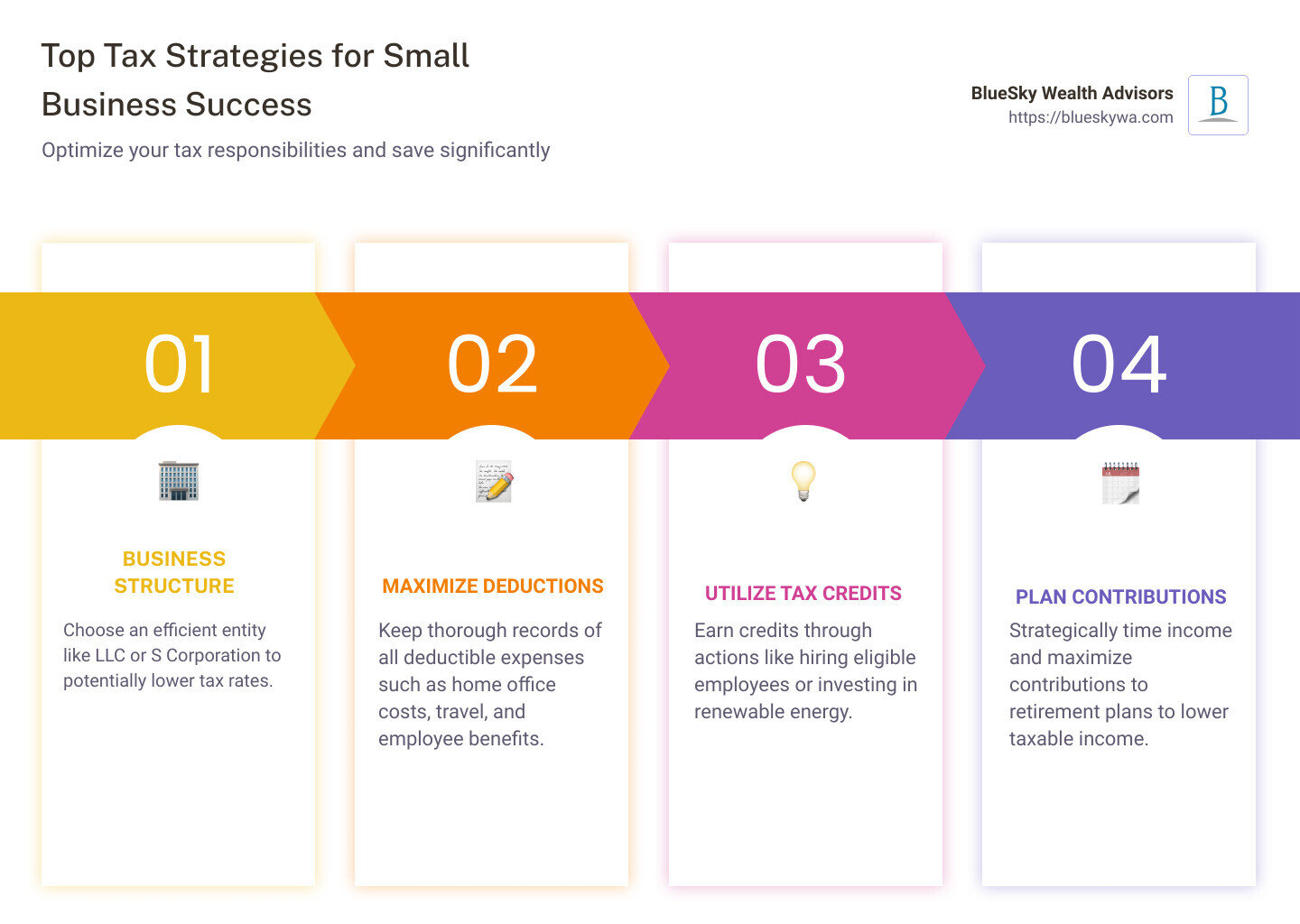
If you’re a small business owner looking to navigate through tax season efficiently, understanding and implementing tax reduction strategies for small business is crucial. These strategies not only ensure compliance and save money but also set a robust foundation for future financial success. Below is a brief overview for quick insight:
Structure Your Business Effectively: Opt for a business entity like LLC or S Corporation to potentially lower tax rates.
Maximize Deductions: Keep track of all deductible expenses such as home office costs, travel, and employee benefits.
Utilize Tax Credits: Engage in activities that earn credits like hiring eligible employees or investing in green energy.
Plan Contributions and Income: Choose the right timing for income and make maximum contributions to retirement plans.
Tax planning is essential in maintaining a healthy financial status and capitalizing on available benefits. It’s about much more than meeting legal requirements; it’s a strategic approach that significantly reduces liabilities and assists in business growth. Through careful planning and utilization of deductions and credits, you can significantly decrease your taxable income and increase your business’s net profit.
In this guide by BlueSky Wealth Advisors, we’ll uncover practical strategies and administrative actions you can integrate into your business operations to not just meet but capitalize on your fiscal responsibilities.
Understanding Tax Reduction Strategies for Small Business
Navigating taxes can be complex, especially for small business owners looking to maximize their financial outcomes. Effective tax management involves more than just fulfilling annual obligations; it’s about strategically harnessing deductions, credits, and deferrals to reduce tax liability. Let’s break down these key components to simplify how they can benefit your business.
Deductions: The Essentials
Deductions are expenses that the IRS allows you to subtract from your total income, effectively reducing the income on which you are taxed. For small businesses, common deductions include:
Home Office: If you use a part of your home regularly and exclusively for business, you may deduct expenses like rent, utilities, and repairs proportionate to the space used.
Equipment and Supplies: Purchases such as computers, software, and office supplies are typically deductible in the year they are purchased.
Vehicle Expenses: If you use your vehicle for business, costs like gas, repairs, and depreciation can be deducted based on the percentage of business use.
Credits: Direct Tax Savings
Unlike deductions, which reduce the income subject to tax, credits directly reduce your tax bill. Here are a few impactful ones:
R&D Tax Credit: For businesses involved in research and development, this credit can offset some of the costs associated with innovative projects.
Work Opportunity Tax Credit (WOTC): This is available if you hire individuals from certain groups who face significant barriers to employment.
Clean Energy Credits: If your business invests in renewable energy sources, you may be eligible for credits that reduce your tax liability.
Deferrals: Timing Is Key
Deferring income to the next tax year can be a strategic choice for businesses expecting a higher tax rate in the current year. This can be achieved through:
Delayed Invoicing: If you have control over when you receive income, consider delaying invoices to push income into the next fiscal year.
Retirement Plans: Contributions to retirement plans like a 401(k) can defer taxes until the money is withdrawn in retirement, typically at a lower tax rate.
Practical Application Let’s consider a case where a small business owner invests in new computers and office furniture. By understanding and applying the Section 179 deduction, they can deduct the full purchase price of these items from their gross income. This upfront deduction provides immediate tax relief, reducing the year’s taxable income and thus the tax liability.
Strategic Insight A smart move for small business owners is to schedule a year-end review of their financials. This review can help identify opportunities for last-minute deductions or whether deferring income could be beneficial given their current year’s profits and anticipated next year’s earnings.
By integrating these tax reduction strategies into your financial planning, you can not only comply with tax laws but also enhance your business’s financial health. Each business is unique, so consider consulting with a tax professional to tailor these strategies to your specific circumstances. This proactive approach, detailed in our guide by BlueSky Wealth Advisors, empowers you to make informed decisions that align with both your immediate financial needs and long-term business goals.
Key Tax Deductions Every Small Business Should Consider
When it comes to tax reduction strategies for small business, understanding key deductions is essential. These deductions can significantly lower your taxable income and reduce your overall tax burden. Let’s dive into three critical areas: Home Office, Equipment, and Vehicle Expenses.
Many small business owners operate out of their homes, but not everyone takes advantage of the home office deduction. To qualify:
Regular and Exclusive Use: The space must be regularly used exclusively for business.
Principal Place of Business: This area must be where you conduct your primary business activities, like managing and billing.
If you meet these conditions, you can choose between two calculation methods: – Simplified Option: Multiply the square footage of your office (up to 300 square feet) by $5. – Regular Method: Calculate the percentage of your home used for business and apply it to home expenses like mortgage interest or rent, utilities, and insurance.
This deduction not only simplifies your tax filing but can also significantly decrease your tax liability.
Equipment Deductions
Investing in business equipment can lead to substantial tax savings. Under Section 179, you can immediately deduct the cost of qualifying equipment—such as computers, furniture, and machinery—rather than depreciating it over several years. For 2023, the limit is $1,080,000. This upfront deduction can reduce your taxable income substantially in the year of purchase.
Vehicle Expenses
For small businesses that use vehicles, there are two methods to calculate deductible expenses: – Standard Mileage Rate: For 2023, it’s 65.5 cents per mile. This rate covers not just gas but also depreciation, insurance, and other costs. – Actual Expenses: Track all costs associated with your business vehicle—gas, repairs, insurance, depreciation—and deduct a portion based on the percentage of business use.
Additionally, if your vehicle weighs more than 6,000 pounds, you might qualify for a larger deduction under the same Section 179 mentioned above.
By carefully documenting these expenses and understanding how to apply them, you can turn necessary business costs into valuable tax deductions.
By incorporating these deductions into your tax strategy, you can significantly reduce your tax obligations, directing funds back into growing and sustaining your business. As always, it’s wise to consult with a tax professional to ensure you’re maximizing these opportunities tailored to your specific business activities. Next, we’ll explore how maximizing tax credits can further reduce your small business tax liability.
Maximizing Tax Credits to Reduce Small Business Liability
Tax credits are a powerful tool for small businesses looking to reduce their tax bills. Unlike deductions, which lower the amount of income subject to tax, credits directly decrease your tax liability, dollar for dollar. Let’s delve into three significant tax credits that could save your small business a substantial amount of money: the Research and Development (R&D) Credit, the Work Opportunity Tax Credit (WOTC), and Clean Energy Credits.
Research and Development (R&D) Credit
If your business invests in innovation, whether developing new products or improving existing ones, you may be eligible for the R&D Credit. This credit is designed to encourage businesses to keep pushing the boundaries of what’s possible, which in turn helps grow the economy.
Who qualifies? Businesses of any size that perform eligible research activities.
What’s the benefit? The credit amount varies based on the expenses related to eligible R&D activities.
A practical example is a tech startup developing a new software tool. By claiming the R&D Credit, they could offset some of the costs associated with their research, making their innovative project more financially feasible.
Work Opportunity Tax Credit (WOTC)
The WOTC is aimed at promoting the hiring of individuals who face significant barriers to employment. This includes veterans, ex-felons, and individuals receiving certain types of public assistance.
Who qualifies? Employers who hire from designated groups facing employment barriers.
What’s the benefit? The credit can be up to $2,400 per eligible employee, depending on the target group and the wages paid.
For instance, a small cafe that hires a veteran could benefit from the WOTC, reducing its tax liability while supporting a valuable community member’s reintegration into the workforce.
Clean Energy Credits
With a growing focus on sustainability, Clean Energy Credits are particularly appealing. These credits are available for businesses that invest in renewable energy sources like solar panels, wind turbines, or geothermal systems.
Who qualifies? Businesses that install or invest in renewable energy systems.
What’s the benefit? The credit typically covers a percentage of the cost of purchasing and installing renewable energy systems.
An example here could be a small manufacturing firm that installs solar panels on its facility’s roof. Not only would the business reduce its energy costs over time, but it could also claim a tax credit for a portion of the installation cost, reducing its tax burden.
Utilizing these tax credits can significantly reduce your small business’s tax liability. Each credit has specific eligibility criteria and benefits, so it’s crucial to understand which credits your business can claim. Implementing these tax reduction strategies for small business not only supports your financial health but also encourages practices that benefit the broader community and environment.
Next, we’ll consider how strategic tax planning with retirement solutions can further optimize your tax situation and support your long-term business goals.
Strategic Tax Planning with Retirement Solutions
When it comes to tax reduction strategies for small business, incorporating retirement solutions is a powerful approach. Not only do these plans offer tax benefits, but they also help in securing the financial future of both the business owners and their employees. Here’s a breakdown of some key options:
SEP IRA (Simplified Employee Pension Plan)
A SEP IRA is ideal for self-employed individuals or small business owners with few or no employees. Here’s why: – High Contribution Limits: You can contribute up to 25% of each employee’s pay (including your own), with a maximum of $66,000 for 2023. – Flexibility in Contributions: Contributions aren’t mandatory every year. In years when business is good, you can contribute more, and in lean years, less or none at all. – Simple to Set Up and Maintain: There are no significant administration costs, making it cost-effective for small businesses.
SIMPLE IRA (Savings Incentive Match Plan for Employees)
For businesses with 100 or fewer employees, a SIMPLE IRA is an excellent choice: – Dual Contribution Options: Employers can either match employee contributions dollar for dollar up to 3% of their salary or contribute 2% of each employee’s salary regardless of the employee’s contributions. – Immediate Vesting: Benefits are immediately 100% vested, which can be a strong incentive for employee retention. – Contribution Limits: The contribution limit for 2023 is $15,500, or $19,000 if the employee is age 50 or older.
401(k) Plans
A 401(k) is one of the most popular retirement options available: – Higher Contribution Limits: For 2023, employees can contribute up to $22,500, with an additional $7,500 catch-up contribution for those aged 50 and above. – Employer Matching: Encourages greater employee participation in the plan. – Tax Deferral: Contributions are made pre-tax, reducing taxable income for the year they are made.
Profit-Sharing Plans
Profit-sharing plans are a flexible way to provide retirement benefits: – Discretionary Contributions: Employers can decide from year to year how much to contribute, or whether to contribute at all, depending on the business profits. – Motivation and Loyalty: Helps align the interests of employees with those of the business, as their benefits depend on the company’s profitability.
Case Study: Consider the example of a small tech startup that implemented a SEP IRA. The owner was able to contribute 25% of his income to the plan, which not only reduced his taxable income but also allowed him to save significantly for retirement. This move was mirrored for his employees, enhancing their job satisfaction and loyalty to the company.
Implementing these retirement solutions requires careful planning and understanding of the tax implications. Each plan has its nuances and tax benefits, so it’s crucial to choose the one that aligns best with your business structure and goals. Partnering with a financial advisor like BlueSky Wealth Advisors can provide tailored advice that maximizes these benefits while ensuring compliance with all tax laws.
By integrating retirement planning into your strategic tax planning, you not only foster a secure financial future but also leverage significant tax advantages that can improve your business’s bottom line.
Next, we’ll explore more innovative tax reduction strategies for small business to further enhance your savings and operational efficiency.
Innovative Tax Reduction Strategies for Small Business
Hiring Family Members
One effective way to reduce the tax burden for small businesses is by hiring family members. This strategy not only supports your family financially but also offers significant tax benefits. When you employ your children or spouse, you’re able to shift income to them, potentially placing it in a lower tax bracket, which can reduce your overall tax liability.
Tax Benefits: – Income Shifting: By paying family members, you transfer income to their lower tax brackets. – Social Security and Medicare Taxes: Wages paid to your children under 18 are exempt from these taxes, which can represent substantial savings. – FUTA Taxes: Hiring your spouse may exempt you from Federal Unemployment Tax Act contributions, depending on your business structure.
It’s crucial that the work they do is legitimate and the pay they receive is reasonable for their duties. This not only complies with IRS requirements but also ensures the integrity of your business practices.
Choosing the Right Business Structure
Selecting the optimal structure for your business can significantly impact your tax obligations and personal liability. Here are three common structures and their tax implications:
LLC (Limited Liability Company): This structure provides liability protection while allowing profits to pass through to your personal tax return, helping avoid double taxation.
S Corporation: Ideal for small businesses that meet the IRS requirements, allowing owners to draw salaries and receive dividends, which can be taxed at a lower rate than income.
C Corporation: Offers the benefit of being taxed separately from its owners, potentially at a lower rate since the corporate tax rate was reduced to 21% under the Tax Cuts and Jobs Act.
Each structure has its unique benefits and drawbacks, and the choice depends heavily on your specific business needs and financial goals.
Leveraging Health Plans for Tax Savings
Health Savings Accounts (HSAs) and health insurance deductions are powerful tools for reducing taxable income. Implementing HSAs for employees not only helps in tax savings but also aids in managing future health costs more effectively.
Key Points: – HSAs: Contributions are made pre-tax, reducing taxable income. Funds grow tax-free and can be withdrawn tax-free for qualified medical expenses. – Health Insurance Deductions: Premiums paid for employee health insurance can often be deducted, lowering the overall taxable income.
These strategies are not just about savings; they also contribute to the health and wellness of your team, which can improve overall productivity and job satisfaction.
By employing these innovative tax reduction strategies, small businesses can leverage significant savings while ensuring compliance and supporting their employees and families. As always, it’s advisable to consult with a tax professional or a financial advisor like BlueSky Wealth Advisors to tailor these strategies to your specific business circumstances and maximize your benefits. Next, we’ll delve into proactive tax planning with BlueSky Wealth Advisors to optimize these strategies over the long term.
Proactive Tax Planning with BlueSky Wealth Advisors
Effective tax planning is not just about reacting to the tax season; it’s about being proactive throughout the year. BlueSky Wealth Advisors excels in helping small business owners implement strategies that not only reduce taxes in the short term but also maximize financial efficiency over the long haul. Let’s explore how personalized strategies and multi-year planning can benefit your business.
Personalized Strategies
No two businesses are the same, which is why cookie-cutter advice simply doesn’t work when it comes to tax planning. BlueSky Wealth Advisors understands this. They start by getting a deep understanding of your business model, financial situation, and future goals.
For instance, if your business has a significant amount of equipment purchases, BlueSky might suggest more aggressive depreciation tactics. Or, if you’re planning to expand, they might recommend deferring certain types of income to align better with your growth phases. This tailored approach ensures that every strategy directly contributes to reducing your tax liabilities effectively.
Multi-Year Planning
Tax planning should not be viewed as a one-time activity but rather as a continuous strategy that evolves. BlueSky Wealth Advisors helps you plan not just for the current year, but for many years ahead. This might include setting up retirement plans that benefit you and your employees in the long term, or making business structure changes that provide sustained tax advantages.
By considering future tax implications of current decisions, BlueSky helps you avoid the pitfalls that could lead to higher taxes down the road. For example, they can guide you on how much income to defer and the best times to take specific deductions based on projected changes in tax laws.
In summary, proactive tax planning with BlueSky Wealth Advisors revolves around understanding your unique business needs and planning strategically for the future. This approach not only helps in significantly reducing your current tax burden but also sets up a strong foundation for financial growth and stability.
Leveraging these personalized and forward-thinking strategies will ensure that your business is not only prepared for the upcoming tax season but is also positioned well for future financial challenges and opportunities. Next, we will discuss how continuous engagement with BlueSky Wealth Advisors can keep your business at the forefront of tax efficiency and compliance.
Conclusion
Long-Term Benefits
When we adopt tax reduction strategies for small business, the benefits extend far beyond the immediate savings on your next tax bill. Strategically managing your taxes means more than just meeting legal requirements—it’s about enhancing the financial health and potential of your business over the long haul.
By optimizing your tax situation, you’re effectively increasing the capital available to reinvest in your business—be it through expanding operations, enhancing employee benefits, or investing in new technology. This reinvestment not only drives your business forward but also strengthens its competitive edge in the market.
Moreover, the money saved through effective tax planning can act as a financial buffer, providing security against economic downturns and allowing for strategic flexibility in decision-making. This is crucial for maintaining business continuity and supporting sustainable growth.
Continuous Learning
Tax laws are constantly evolving, and staying informed is crucial. At BlueSky Wealth Advisors, we emphasize the importance of continuous learning as a core component of effective tax management. By keeping abreast of the latest tax changes and strategies, you can make informed decisions that align with both current laws and your business goals.
We encourage regular consultations and provide resources that help demystify complex tax issues. This proactive approach ensures that you’re always leveraging the most current and beneficial strategies available.
To truly benefit from tax reduction strategies for small business, view tax planning as a dynamic and ongoing part of your business strategy. Partnering with experts like us at BlueSky Wealth Advisors ensures that your tax planning adapts to new laws, your evolving business needs, and the shifting economic landscape.
In conclusion, integrating these tax strategies effectively requires a commitment to long-term planning and education. By focusing on these areas, your business can enjoy sustained growth and financial health, well-prepared for future challenges and opportunities in the ever-changing world of tax policy.
Tax Reduction Strategies for Retirees: If you’re nearing retirement or already there, understanding how to manage your taxes effectively is crucial. Here’s a quick guide to get you started: 1. Optimize withdrawals from retirement accounts 2. Invest in tax-efficient assets like municipal bonds 3. Make use of tax credits and deductions 4. Consider Roth conversions for tax-free retirement income 5. Relocate to tax-friendly states if it benefits your financial situation
Retirement is not just a phase of life; it’s a financial strategy that needs careful planning, especially when it comes to taxes which can eat into your hard-earned savings. Taxes in retirement are unavoidable, but with smart planning, you can minimize their impact. This introduction to tax-efficient strategies is designed to help you understand the necessary steps to secure your financial security without giving up more of your nest egg than necessary to the IRS.
Starting with understanding the different types of retirement accounts and their tax implications, to strategic withdrawals that keep you in a lower tax bracket, the aim is to cover various facets of tax planning. The steps you take today can significantly enhance your financial health, allowing you to enjoy your retirement years with peace and prosperity.
Understanding Different Retirement Accounts
When planning for retirement, one of the key decisions involves choosing between different types of retirement accounts. Each account type comes with its own tax implications which can significantly impact your financial health in retirement. Let’s explore the major types of retirement accounts and their respective tax characteristics.
Traditional vs. Roth Accounts
Traditional Accounts (401(k), IRA): – Pre-tax Contributions: Contributions are made with pre-tax dollars, which means they reduce your taxable income for the year they are made. – Tax-Deferred Growth: The investments in these accounts grow tax-deferred, meaning you don’t pay taxes on the gains until you withdraw the money. – Taxation Upon Withdrawal: Withdrawals are taxed as ordinary income at your current tax rate during retirement.
Roth Accounts (Roth IRA, Roth 401(k)): – After-Tax Contributions: Contributions are made with after-tax dollars, meaning they do not reduce your taxable income in the year of contribution. – Tax-Free Growth: Investments grow tax-free, and no taxes are paid on the gains if specific conditions are met. – Tax-Free Withdrawals: Withdrawals are tax-free in retirement, providing a significant advantage if you expect to be in a higher tax bracket or if tax rates increase.
Impact of Account Types on Taxation
Deferred Taxes: Traditional retirement accounts like the 401(k) and traditional IRA allow for tax-deferred growth. While this can be beneficial during your working years, it’s crucial to consider that you will eventually pay taxes on these funds when you start taking distributions, typically during retirement. This deferred tax liability is an essential factor in retirement planning.
Immediate Taxation: Roth accounts, by contrast, provide immediate taxation on contributions but offer tax-free growth and withdrawals. This can be particularly advantageous for those who anticipate higher tax rates in the future, either due to personal income changes or broader tax rate increases.
Understanding these differences is crucial in making informed decisions about where to place your retirement savings. By considering the tax implications of each account type, you can strategically plan to minimize taxes and maximize your retirement income. This approach ensures that you are better prepared financially for your retirement years, allowing you to enjoy this phase of life with fewer financial worries.
Next, we will delve into strategic withdrawals and how they can be optimized to maintain lower tax brackets during retirement, further enhancing your financial stability.
Strategic Withdrawals to Optimize Tax Brackets
Required Minimum Distributions (RMDs)
When you reach a certain age, the government requires you to start withdrawing from your retirement accounts like 401(k)s and traditional IRAs. This is known as Required Minimum Distributions or RMDs. Under the SECURE Act 2.0, the age for RMDs has been updated. If you turned 72 before 2023, the old rules apply. However, for those turning 73 in 2023 or later, the new rules set the age at 73. Starting in 2033, it will increase to 75.
Why does this matter? If you miss these withdrawals, you face a hefty penalty—25% on the missed amount, plus the regular income tax on it. Timely withdrawals are crucial to avoid these penalties and manage your tax liabilities effectively.
Managing Tax Brackets
Understanding and managing your tax bracket in retirement can lead to significant tax savings. As you withdraw from your retirement accounts, this income can push you into higher tax brackets. Here’s how you can manage this:
Withdrawal Timing: Consider the timing of your withdrawals. If you’re on the edge of a tax bracket, it might make sense to withdraw less in a year where other income sources (like part-time work or selling assets) push you higher.
Income Thresholds and Bracket Boundaries: Know the boundaries of your tax brackets. For 2023, for example, if you are filing as a single, the 22% tax bracket starts at $41,776 of taxable income. Keeping your income below the next bracket’s threshold can save you from higher taxes.
Strategic Withdrawals: Start withdrawals before you hit RMD age, especially in years when your income is lower. This can spread out your tax liability and keep you in a lower bracket over more years.
By planning your withdrawals carefully, you can manage your taxable income levels effectively, staying within a lower tax bracket and reducing your overall tax burden. This strategic approach not only helps in managing taxes but also ensures that your retirement funds last longer, securing your financial stability in the golden years.
Next, we will explore specific tax reduction strategies for retirees, including Roth conversions and the benefits of leveraging tax credits and deductions. These strategies are pivotal in maximizing your income and minimizing tax liabilities during retirement.
Tax Reduction Strategies for Retirees
Utilizing Roth Conversions
One effective strategy to consider is Roth conversions. This involves transferring funds from a traditional IRA or 401(k) to a Roth IRA. The advantage? While you’ll pay taxes on the converted amount at your current income tax rate, all future withdrawals from the Roth IRA are tax-free, provided specific conditions are met. This can be particularly advantageous if you expect to be in a higher tax bracket in retirement or if tax rates increase.
However, it’s crucial to manage the timing of these conversions. As financial experts suggest, spreading out the conversions over several years can prevent pushing yourself into a higher tax bracket in any single year. For instance, if you’re nearing retirement and anticipate a drop in income, initiating a Roth conversion during these lower-income years could minimize the tax impact.
Leveraging Tax Credits and Deductions
Maximizing tax credits and deductions is another vital strategy to reduce taxable income. Here are key areas where retirees can benefit:
Standard Deductions: For the 2023 tax year, the standard deduction is $13,850 for singles and $27,700 for married couples filing jointly. This deduction reduces your taxable income, directly lowering your tax liability.
Charitable Contributions: If you itemize your deductions, charitable contributions can be a significant tax deduction. For those who are 70.5 years or older, making direct transfers from an IRA to a charity—a move known as a Qualified Charitable Distribution (QCD)—counts towards your RMD and does not trigger taxable income, thus potentially keeping you in a lower tax bracket.
Medical Expenses: Retirees often face high medical costs, which can also provide tax relief. You can deduct unreimbursed medical expenses that exceed 7.5% of your adjusted gross income. This includes everything from hospital stays and doctor visits to health insurance premiums, particularly if you’re self-employed.
By understanding and applying these tax reduction strategies for retirees, you can significantly lower your tax bills and enhance your financial health in retirement. Each strategy requires careful consideration—ideally with the guidance of a professional—to tailor these approaches to your specific financial situation.
We’ll delve into the benefits of investing in tax-efficient assets, which can further optimize your tax situation and enhance your retirement readiness.
Investing in Tax-Efficient Assets
Investing wisely is crucial for maximizing your retirement savings and minimizing your tax liability. Let’s explore some strategic assets that can be beneficial for retirees looking to optimize their tax situation.
Benefits of Municipal Bonds
Municipal bonds, or “munis,” are issued by local or state governments to fund public projects like roads, schools, and infrastructure. One of the chief advantages of investing in municipal bonds is the federal tax exemption on the interest income you earn. This means that the money you make from these bonds is not taxed at the federal level, which can lead to significant savings, especially if you are in a higher tax bracket.
However, it’s important to understand the state tax considerations. If you live in the state where the bond was issued, you might also enjoy exemption from state and local taxes. This double exemption can make municipal bonds a highly attractive investment for retirees living in high-tax states.
For example, a retiree living in California might benefit more from investing in California municipal bonds than someone living in a state with lower or no state income tax. Always check the specific tax rules related to any bond you consider purchasing.
Long-Term Capital Gains Advantages
When it comes to investing in assets like stocks, bonds, or real estate, holding them for more than a year before selling can qualify you for long-term capital gains tax rates, which are considerably lower than short-term rates. These rates are 0%, 15%, or 20%, depending on your overall taxable income.
Holding period benefits are significant. By maintaining your investment for over a year, you move from a higher tax rate bracket (which could be as high as 37% for short-term gains) to a much lower bracket. This strategy not only helps in growing your investments but also reduces the amount of tax you pay when you decide to sell.
For instance, if you purchased stocks or a property and held onto these assets for several years, any appreciation in value would be subject to these lower tax rates upon sale. This is particularly beneficial for retirees who might need to liquidate assets as a part of managing their retirement funds.
By incorporating municipal bonds and taking advantage of long-term capital gains, retirees can enjoy a more stable and tax-efficient income stream. These strategies allow for a reduction in taxable income and can significantly enhance the longevity of your retirement savings.
Continuing on, the next section will explore the potential benefits of relocating to tax-friendly states, which can also play a crucial role in reducing your overall tax burden during retirement.
Relocation to Tax-Friendly States
Choosing the Right State
When considering a move to reduce your tax burden in retirement, it’s crucial to weigh several factors beyond just the tax benefits. Let’s explore some key aspects to keep in mind:
State Income Tax: Some states, like Florida and Texas, do not impose a state income tax, which can significantly reduce your overall tax liability. This means more of your retirement income stays in your pocket, rather than going to the government.
Property Tax: Property taxes can vary widely from one state to another. For instance, states like Alabama and Louisiana generally have lower property taxes compared to states like New Jersey and Illinois. Lower property taxes can decrease your annual expenses, potentially making a state more attractive for retirement.
Sales Tax: States like Delaware, Montana, and Oregon do not charge sales tax, which can mean everyday savings on purchases. This might seem small, but it adds up over time, especially if you’re living on a fixed income.
Tax-Friendly States: Apart from the states with no income tax, some states offer specific tax benefits for retirees, such as exemptions on Social Security benefits or public pension income. States like Pennsylvania and Mississippi are known for being particularly tax-friendly to retirees.
Cost of Living: A lower cost of living can offset many expenses in retirement, beyond just taxes. States with a lower overall cost of living allow your retirement savings to last longer, affording you a better quality of life.
Proximity to Family: While the financial aspects are crucial, the emotional and practical sides of moving are equally important. Living closer to family can provide emotional support and practical help, which becomes more valuable as one ages. The cost and effort of traveling to visit family if you live far away can negate some of the financial savings from lower taxes.
When you’re considering moving to a tax-friendly state, think about the big picture. It’s not just about the taxes; it’s about how your overall quality of life will be affected. States like Florida and Nevada might offer significant tax advantages, but consider factors like climate, healthcare facilities, community activities, and other personal preferences.
By carefully evaluating these factors, you can make a well-informed decision that balances both financial benefits and personal satisfaction in your retirement years. The best choice for one person might not be the right choice for another. It’s all about finding the best fit for your specific situation and ensuring you can enjoy your retirement to the fullest.
Conclusion
As we wrap up our exploration of tax reduction strategies for retirees, it’s clear that careful planning and strategic decision-making are crucial to optimizing your financial health during retirement. At BlueSky Wealth Advisors, we are dedicated to providing personalized financial solutions that cater to your unique needs and goals.
BlueSky Wealth Advisors: Your Partner in Financial Success
At BlueSky Wealth Advisors, we understand that every retiree’s financial landscape is different. That’s why we offer tailored advice that aligns with your personal and financial circumstances. Our team of experts is committed to helping you navigate the complexities of retirement taxation, ensuring that you benefit from the most effective strategies available.
Personalized Financial Solutions
Our approach to retirement planning is highly personalized. We take the time to understand your overall financial picture, including your income sources, investment portfolio, and long-term aspirations. This comprehensive understanding allows us to craft strategies that are not only aimed at reducing your tax liabilities but also at enhancing your financial well-being throughout your retirement years.
Proactive Tax Strategies
Proactivity is key when it comes to tax planning. By staying ahead of changes in tax legislation and understanding the nuances of tax-efficient investing, BlueSky Wealth Advisors ensures that you are always positioned to take full advantage of available tax benefits. Whether it’s deciding when to take Required Minimum Distributions or considering a Roth conversion, our proactive approach helps you minimize your tax burden and preserve more of your hard-earned retirement savings.
By partnering with BlueSky Wealth Advisors, you gain access to a team that is as invested in your financial success as you are. We are here to guide you through every financial decision, big or small, and to help you implement the tax reduction strategies that best suit your retirement plan.
As you move forward, consider how the insights shared here can be integrated into your financial planning. With the right strategies and a trusted advisor by your side, you can look forward to a financially secure and fulfilling retirement. If you have any questions about how to apply these strategies to your situation or need further clarification, don’t hesitate to reach out to us. BlueSky Wealth Advisors is here to help you navigate your path to a prosperous financial future.
Frequently Asked Questions about Tax Reduction Strategies for Retirees
As you move forward, consider how the insights shared here can be integrated into your financial planning. With the right strategies and a trusted advisor by your side, you can look forward to a financially secure and fulfilling retirement. If you have any questions about how to apply these strategies to your situation or need further clarification, don’t hesitate to reach out to us. BlueSky Wealth Advisors is here to help you navigate your path to a prosperous financial future.
What is the best tax strategy for retirement?
The best tax strategy for retirement involves a combination of understanding your tax bracket, making smart withdrawals from your retirement accounts, and considering Roth conversions. The goal is to balance your income sources in a way that minimizes your tax liabilities over the long term. It’s crucial to plan your Required Minimum Distributions (RMDs) carefully to avoid unnecessary penalties and higher tax brackets. For personalized advice, consider discussing your specific situation with a financial advisor at BlueSky Wealth Advisors Tax Planning.
How can I generate tax-free income in retirement?
Generating tax-free income in retirement can be achieved through investments in Roth IRAs, where withdrawals are tax-free, and in municipal bonds, which are often exempt from federal taxes and sometimes state taxes as well. Another strategy is to make qualified charitable distributions (QCDs) from your IRA, which can satisfy your RMD requirements without increasing your taxable income. Each of these options has specific conditions and benefits, so it’s wise to consult with a financial expert to tailor these strategies to your needs.
How to pay zero taxes in retirement?
Paying zero taxes in retirement requires careful planning and strategic financial moves. This might include:
Maximizing Contributions to Roth Accounts: The money grown in Roth IRAs and Roth 401(k)s is withdrawn tax-free in retirement.
Investing in Tax-Exempt Bonds: Municipal bonds can offer income that is not taxed at the federal level.
Capital Gains Management: Holding investments for over a year before selling can qualify you for lower long-term capital gains tax rates.
Relocating to Tax-Friendly States: Living in a state with no income tax can significantly reduce your tax burden.
The goal is to manage your retirement funds in a way that keeps your taxable income as low as possible. For more detailed guidance, BlueSky Wealth Advisors can provide personalized strategies based on your unique financial situation.
As you consider these FAQs, implementing effective tax reduction strategies for retirees can significantly impact your financial comfort and stability in your golden years. Always consider consulting with a professional to tailor these strategies to your specific circumstances. At BlueSky Wealth Advisors, we’re committed to helping you achieve a tax-efficient retirement.
Tax Reduction Strategies for High Income Earners (2024) – Are you seeking effective methods to reduce your tax liability? High-income earners can leverage strategic financial planning to minimize taxes through various methods such as maximizing retirement contributions, optimizing investment choices, and smartly timing their income and purchases.
Understanding the nuances and opportunities for tax planning is crucial, especially when you navigate through complex regulations that may otherwise significantly impact your financial growth.
Tax efficiency is paramount for those with substantial incomes. A slight adjustment in your strategy could translate to substantial savings, which can be redirected towards accelerating financial goals or enhancing your lifestyle. However, the high-income bracket also introduces unique challenges, including the constant evolution of tax laws and the greater likelihood that you will face higher tax rates.
Given the stakes, it’s vital to stay informed of the most current and beneficial strategies. Strategic tax planning not only ensures compliance but optimizes your finances so that you can preserve more of your hard-earned money.
Understanding Your Tax Bracket
Understanding your tax bracket is crucial when looking into tax reduction strategies for high income earners. Let’s break down the basics: Federal income tax brackets, Adjusted Gross Income (AGI), and Taxable Income.
Federal Income Tax Brackets
The federal tax system is progressive, meaning that different portions of your income are taxed at increasing rates. For example, in 2023, if you are a single filer, the tax rates might start at 10% for income up to a certain threshold and could go up to 37% for income over $539,900.
Here’s what you need to know: – The more you earn, the higher the percentage of tax you pay on your top dollars. – Each tax bracket has a range of income values that are taxed at a particular rate.
Adjusted Gross Income (AGI)
AGI is your total gross income minus specific deductions that the IRS allows. These deductions include things like retirement plan contributions, student loan interest, and tuition and fees. AGI is important because it determines your eligibility for various tax credits and deductions.
Key points about AGI: – Lowering your AGI can reduce your taxable income and the amount of tax you owe. – Contributions to traditional IRAs and 401(k)s are effective ways to reduce your AGI.
Taxable Income
Taxable income is what’s left after you subtract deductions from your AGI. You can either take the standard deduction or itemize deductions based on expenses like mortgage interest, state taxes paid, and charitable contributions.
Understanding this is crucial: – The choice between standard deduction and itemizing depends on which lowers your tax bill the most. – For 2023, the standard deduction for single filers is $13,850 and $27,700 for married couples filing jointly.
By comprehensively understanding these components, you can better navigate the complex world of taxes and leverage strategies to minimize your liabilities. As tax brackets fluctuate and tax laws evolve, staying informed is your best strategy for keeping more of your earnings. This knowledge forms the foundation for exploring deeper tax reduction strategies and making informed decisions that align with your financial goals.
Tax Reduction Strategies for High Income Earners
Maximize Retirement Account Contributions
One of the most straightforward tax reduction strategies for high income earners is to maximize contributions to retirement accounts like 401(k)s, 403(b)s, and SIMPLE IRAs. For 2024, the contribution limits have increased, allowing you to set aside more money on a pre-tax basis, which can significantly lower your taxable income for the year.
401(k) and 403(b): The maximum contribution is $23,000.
SIMPLE IRA: The limit is $16,000.
Catch-up contributions: If you’re over 50, you can contribute an additional $7,500 for 401(k)s and $3,500 for SIMPLE IRAs.
By fully funding these accounts, you not only save for retirement but also reduce your current tax liability, potentially placing you in a lower tax bracket.
Opt for Roth IRA Conversions
Converting funds from a traditional IRA or 401(k) to a Roth IRA is a savvy move for those anticipating higher tax rates in the future. While Roth IRA contributions are made with after-tax dollars, the significant advantage is that withdrawals are tax-free under qualified conditions. This includes the growth on your investments, which is also tax-free.
Why consider a Roth IRA conversion? – Tax-free withdrawals: Ideal in retirement when you might need tax-free income. – Future tax savings: Protects you against potential increases in tax rates.
Roth conversions are especially beneficial in years when your income is lower, as the tax impact of the conversion will be less severe, allowing you more control over your taxes now and in the future.
Invest in Municipal Bonds
For high-income earners looking for tax-efficient investment options, municipal bonds offer a compelling choice. The interest earned on these bonds is often exempt from federal income taxes, and in many cases, state and local taxes as well, particularly if you live in the state where the bond was issued.
Benefits of municipal bonds: – Tax-exempt interest: Reduces your taxable income. – State tax benefits: Additional savings if the bonds are from your home state.
While the returns on municipal bonds might be lower compared to taxable bonds, the tax benefits can make them a worthwhile addition to your portfolio, particularly if you are in a higher tax bracket.
By leveraging these strategies—maximizing retirement contributions, considering Roth IRA conversions, and investing in municipal bonds—you can effectively reduce your taxable income and manage your tax burden more efficiently. As you continue to explore advanced tax planning techniques, these foundational strategies provide a robust starting point for securing your financial future.
Advanced Tax Planning Techniques
Utilize Charitable Contributions
Donor-advised funds are a smart choice for high-income earners looking to manage their charitable giving efficiently. When you contribute to a donor-advised fund, you can make a large donation in one year, getting an immediate tax deduction for that year. This is particularly useful in a year with unusually high income. You can then recommend grants from the fund to your favorite charities over time. This strategy not only provides upfront tax relief but also allows you to plan your charitable activities thoughtfully.
Qualified Charitable Distributions (QCDs) offer another tax-savvy way to give. If you are 70.5 years old or older, you can directly transfer up to $100,000 per year from your IRA to a qualified charity. This amount counts towards your required minimum distributions (RMDs) but does not increase your taxable income. This can be especially beneficial if you are trying to stay in a lower tax bracket.
Real Estate Tax Strategies
Real estate investors can benefit from a 1031 exchange, which allows you to defer paying capital gains taxes on an investment property when it is sold, as long as another similar property is purchased with the profit gained by the sale. This can be a powerful way to build wealth over time by deferring taxes indefinitely as you roll over profits from one investment to the next.
Opportunity Zones also provide a unique tax advantage for real estate investors. By investing in these designated areas, you can defer and potentially reduce your capital gains taxes. If the investment in the Opportunity Zone is held for at least ten years, the capital gains on the new investment are tax-free.
Investment Choices for Tax Efficiency
Tax-loss harvesting is a technique to reduce your taxes by selling investments that have experienced a loss. By realizing these losses, you can offset gains from other investments, reducing your overall taxable income. It’s important to avoid the wash-sale rule by not repurchasing the same or substantially identical asset within 30 days before or after the sale.
Investing in companies that pay dividend income can also be tax-efficient, especially if they pay qualified dividends. Qualified dividends are taxed at the lower capital gains tax rate rather than the higher income tax rates, which can significantly reduce your tax liability.
Finally, understanding and utilizing capital gains strategies is crucial. Holding investments for more than a year before selling can qualify you for lower long-term capital gains tax rates. This simple strategy can save you a significant amount in taxes, especially if you are in a high-income bracket.
By incorporating these advanced techniques into your tax planning, you can leverage your charitable inclinations, real estate investments, and market investments to not only grow your wealth but also manage your tax burden effectively. As we move into specific scenarios, these strategies will continue to play a vital role in optimizing your financial outcomes.
Tax Planning for Specific Scenarios
Handling Bonuses and Windfalls
Receiving a bonus or windfall can significantly impact your tax situation, especially for high-income earners. Here are some strategies to manage this effectively:
Deferral Options: If you anticipate being in a lower tax bracket in the following year, consider deferring your bonus. This can be achieved by asking your employer to delay the bonus payout until the beginning of the next year. This strategy can lead to substantial tax savings by aligning the extra income with a year where it will be taxed at a lower rate.
Investment Allocation: Instead of spending your bonus or windfall immediately, think about investing it. Smart investment choices can not only grow your wealth but also provide tax benefits. For instance, investing in tax-advantaged accounts like a 401(k) or an IRA can defer taxes until retirement, potentially lowering your current taxable income.
Strategies for High-Net-Worth Filers
High-net-worth individuals need to be particularly strategic about their tax planning due to their complex financial situations:
Asset Placement: Use tax-efficient asset placement strategies to minimize taxes. Place income-producing investments, like bonds, in tax-deferred accounts and investments with high growth potential, like stocks, in taxable accounts. This can reduce the tax impact on returns from these assets.
Tax Lot Matching: When selling investments, consider using tax lot matching to manage capital gains. This involves selecting specific shares to sell based on their purchase price to control the capital gains tax liability.
Tax Considerations for Business Owners
Business owners have unique opportunities and challenges when it comes to tax planning:
Business Structure: Choosing the right business structure can greatly affect your tax liabilities. Structures like S Corporations or Limited Liability Companies (LLCs) can offer benefits in terms of self-employment taxes and income splitting.
Hiring Family Members: Employing family members can help shift income within your family and take advantage of lower tax brackets. Ensure that the compensation is reasonable for the work performed, as the IRS pays close attention to these arrangements.
By understanding and utilizing these strategies, high-income earners, including those receiving bonuses or windfalls, high-net-worth individuals, and business owners, can significantly reduce their tax burdens. As you continue to navigate through your financial landscape, consider these tailored strategies to optimize your tax situation. Moving forward, we will explore frequently asked questions about tax reduction strategies for high income earners to further clarify your options and planning methods.
Frequently Asked Questions about Tax Reduction Strategies for High Income Earners
How can high income earners reduce their taxable income?
High income earners have several techniques at their disposal to reduce taxable income effectively. Here are some key strategies:
Maximize Retirement Contributions: Contributing to retirement accounts like 401(k)s, 403(b)s, or IRAs can significantly reduce your gross income. For 2023, the contribution limit for 401(k) plans is $22,500 with an additional catch-up contribution of $7,500 if you’re aged 50 or older.
Health Savings Accounts (HSAs): If you’re enrolled in a high-deductible health plan, contributing to an HSA not only offers a tax deduction but also tax-free growth and withdrawals for qualified medical expenses.
Invest in Tax-Efficient Funds: Investing in index funds or ETFs can be more tax-efficient compared to actively managed funds because they typically generate fewer capital gains due to lower turnover.
Harvest Tax Losses: Selling investments at a loss can offset gains you’ve realized throughout the year, which can help reduce your taxable income.
What are the best tax-saving investments for high earners?
For high earners looking to optimize their investment strategy for tax purposes, consider the following options:
Municipal Bonds: The interest from these bonds is generally exempt from federal income tax and possibly state and local taxes if you live in the state where the bond was issued.
Roth IRA Conversions: While this involves paying taxes now on pre-tax retirement funds, it converts them into Roth IRAs, which will then grow tax-free and offer tax-free withdrawals in retirement.
Real Estate Investments: Utilizing strategies like the 1031 exchange can allow property investors to defer paying capital gains taxes when they sell a property and reinvest the proceeds in a like-kind property.
How do changes in tax laws affect high income earners?
Tax laws are constantly evolving, which can have significant implications for high-income earners. For instance:
Expiration of Tax Cuts and Jobs Act Provisions: Some of the tax relief provided by the Tax Cuts and Jobs Act is set to expire after 2025, which could result in higher tax rates and fewer deductions available.
Adjustments to Income Brackets and Deductions: The IRS regularly adjusts tax brackets and deduction limits to account for inflation, which can shift the strategies that are most beneficial in any given year.
Legislation like the SECURE Act and SECURE Act 2.0: These laws have introduced changes to retirement savings rules, affecting how high-income earners plan for retirement and manage their estates.
Staying informed with the latest tax law changes is crucial. High-income earners should consider regular consultations with tax professionals to ensure that they are using the most effective strategies available under the current law. This proactive approach will help maximize your tax savings and align your financial planning with the latest tax regulations. Moving forward, let’s delve deeper into specific tax planning scenarios to better understand how these strategies can be applied in different financial situations.
Conclusion
As we wrap up our discussion on tax reduction strategies for high income earners, it’s clear that the journey towards effective tax management is ongoing and requires a strategic, long-term approach. At BlueSky Wealth Advisors, we emphasize the importance of continuous planning and adaptation to evolving tax laws to ensure our clients’ financial strategies remain optimal.
Long-term Planning
Long-term tax planning is vital for high-income earners looking to preserve and grow their wealth over time. By understanding and anticipating future changes in tax legislation, you can make informed decisions that align with your financial goals. We recommend establishing a forward-looking tax strategy that considers potential shifts in income, investments, and retirement plans.
Regular Advisor Meetings
Regular meetings with your financial advisor are crucial. These sessions provide an opportunity to review and adjust your financial plan based on recent changes in your life or the broader economic landscape. At BlueSky Wealth Advisors, we encourage our clients to schedule regular check-ins. This enables us to proactively address new opportunities for tax savings and ensure that your financial plans are always aligned with the latest tax regulations.
BlueSky Wealth Advisors
Choosing the right financial advisor is key. At BlueSky Wealth Advisors, our team of experts is dedicated to providing tailored advice that maximizes your financial potential while minimizing tax liabilities. We pride ourselves on our commitment to serving as your trusted advisor, ensuring that your wealth management strategy not only meets your current needs but also sets the foundation for future prosperity.
In conclusion, managing your taxes effectively requires more than just knowledge of the latest tax rules—it demands a strategic partnership with advisors who understand the nuances of your financial landscape. At BlueSky Wealth Advisors, we are committed to guiding high-income earners through the complexities of tax planning, ensuring that every financial decision supports your long-term objectives. Let us help you turn tax planning from a chore into an opportunity to enhance your financial success.