Oil prices play an important role in the global economy, directly influencing the cost of gasoline at the pump and indirectly impacting the prices of all goods and services. The price of oil has also been an important factor influencing global markets and inflation trends over the past few years. Historically, the relationship between oil and the economy is a two-way street: low or stable oil prices stimulate the economy, and a growing economy increases the demand for oil, and vice versa.
Oil is sensitive to geopolitics and economic growth
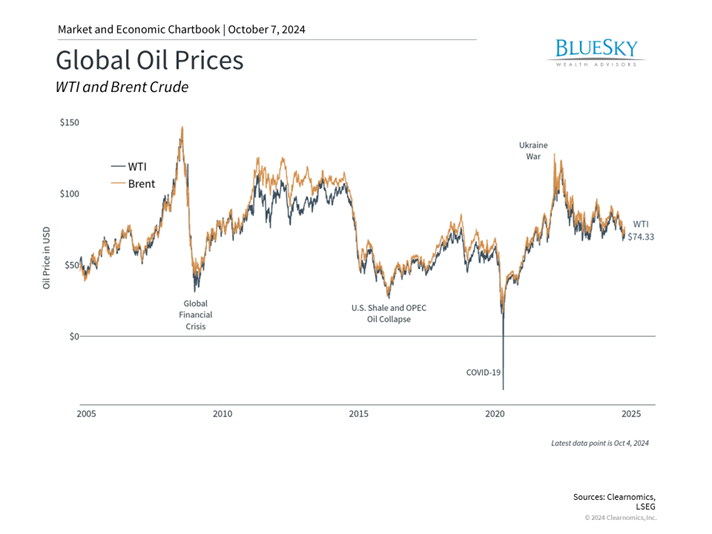
Although prices have fallen from their 2022 high, they have risen amid a spike in geopolitical tensions and the potential risk to oil supply. The escalating conflict in the Middle East, which began a year ago with Hamas’s October 7 attack on Israel, is concerning and has significant humanitarian consequences. While acknowledging the human side of the conflict, some investors may wonder what trends in oil prices may mean for their portfolios and the broader economy in the coming months.
The price of Brent crude, the global oil benchmark, recently jumped to $78 per barrel due to the conflict between Israel and Hezbollah/Iran. While this represents a 13% increase from the recent low of $69 a month ago, oil prices are still roughly flat on the year and far below the 2022 peak of nearly $128. Oil prices can be volatile and difficult to predict, but fears that the conflict in the Middle East would send prices skyrocketing above $100 a barrel have so far not materialized.
Historically, oil prices are influenced by both geopolitics and economic growth. While conflicts can cause prices to spike, as they did when Russia invaded Ukraine, sustained increases in oil prices have more often been the result of rising demand due to strong economic growth. The historic level of oil prices during the mid-2000s, for instance, was the result of rapid global growth prior to the 2008 housing crash and global financial crisis. Thus, geopolitics and growth tend to impact supply and demand, respectively, which can affect how long prices stay high and the resulting effects.
The U.S. is the world’s largest producer of oil and gas
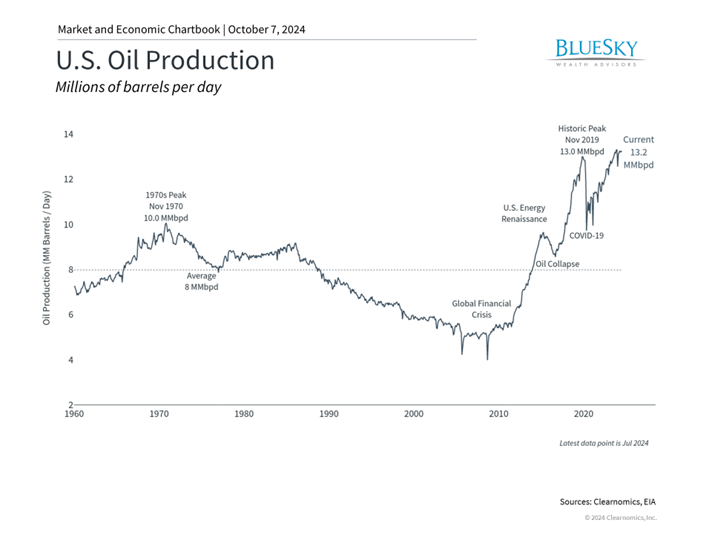
One reason the distinction between supply- and demand-driven shocks matters is because oil producers can respond to changing prices. Unlike in the mid-2000s, the U.S. is now the world’s largest producer of crude oil. Advancements in exploration and drilling have increased output, allowing the industry to maintain high productivity levels. According to the Energy Information Administration, these improvements have been key to sustaining U.S. oil production growth which now exceeds 13.2 million barrels per day.
In theory, this means that the U.S. can play the role of “swing producer” to increase supply when oil prices are high. Of course, this is an oversimplification since the U.S. still relies on foreign imports due to the different types of crude oil needed by refineries as well as the effects of various energy policies. Nonetheless, it helps to insulate the U.S. from geopolitics and possibly reduces the impact of oil shocks.
In the long run, world oil production is expected to outstrip demand over the next several years, according to the International Energy Agency. This is partly due to U.S. production, but it also reflects the changing dynamics of OPEC+. The group has extended production cuts into 2025 in order to maintain higher oil prices, although the incentives to renege on these commitments to gain market share are high among member countries. This has made the cartel less relevant over the past decade.
Despite these trends and the growing adoption of renewable energy sources, the world remains heavily reliant on oil, which means that it still serves as a transmission mechanism for geopolitical tension to influence the global economy. A further spike in oil prices could act as a headwind to the economy and the “soft landing” the Fed is hoping to achieve. At the same time, there are many factors that make this less likely than in the past.
Gasoline prices remain relatively low
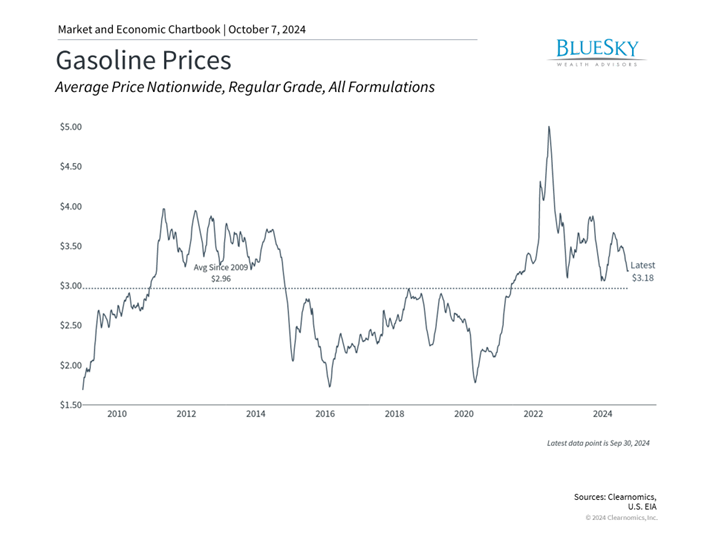
Perhaps the biggest impact of higher oil prices on everyday consumers is via gasoline prices at the pump. Fortunately, gasoline prices remain far lower than their peak in 2022 when the average price per gallon of regular unleaded reached $5. This led the Department of Energy to begin releasing oil from the Strategic Petroleum Reserve (SPR), an emergency supply of crude maintained by the government. Since then, the government has been refilling the SPR at more attractive prices.
Higher gasoline prices are effectively a tax on households and consumers since driving to work, school, and buying groceries are necessities. Higher gas prices also reduce disposable income for other purchases, especially larger discretionary items, which can impact retail sales and corporate earnings.
From an investment perspective, navigating oil price fluctuations can be challenging especially if they are the result of uncertain or troubling geopolitical developments. The performance of the energy sector during periods of market stress illustrates this point. In 2022, when the broader S&P 500 index was down 18% and most sectors posted negative returns, the energy sector delivered a remarkable 66% gain. This followed a 55% return in 2021 for the sector when the economy roared back after the pandemic.
While past performance does not guarantee future results, maintaining a diversified portfolio that includes many sectors, including energy, can help investors to offset the volatility that results from rising oil prices. In the long run, holding a portfolio that can weather market swings allows investors to stay focused on their long-term financial goals.
The bottom line? Oil prices have risen due to Middle East tensions but remain well below their recent peaks. While oil can impact economic growth, investors should focus on maintaining broad sector exposures in their portfolios and avoid overreacting to daily headlines.
Copyright (c) 2024 Clearnomics, Inc. All rights reserved. The information contained herein has been obtained from sources believed to be reliable, but is not necessarily complete and its accuracy cannot be guaranteed. No representation or warranty, express or implied, is made as to the fairness, accuracy, completeness, or correctness of the information and opinions contained herein. The views and the other information provided are subject to change without notice. All reports posted on or via www.clearnomics.com or any affiliated websites, applications, or services are issued without regard to the specific investment objectives, financial situation, or particular needs of any specific recipient and are not to be construed as a solicitation or an offer to buy or sell any securities or related financial instruments. Past performance is not necessarily a guide to future results. Company fundamentals and earnings may be mentioned occasionally, but should not be construed as a recommendation to buy, sell, or hold the company’s stock. Predictions, forecasts, and estimates for any and all markets should not be construed as recommendations to buy, sell, or hold any security–including mutual funds, futures contracts, and exchange traded funds, or any similar instruments. The text, images, and other materials contained or displayed in this report are proprietary to Clearnomics, Inc. and constitute valuable intellectual property. All unauthorized reproduction or other use of material from Clearnomics, Inc. shall be deemed willful infringement(s) of this copyright and other proprietary and intellectual property rights, including but not limited to, rights of privacy. Clearnomics, Inc. expressly reserves all rights in connection with its intellectual property, including without limitation the right to block the transfer of its products and services and/or to track usage thereof, through electronic tracking technology, and all other lawful means, now known or hereafter devised. Clearnomics, Inc. reserves the right, without further notice, to pursue to the fullest extent allowed by the law any and all criminal and civil remedies for the violation of its rights.
As we enter the second half of the year, it’s important for long-term investors to maintain perspective on the major events that have driven markets. Despite ongoing economic uncertainty, the stock market has experienced a strong rally as investors anticipate the first Fed rate cut and the rally in artificial intelligence stocks continues. During the first six months of the year, the S&P 500 gained 15.3% with dividends, the Nasdaq 18.6%, and the Dow Jones Industrial Average 4.8%. The 10-year Treasury yield declined from its April peak of 4.7% to 4.4%, allowing the overall bond market to be roughly flat on the year. International stocks have performed better as well, with developed markets generating 5.7% and emerging markets 7.7%.
This strong performance may have caught some investors off guard while others may not have been properly positioned to take advantage of the upswing across many asset classes. This is because market sentiment can often turn on a dime, especially when there is so much investor and media focus on short-term events. For example, the recession that was anticipated at the beginning of the year has not yet occurred and there are signs that inflation, which ran hotter than expected for a few months, is beginning to improve.
Of course, the market’s focus will now shift toward major events in the second half of the year. Perhaps the most notable is the upcoming presidential election. As investors prepare to cast their ballots in November, they will also wonder what each political party could mean for their portfolios and financial plans. Investors will also watch the timing and number of Fed rate cuts closely since lower rates are generally positive for both stocks and bonds.
While the outcome of these events is uncertain and introduces new risks, the first half of the year is a reminder that overreacting to day-to-day headlines, at the expense of long-term underlying trends, can often result in poor investment decisions. History shows that it’s important to separate our personal feelings around politics from our financial decisions in order to stay invested, diversified, and disciplined. Below are five key facts all investors should keep in mind to stay levelheaded through the rest of 2024 and beyond.
1. The market continues to reach new all-time highs
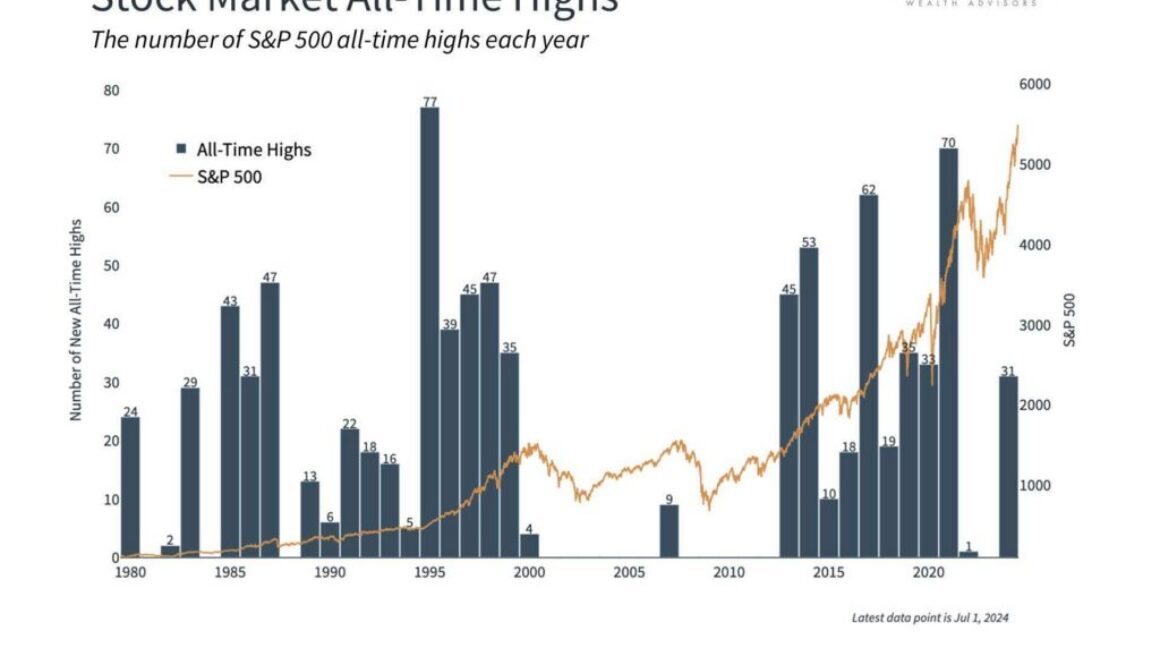
On its way to a 15.3% gain in the first half of the year, the S&P 500 has achieved over 30 new all-time highs. While this is positive, it can also make many investors nervous. When the market is in uncharted territory, it’s easy to worry that it may be “due for a pullback.”
The reality is that price swings are an unavoidable part of investing and the market will certainly pull back at some point. However, the timing of these declines is difficult if not impossible to predict. At the same time, major stock market indices will naturally spend a significant amount of time near record levels during bull markets, as shown in the accompanying chart. Trying to time the market tends to be counterproductive for this reason.
This year, artificial intelligence stocks – particularly Nvidia – have contributed greatly to market returns with the Information Technology and Communication Services sectors gaining 28.2% and 26.7%, respectively. However, other sectors have more recently begun to benefit as well with Energy, Financials, Utilities, and Consumer Staples all experiencing rallies of around 10%. All told, 10 of the 11 sectors are positive on the year. While it’s unclear where large-cap technology stocks may go from here, staying diversified allows investors to benefit from a wide variety of sectors.
2. With inflation cooling, the Fed is on track to cut rates later this year
Investors have been anticipating the first rate cut of the cycle since the beginning of the year. This has not only driven returns, but is one reason markets have swung so much when new economic data has caused expectations to shift.
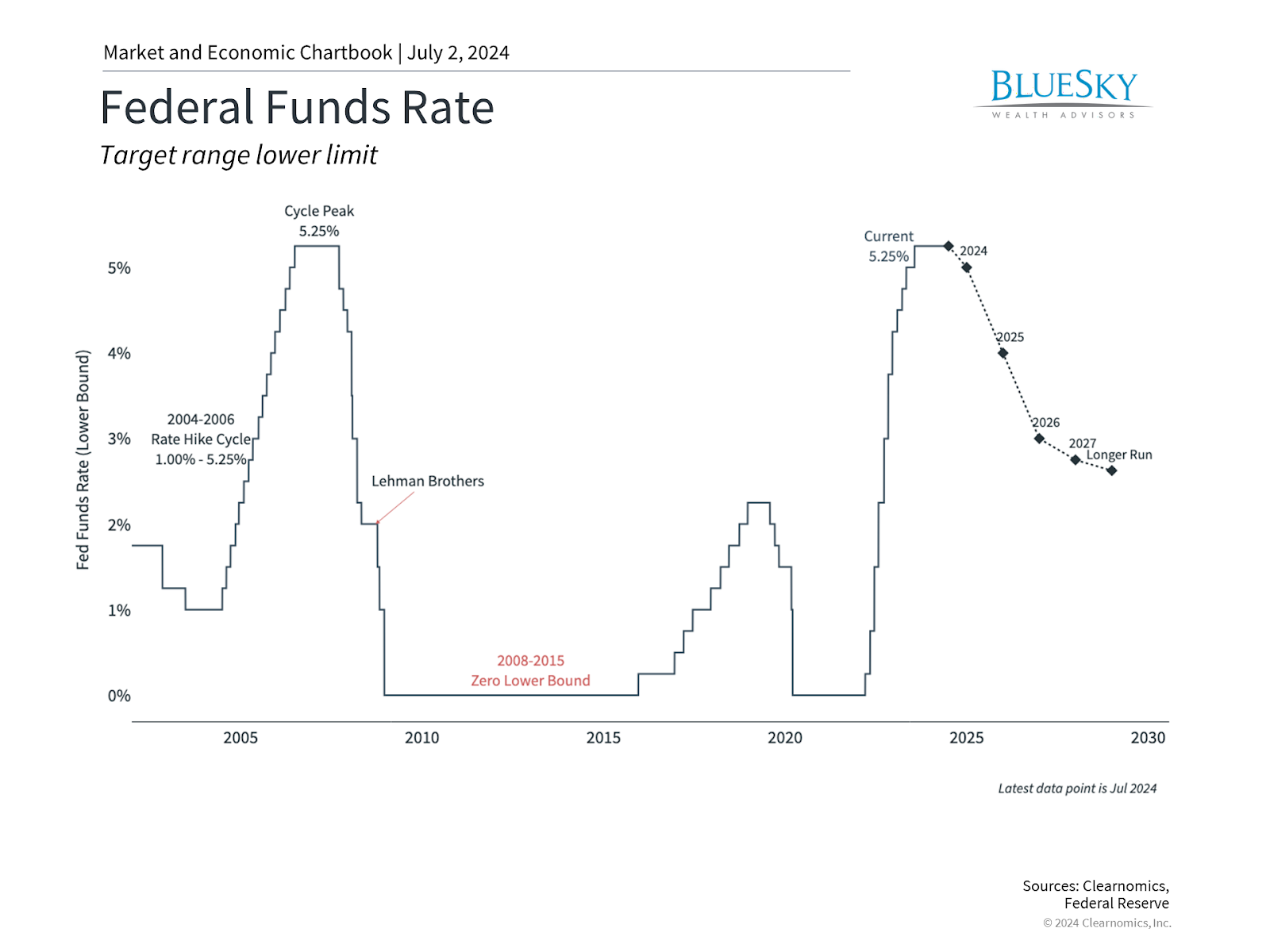
The accompanying chart shows the possible path of the federal funds rate based on the Fed’s latest projections. At its last meeting, the Fed cited strong job gains and low unemployment as indicators of solid economic activity but emphasized that “inflation has eased over the past year but remains elevated.” Fortunately, the latest inflation data in May showed a significant deceleration that has preserved the possibility of a rate cut this year.
Many of the additional rate cuts that investors previously expected have simply been pushed into next year and will depend on the economic data over the next six months. Regardless of the exact timing and path of Fed rate cuts, these projections represent a reversal of the emergency monetary policy actions that began in early 2022.
3. Steadier rates support the bond market
The path of interest rates has been highly uncertain over the past few years due to inflation, economic growth, and the Fed. Higher rates have defied the expectations of investors and economists, creating a challenging environment for the bond market, since rising rates push down bond prices.
After hotter-than-expected readings in the first quarter of the year, the latest Consumer Price Index data showed no change in overall prices in May for the first time in almost two years. Core CPI rose 0.2% in May, or 3.4% year-over-year, a healthy deceleration from the previous month’s 3.6% pace. Other data, such as the Personal Consumption Expenditures index that the Fed favors, and the Producer Price Index, have shown similar patterns.
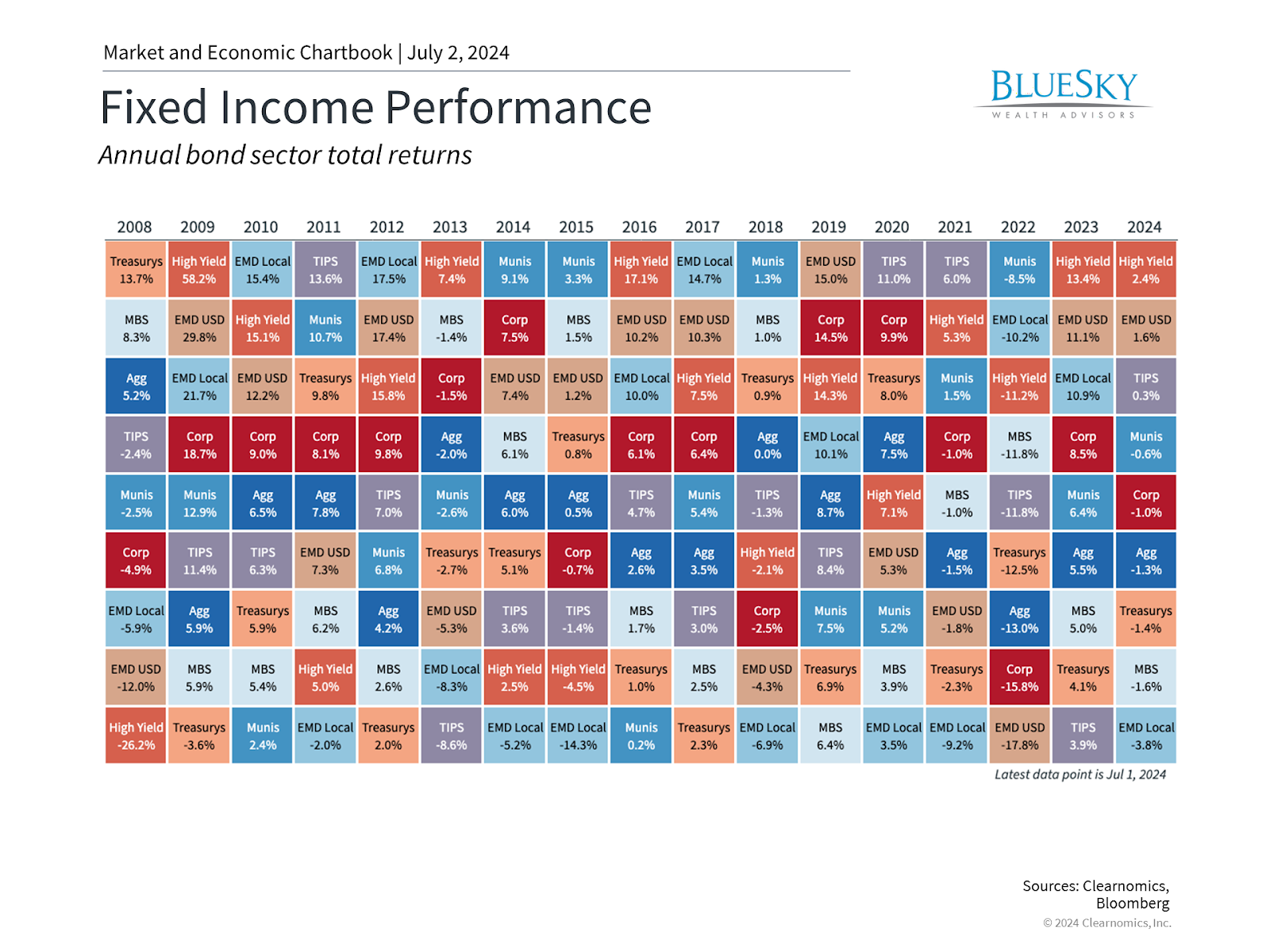
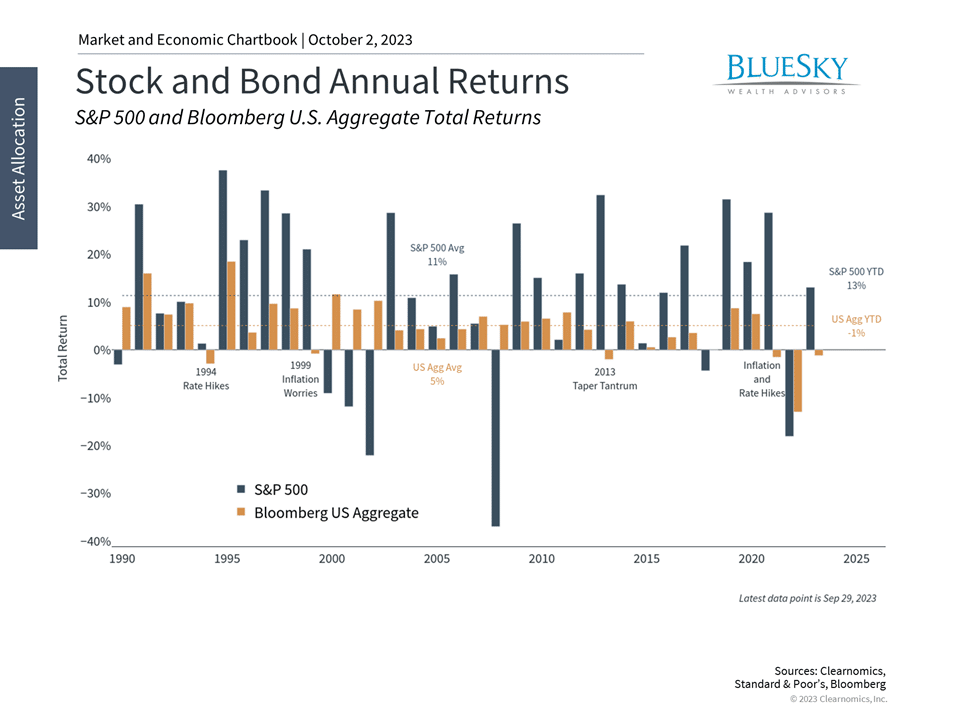
These developments, along with new Fed guidance, have pushed rates lower in recent days, supporting bond prices. The Bloomberg U.S. Aggregate Bond Index, a measure of the overall bond market, is nearly flat on the year after declining as much as 4% in April. This is in sharp contrast to 2022 when bonds fell into a bear market during the historic jump in interest rates, before stabilizing and rebounding in 2023.
4. Many investors remain on the sidelines in cash
In times of market uncertainty, investors often seek the safety of cash. This has been true over the past several years as markets have swung due to the pandemic, geopolitical events, Fed rate hikes, inflation, gridlock in Washington, technology trends, and more. Additionally, interest rates on cash are at their highest levels in decades, making it appear that there are attractive “risk-free” returns.
While cash is important, it can become problematic when investors hold too much cash. This is because cash is not truly risk-free for two important reasons. First, inflation quietly erodes the purchasing power of cash over time. So even if yields appear to be high, the real value of your money could decline.
Second, the prospects for cash will only worsen if and when the Fed does begin to cut rates. Investors would be forced to reinvest their cash either at lower interest rates or in stocks and bonds whose prices would most likely have already risen.
5. The presidential election is heating up
Coverage of the presidential election is heating up. While elections are an essential way for Americans to help shape the direction of the country as citizens, voters and taxpayers, it’s important to vote at the ballot box and not with investment portfolios.
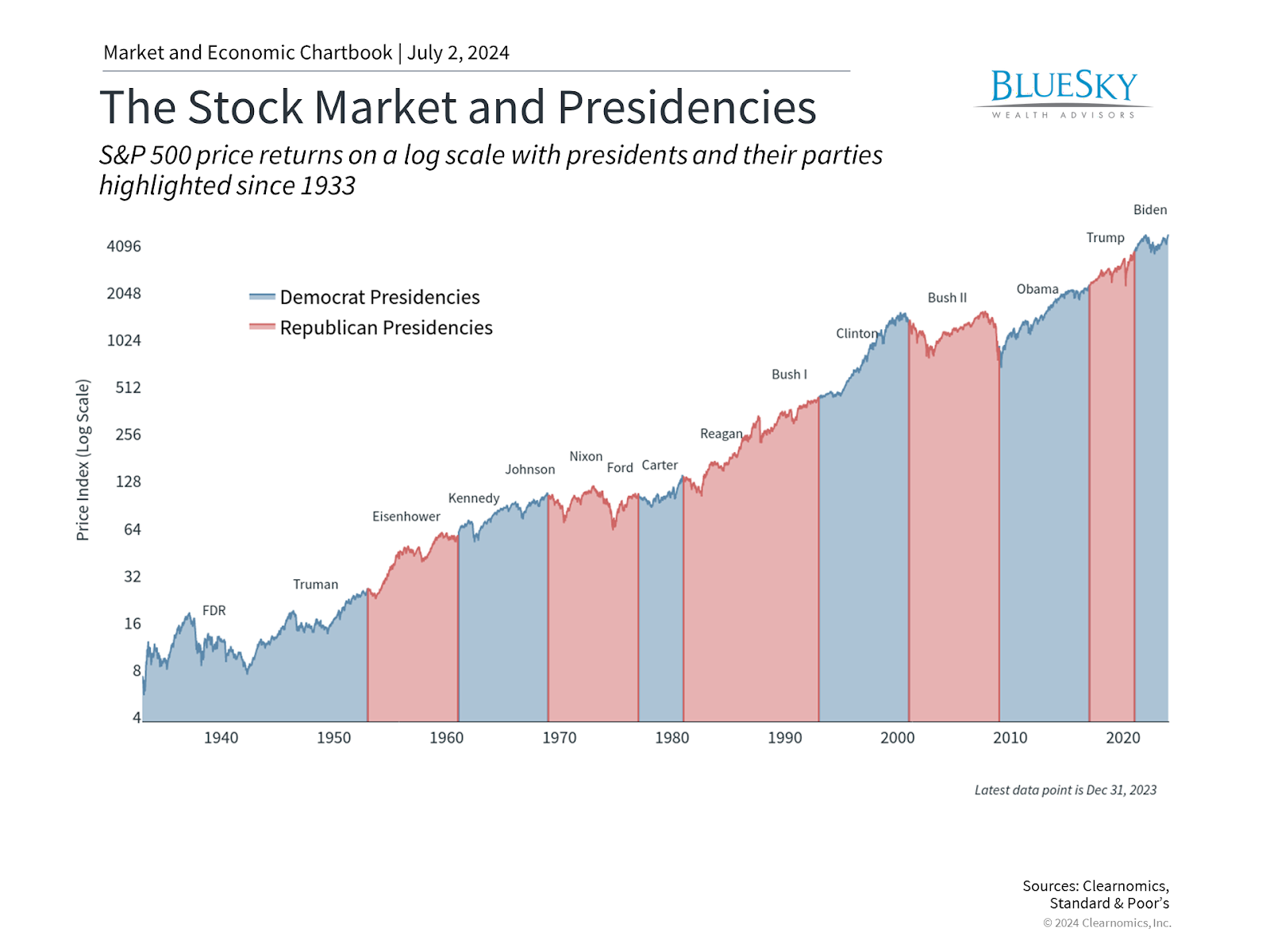
History shows that markets can perform well under both major political parties. As the accompanying chart shows, the economy and stock market have grown over decades regardless of who was in the White House. What mattered more across these periods were the ups and downs of the business cycle.
Of course, politics can impact taxes, trade, industrial activity, regulations, and more. However, not only do policy changes tend to be incremental, but also the exact timing and effects are often overestimated. Thus, it’s important to focus less on day-to-day election poll results and more on the long-term economic and market trends. Ideally, investors concerned about the impact of specific policies on their financial plans should speak with a trusted financial advisor.
The bottom line? Investors should keep these five factors in mind as we head into summer. As always, it’s important to maintain a long-term perspective to achieve investing goals. Working with a trusted financial advisor can help you navigate through an uncertain future and be prepared for changes in the economy and stock market through the rest of 2024.
Copyright (c) 2024 Clearnomics, Inc. All rights reserved. The information contained herein has been obtained from sources believed to be reliable, but is not necessarily complete and its accuracy cannot be guaranteed. No representation or warranty, express or implied, is made as to the fairness, accuracy, completeness, or correctness of the information and opinions contained herein. The views and the other information provided are subject to change without notice. All reports posted on or via www.clearnomics.com or any affiliated websites, applications, or services are issued without regard to the specific investment objectives, financial situation, or particular needs of any specific recipient and are not to be construed as a solicitation or an offer to buy or sell any securities or related financial instruments. Past performance is not necessarily a guide to future results. Company fundamentals and earnings may be mentioned occasionally, but should not be construed as a recommendation to buy, sell, or hold the company’s stock. Predictions, forecasts, and estimates for any and all markets should not be construed as recommendations to buy, sell, or hold any security–including mutual funds, futures contracts, and exchange traded funds, or any similar instruments. The text, images, and other materials contained or displayed in this report are proprietary to Clearnomics, Inc. and constitute valuable intellectual property. All unauthorized reproduction or other use of material from Clearnomics, Inc. shall be deemed willful infringement(s) of this copyright and other proprietary and intellectual property rights, including but not limited to, rights of privacy. Clearnomics, Inc. expressly reserves all rights in connection with its intellectual property, including without limitation the right to block the transfer of its products and services and/or to track usage thereof, through electronic tracking technology, and all other lawful means, now known or hereafter devised. Clearnomics, Inc. reserves the right, without further notice, to pursue to the fullest extent allowed by the law any and all criminal and civil remedies for the violation of its rights.
In times of market uncertainty, investors often seek the safety of cash. This has been true over the past several years as markets have swung due to the pandemic, geopolitical events, Fed rate hikes, inflation, gridlock in Washington, technology trends, and more. More recently, the possibility of worse-than-expected inflation and a delay of the first Fed rate cut have led to renewed investor concerns. At the same time, interest rates on cash are at their highest levels in decades, making it appear that there are attractive “risk-free” returns. What role should cash play in investor portfolios today?
Money market funds have experienced significant inflows
After over a decade of historically low interest rates, higher cash yields are a welcome development for many investors. Interest rates are higher across all cash instruments including many savings accounts, certificates of deposit, and money market funds, just to name a few. This is because the Fed raised rates rapidly from early 2022 to mid-2023 and has kept the federal funds rate in a range of 5.25% to 5.50% since last July. After the recent Fed meeting, Fed Chair Jerome Powell noted that it “will take longer than previously expected” to gain greater confidence that inflation is on the right path, implying that policy rates could stay higher for longer.
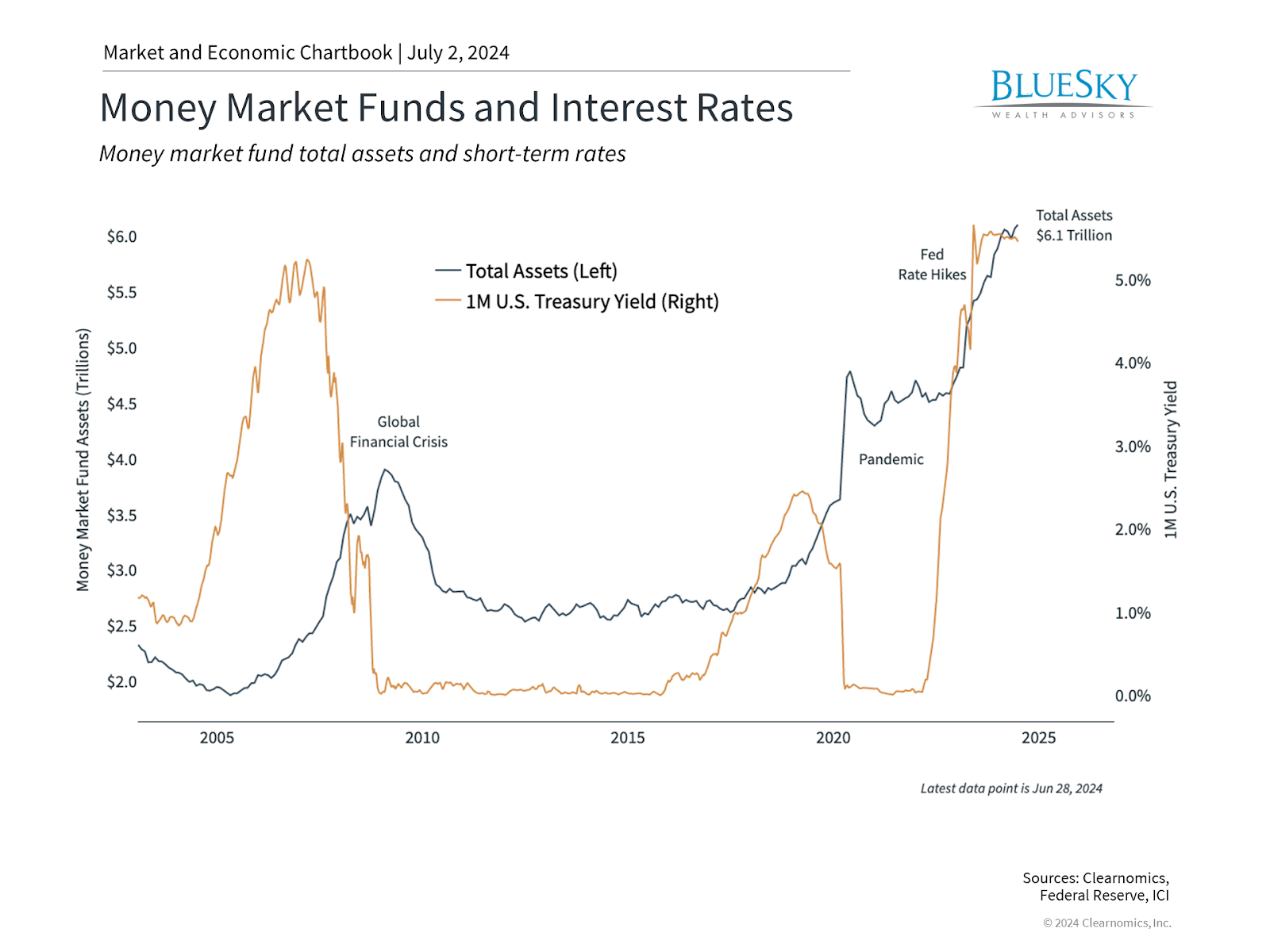
These dynamics have led many investors to hold more cash than in the past. Money market funds, for instance, have attracted inflows with total assets reaching new all-time highs of $6 trillion. This is more than double the assets held in money market funds prior to the pandemic when interest rates were near zero for the better part of a decade. As the accompanying chart shows, money market fund assets have typically grown in times of economic distress or when interest rates have been high.
Cash is an essential part of any financial and investment plan. From a financial planning perspective, cash provides the liquidity needed to cover expenses and important life events. The down payment on an upcoming home purchase, for instance, should primarily be held in cash-like instruments. Similarly, it’s important to have enough cash to serve as an emergency fund in case of unexpected personal events such as injury or illness or broader events such as an economic downturn. From an investment standpoint, cash can also serve important roles including reducing overall portfolio risk and by allowing investors to take advantage of attractive market prices.
Inflation erodes the value of cash
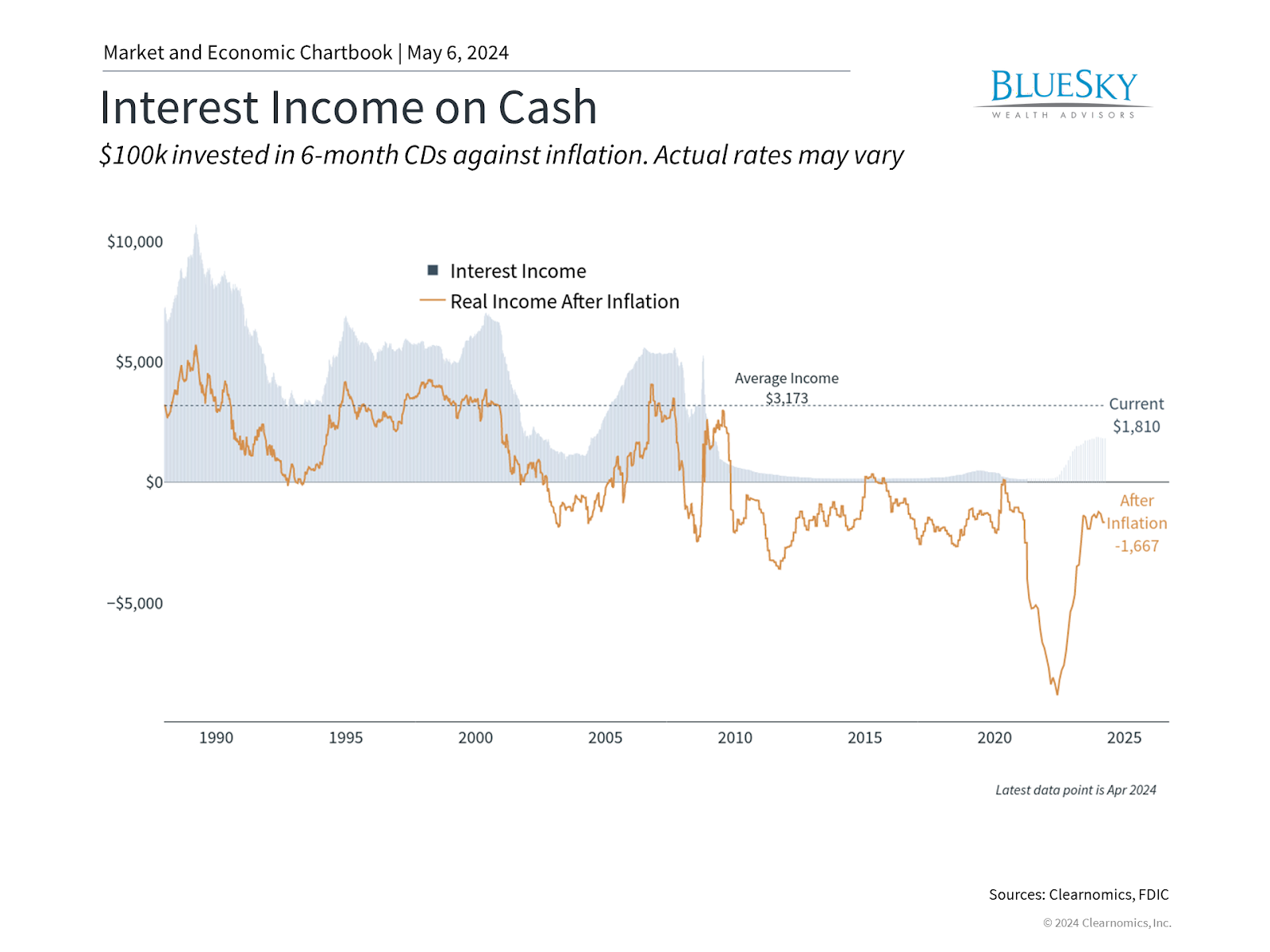
While cash is important, it can become problematic when investors hold too much cash. This is because cash is not truly risk-free for two important reasons. First, inflation quietly erodes the purchasing power of cash over time. So even if yields appear to be high, the real value of your money could decline. As the accompanying chart shows, the inflation-adjusted income on cash has consistently been negative when considering average certificate of deposit rates.
While there are many cash instruments that could generate more yield than these averages, the problem is that these rates are not “locked in.” By definition, short-term rates need to be rolled over often as instruments mature and expire, introducing what is known as “reinvestment risk,” or the idea that future rates may not be as attractive. Even in the best case scenario, investors need to actively manage these instruments to ensure that they are still receiving the level of rates they expect.
The second challenge with holding excess cash is the opportunity cost of not investing in stocks or bonds. Just as interest rates have risen for cash, yields have also jumped across many types of bonds. The average yield on U.S. investment grade corporate bonds, for instance, is now 5.5% – far more attractive than the average of 3.7% since 2009. Unlike cash, these yields are longer-term in nature and these bonds could experience price appreciation if rates do decline.
Similarly, the stock market has performed extremely well despite many investor concerns over the past few years. The S&P 500 is still up 8% with dividends and has gained about 47% since the market bottom in 2022. While the past is no guarantee of the future, these returns have far outpaced inflation and would have helped to offset the erosion of purchasing power across a portfolio.
Stocks and bonds have outpaced inflation over history
The prospects for cash will only worsen if the Fed does begin to cut rates later this year. Investors would be forced to reinvest their cash either at lower interest rates or in stocks and bonds whose prices would most likely have already risen. The possibility of falling rates has been an important driver of the overall stock market that will likely continue.
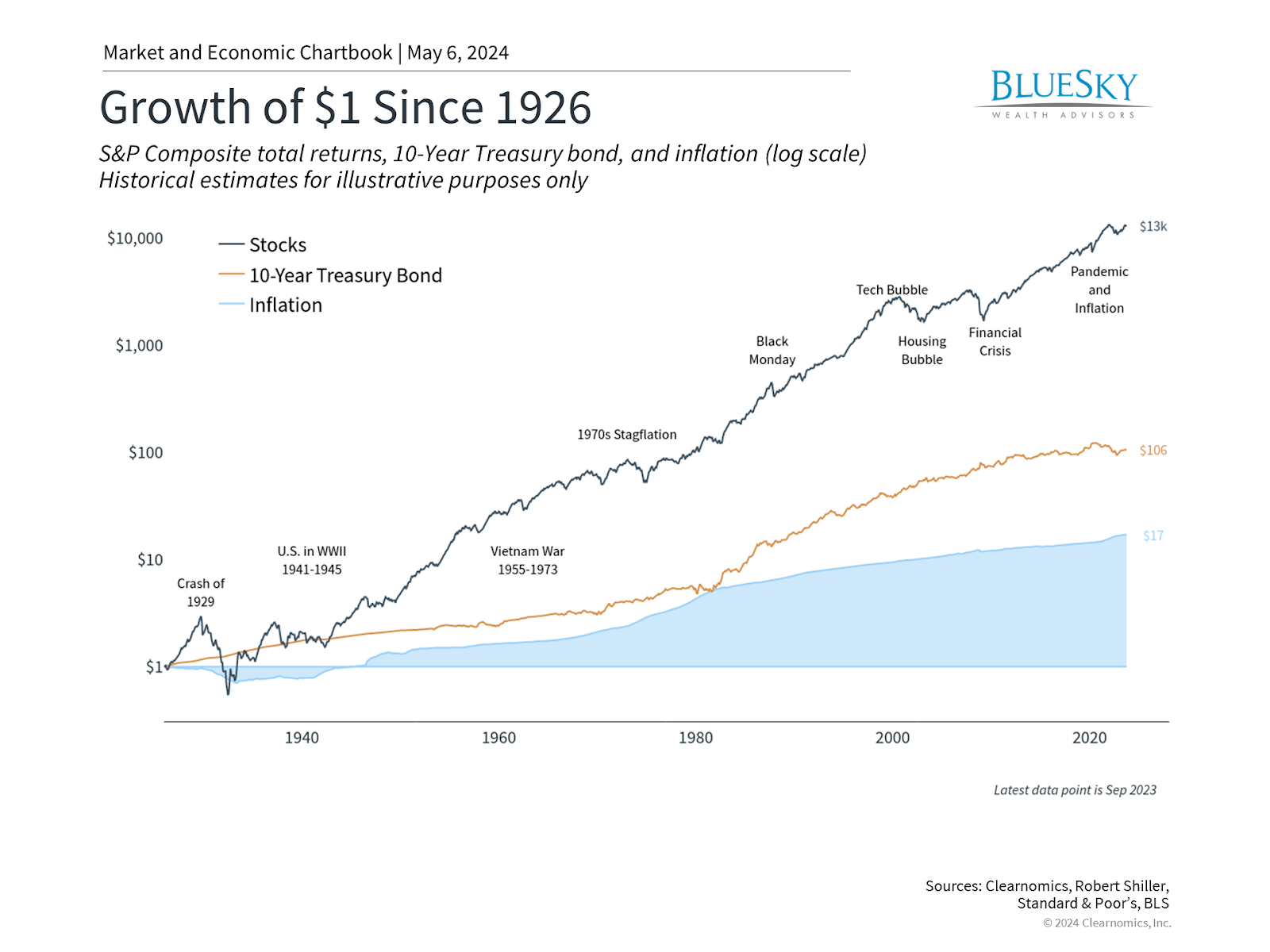
The accompanying chart makes this opportunity cost clear. Due to inflation, what cost one dollar in 1926 now costs $17. However, the stock market has significantly outpaced inflation over long periods of time. A hypothetical one dollar investment in the stock market in 1926 would be worth over $13,000 today. A similar investment in long-term bonds would be worth $106, also outpacing inflation.
Thus, while short-term investments can play important roles in financial plans and portfolios, it’s critical in today’s market environment to avoid holding cash for the wrong reasons. Market fear and high short-term rates have driven significant flows into cash and cash-like instruments. While these may make sense for short periods, history shows that they are not the foundation of long-term financial success.
The bottom line? Investors should review their cash holdings as the stock market continues to rally and the Fed prepares to cut rates. In the long run, holding a proper allocation of stocks and bonds is still the best way to achieve financial goals.
Copyright (c) 2024 Clearnomics, Inc. All rights reserved. The information contained herein has been obtained from sources believed to be reliable, but is not necessarily complete and its accuracy cannot be guaranteed. No representation or warranty, express or implied, is made as to the fairness, accuracy, completeness, or correctness of the information and opinions contained herein. The views and the other information provided are subject to change without notice. All reports posted on or via www.clearnomics.com or any affiliated websites, applications, or services are issued without regard to the specific investment objectives, financial situation, or particular needs of any specific recipient and are not to be construed as a solicitation or an offer to buy or sell any securities or related financial instruments. Past performance is not necessarily a guide to future results. Company fundamentals and earnings may be mentioned occasionally, but should not be construed as a recommendation to buy, sell, or hold the company’s stock. Predictions, forecasts, and estimates for any and all markets should not be construed as recommendations to buy, sell, or hold any security–including mutual funds, futures contracts, and exchange traded funds, or any similar instruments. The text, images, and other materials contained or displayed in this report are proprietary to Clearnomics, Inc. and constitute valuable intellectual property. All unauthorized reproduction or other use of material from Clearnomics, Inc. shall be deemed willful infringement(s) of this copyright and other proprietary and intellectual property rights, including but not limited to, rights of privacy. Clearnomics, Inc. expressly reserves all rights in connection with its intellectual property, including without limitation the right to block the transfer of its products and services and/or to track usage thereof, through electronic tracking technology, and all other lawful means, now known or hereafter devised. Clearnomics, Inc. reserves the right, without further notice, to pursue to the fullest extent allowed by the law any and all criminal and civil remedies for the violation of its rights.
For many households, college decisions are a cause for celebration. However, college also represents one of the largest expenses and sources of financial stress in our lives, on par with retirement or buying a home. These feelings are only worsened by the current market environment as investors adjust to high interest rates and a less certain path of Fed rate cuts, more stubborn inflation, and stock market volatility. Naturally, these financial concerns can raise questions around college planning and decisions. What long-term perspectives should investors and their families consider as they make these important financial and life decisions?
College costs have outpaced inflation
It’s well known that the cost of college has risen far faster than inflation over the past 40 years. The accompanying chart shows the average level of tuition and fees after adjusting for inflation – i.e., increases shown on the chart are above and beyond inflation – according to the National Center for Education Statistics. For example, the average cost of tuition and fees alone for the 2022-2023 school year was $35,248 for private four-year institutions and $9,750 for public universities.
Tuition figures can vary greatly depending on the institution. Students and their families can also expect other expenses beyond tuition and fees such as the cost of room and board which average over $13,000 a year. At the most expensive colleges, the total cost of attendance can be around $85,000 per year for a total four-year cost of $340,000 or more. The cost of two-year colleges has not risen as much but has still outpaced inflation. These ever-rising costs are one reason many have grown disenchanted with higher education.
Higher education is still valuable
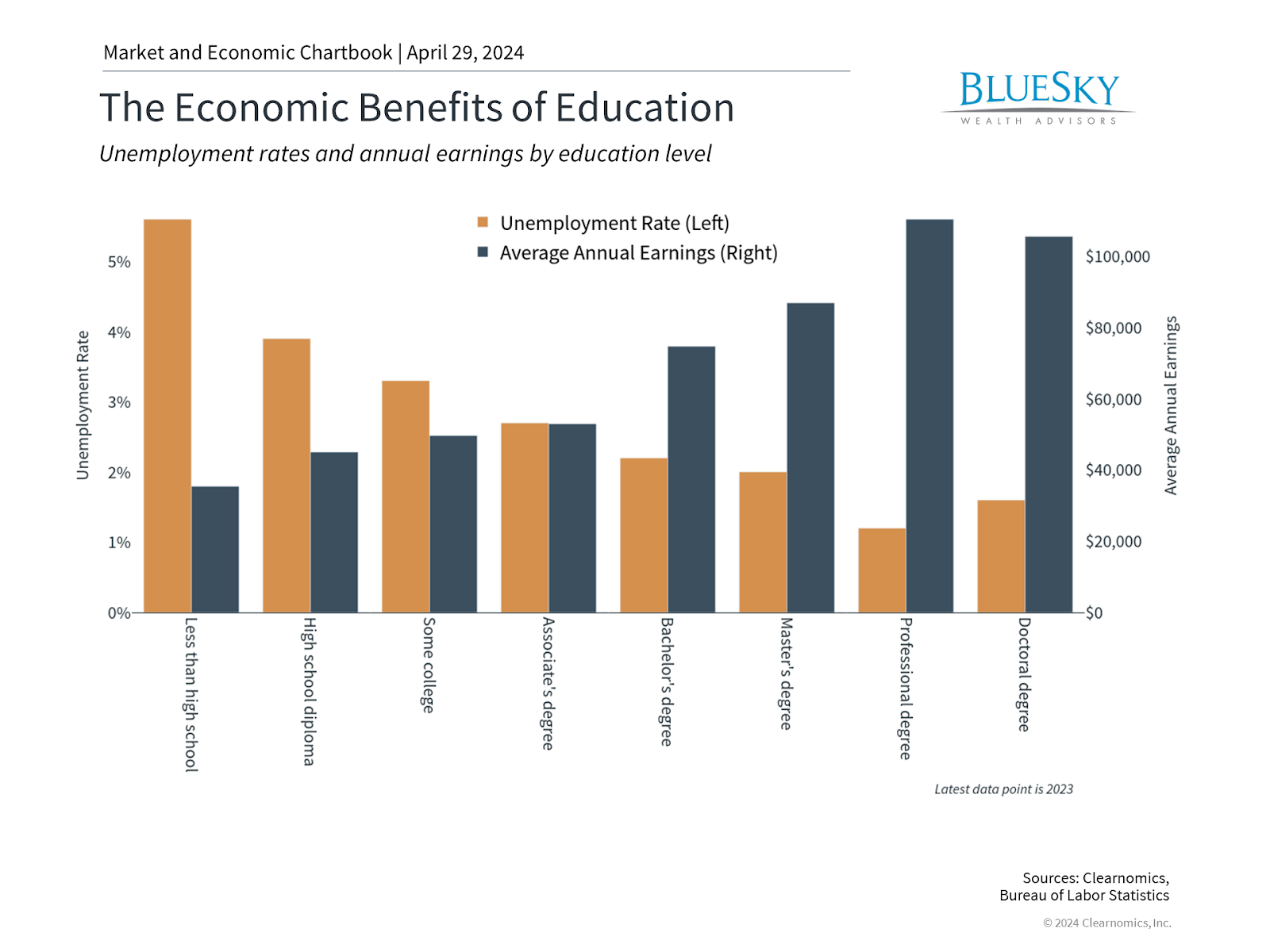
Despite rising costs, there is clear evidence that, on average, college graduates earn more and are more likely to be employed than those with lower levels of education. The accompanying chart shows that, according to the Bureau of Labor Statistics, the unemployment rate for those with a college degree was just 2.2% in 2023 compared with 3.9% for those with a high school diploma alone. The median annual earnings of college graduates was $74,650, significantly higher than the $44,950 median for those with a high school diploma alone.
This pattern continues for increasing levels of education including master’s, professional, and doctoral degrees. These figures are the primary reason college is still seen by many as the best path to financial success. Of course, these statistics only show overall trends and do not consider individual circumstances, including opportunity costs and the choice of college major.
For example, economic theory would suggest that current low unemployment rates and wage gains may make the opportunity cost of spending four years in college less attractive when compared to gaining work experience, on-the-job training, two-year colleges or trade schools. This calculus is reversed during economic downturns when the opportunity costs are lower, thus driving up the application and attendance rates of college and professional degree programs such as business school, medical school and law school.
Another long-term concern among investors and economists is the aggregate level of student loan debt across the country, which now exceeds $1.6 trillion according to the NY Fed’s Consumer Credit Panel. This has become a hot button issue across the country and in Washington. The White House, for instance, has announced a new plan to forgive student loan debt for 30 million Americans, with $146 billion in debt relief approved through executive actions so far. Given the size and scope of this challenge, the topic of higher education and student loans will likely continue to be a divisive political issue.
Earnings vary greatly by college major
When it comes to student loans and individuals, the ability to repay these debts varies greatly by college major. The accompanying chart shows the average level of earnings for those with a bachelor’s degree only. It may come as no surprise that science, engineering and business degrees have generally resulted in the highest annual earnings, compared to degrees in arts, education and humanities fields. These figures are averages across all professionals, not just new graduates, and thus capture the long run earnings potential of each major.
For example, the median salary for a graduate who studied social work is under $50,000 while the average graduate who studied electrical engineering makes over $100,000. Thus, college major and post-graduate employment opportunities are important to consider when deciding whether to borrow money for college. Choosing to pursue a field of study that has high earnings potential across one’s career can help to mitigate the burden of financing a degree with student loan debt.
That said, financial considerations are important, but they are not the only factor when considering higher education. Pursuing one’s interests and achieving personal fulfillment are arguably just as important, even if they are harder to measure and quantify.
The bottom line? While the cost of college has risen dramatically in recent decades, there are still many financial benefits to higher education. Whether to attend college, what type of program, and which major are all personal considerations that need to be considered carefully.
Copyright (c) 2024 Clearnomics, Inc. All rights reserved. The information contained herein has been obtained from sources believed to be reliable, but is not necessarily complete and its accuracy cannot be guaranteed. No representation or warranty, express or implied, is made as to the fairness, accuracy, completeness, or correctness of the information and opinions contained herein. The views and the other information provided are subject to change without notice. All reports posted on or via www.clearnomics.com or any affiliated websites, applications, or services are issued without regard to the specific investment objectives, financial situation, or particular needs of any specific recipient and are not to be construed as a solicitation or an offer to buy or sell any securities or related financial instruments. Past performance is not necessarily a guide to future results. Company fundamentals and earnings may be mentioned occasionally, but should not be construed as a recommendation to buy, sell, or hold the company’s stock. Predictions, forecasts, and estimates for any and all markets should not be construed as recommendations to buy, sell, or hold any security–including mutual funds, futures contracts, and exchange traded funds, or any similar instruments. The text, images, and other materials contained or displayed in this report are proprietary to Clearnomics, Inc. and constitute valuable intellectual property. All unauthorized reproduction or other use of material from Clearnomics, Inc. shall be deemed willful infringement(s) of this copyright and other proprietary and intellectual property rights, including but not limited to, rights of privacy. Clearnomics, Inc. expressly reserves all rights in connection with its intellectual property, including without limitation the right to block the transfer of its products and services and/or to track usage thereof, through electronic tracking technology, and all other lawful means, now known or hereafter devised. Clearnomics, Inc. reserves the right, without further notice, to pursue to the fullest extent allowed by the law any and all criminal and civil remedies for the violation of its rights.
BlueSky Wealth Advisors is pleased to announce that the American Institute of CPAs (AICPA) has awarded Senior Wealth Advisor Tara Hughes CPA/PFS, CGMA, with her Personal Financial Specialist (PFS) Credential.
We are beyond proud of Tara for obtaining her Personal Financial Specialist (PFS) Credential. The PFS is a certificate held for Certified Public Accountants (CPAs), allowing them to grow their expertise to include financial planning and wealth management. AICPA states the PFS certification represents “a powerful combination of extensive tax expertise and comprehensive knowledge of financial planning” as PFS designees must be experts in estate planning, retirement planning, investing, insurance, and other personal financial planning areas. A PFS is an expert in the financial planning industry and has a wealth of tax and corporate finance knowledge as a CPA. The PFS designation requires extensive experience and successfully passing rigorous testing. The clients of BlueSky Wealth Advisors benefit tremendously from Tara’s hard work and dedication. We are fortunate to have her on the BlueSky team!
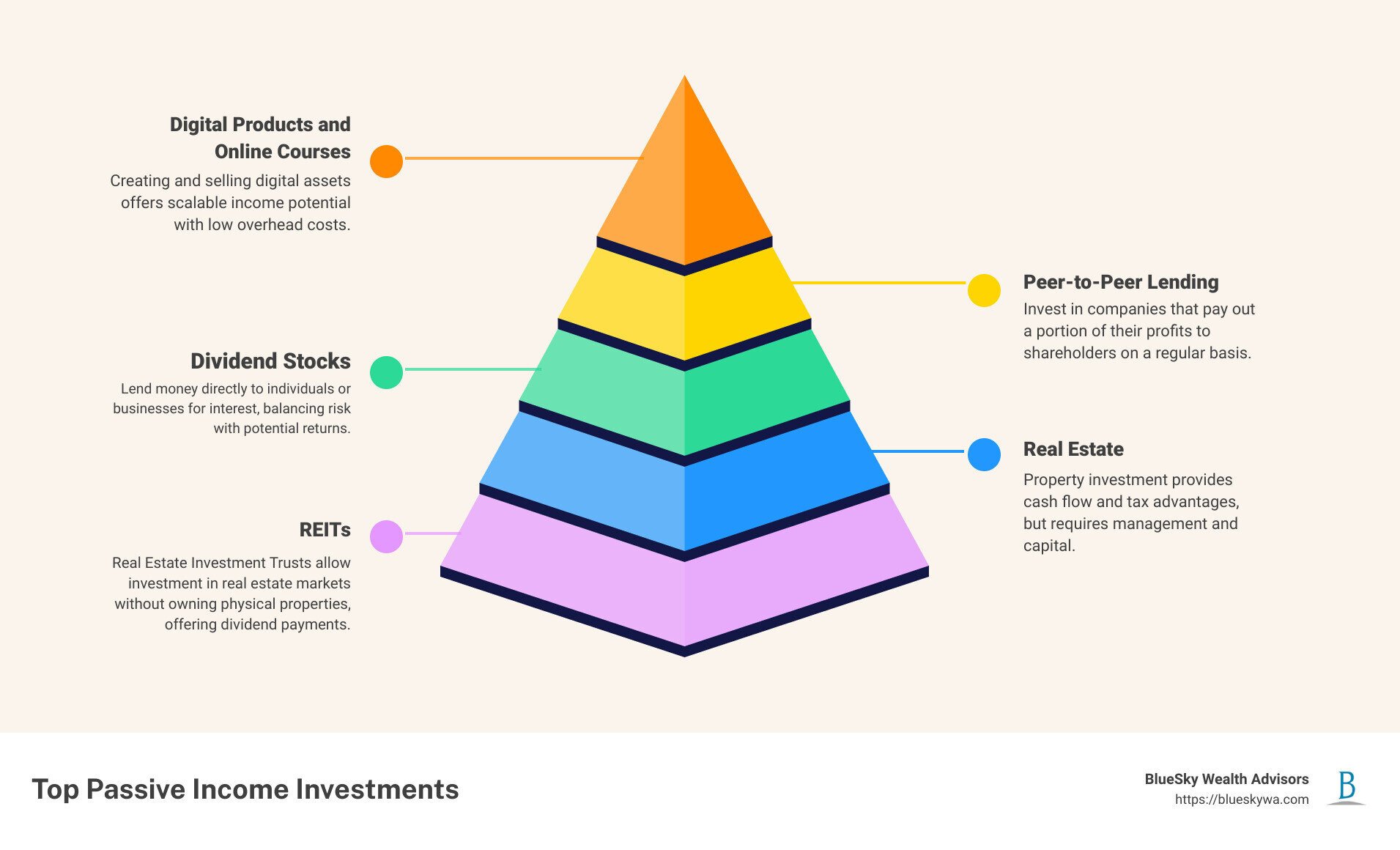
When it comes to exploring passive income investments for building wealth, the key is finding options that align with your financial goals and lifestyle. Passive income investments can provide a steady stream of income without the daily grind, offering a way to secure financial independence and establish a meaningful legacy.
Real Estate: Whether it’s rental properties or REITs, real estate offers potential for significant returns.
Dividend Stocks: Investing in companies that pay out dividends regularly.
Peer-to-Peer Lending: Acting as a bank, lending money to individuals or businesses in exchange for interest payments.
Digital Products and Online Courses: Creating and selling digital goods or educational courses online.
For the financially comfortable individual seeking to optimize their tax situation and secure financial independence through passive income, these options represent just the tip of the iceberg. By diversifying your portfolio across different assets, you can create a resilient income stream that contributes to a stable and prosperous financial future.
Starting your journey towards building wealth through passive income investments requires careful consideration and planning. Selecting the right mix of investments tailored to your financial situation and goals can provide long-term security and the freedom to live life on your terms.
Understanding Passive Income Investments
When we talk about passive income investments, we’re referring to ways you can make money with little to ongoing effort. It’s about setting up a source of income that continues to pay you even when you’re not actively working on it.
Definition
Imagine planting a tree. Initially, you dig the hole, plant the tree, and water it. But once it’s mature, you can enjoy its shade and fruits without much daily effort. Passive income investments work similarly. You might need to do some upfront work or investment, but over time, these investments generate income without daily grind.
Benefits
Steady Income Stream: Passive income can provide a regular income stream, supplementing your main income or even becoming your primary source of money in the long run.
Financial Security: Having multiple sources of income can provide a safety net, reducing financial stress if one income stream dries up.
Time Freedom: With passive income, you can potentially reduce the hours you need to work, giving you more time for hobbies, family, or travel.
Compounding Growth: Many passive income investments, like dividend stocks or real estate, can grow in value over time, compounding your earnings.
Passive vs. Active Income
Active Income: This is money earned from a job or business where you’re actively working. Think of it as trading time for money. If you stop working, the money stops too.
Passive Income: Unlike active income, passive income doesn’t require your constant time or effort. It’s about creating or investing in a system that generates income for you.
Making the Choice
Choosing between active and passive income often depends on your current financial situation, future goals, and how much time you’re willing to invest upfront. While passive income can offer more freedom and potentially unlimited earnings, it usually requires significant initial effort, time, or money.
For those looking to build wealth, a combination of both active and passive income may be the best strategy. Active income can provide immediate financial support, while passive income investments build a foundation for long-term financial security and independence.
The key to successful passive income is diversification. Don’t put all your eggs in one basket. Explore different avenues like real estate, dividend stocks, or peer-to-peer lending to find what works best for you. With careful planning and a bit of patience, you can create a resilient income stream that contributes to a stable and prosperous financial future.
In the next section, we’ll dive into some of the top passive income investments to consider, helping you make informed decisions on where to put your money to work for you.
Top Passive Income Investments to Consider
Building wealth through passive income investments is a smart strategy for those looking to grow their finances with minimal ongoing effort. Let’s explore some of the best options available.
Dividend Stocks
Investing in dividend stocks is akin to receiving a paycheck for owning a piece of a company. Dividend Aristocrats, companies that have increased their dividend payouts for 25 consecutive years or more, are particularly attractive for their stability and reliability. However, it’s important to understand the tax treatment of dividends, as qualified dividends are taxed at a lower rate than ordinary income. Look for stocks that offer quarterly payouts to ensure a regular income stream.
Real Estate
Real estate investments can provide cash flow through rental income and potential tax advantages. Whether you’re hands-on or prefer a more passive role through property management companies, real estate can offer substantial returns. Platforms like Realty Mogul allow investors to get into the real estate market with less capital, making it more accessible.
Index Funds
For those seeking a hands-off investment approach, index funds tracking major indices like the S&P 500 offer low fees and the potential for long-term growth. These funds are designed to mirror the performance of the index, providing a diversified investment with minimal effort required from the investor.
Bonds and Bond Funds
Bonds offer interest payments and a level of stability that can be appealing during volatile market periods. The maturity date of bonds and the high-yield options available can cater to different investment horizons and risk tolerances. Bond funds can further diversify your holdings, spreading out risk across various issuers.
High-Yield Savings Accounts and CDs
For a risk-free option, high-yield savings accounts and certificates of deposit (CDs) at online banks offer better interest rates than traditional banks. These accounts are FDIC-insured, making them a safe place to park your cash. CIT Bank CD is an example where you can lock in a higher rate for a set period.
Peer-to-Peer Lending
Peer-to-peer lending platforms allow you to lend money directly to individuals or businesses, with the potential for higher returns than traditional savings accounts. This investment carries its own set of risks and returns, and diversification is key to mitigating potential losses. Proper borrower vetting processes are crucial.
Real Estate Investment Trusts (REITs)
REITs offer a way to invest in real estate without owning physical property. These trusts own and manage income-producing real estate and pay out dividends to investors. Diversified portfolios and regular dividend checks make REITs an attractive option for passive income. Platforms like Masterworks and YieldStreet provide unique opportunities to invest in real estate and other assets.
Each of these passive income investments comes with its own set of benefits and considerations. Whether you’re drawn to the stability of bonds and CDs, the growth potential of dividend stocks and index funds, or the tangible assets offered by real estate and REITs, there’s an option to fit your financial goals and risk tolerance. Diversification across these vehicles can enhance your portfolio’s resilience and potential for growth, setting you on a path toward financial freedom.
Innovative Passive Income Streams
In building wealth, it’s smart to look beyond traditional investments. Let’s explore some creative ways to make your money work for you while you sleep, focus on your passions, or even travel the world.
Selling Designs or Art Online
Etsy and Squarespace are two platforms that can turn your creativity into cash. If you’re an artist or designer, consider selling your artwork or designs online. It’s a straightforward way to earn money from digital products you create once and sell many times.
Etsy is perfect for handmade goods, art, and unique designs. It connects you with buyers looking for something special.
Squarespace, on the other hand, lets you build a professional website to showcase and sell your art or designs, offering more control over how you present your work.
And if you’re interested in flipping websites, Flippa is a marketplace for buying and selling online businesses, including e-commerce stores and blogs. It’s a more advanced option, but it can be lucrative if you know what you’re doing.
Affiliate Marketing
Affiliate marketing is a fantastic way to make money by promoting products you love. You share a product link on your blog, social media, or website. When someone makes a purchase through your link, you earn a commission.
Blogs are a powerful platform for affiliate marketing. Write detailed product reviews or how-to guides and include your affiliate links.
Social Media platforms, especially when you have a large following, can generate significant affiliate income. Tools like HypeAuditor can help you grow and manage your audience.
The key is to promote products that align with your interests and your audience’s needs. This way, you’re providing value, not just advertisements.
E-commerce Store
Starting an e-commerce store can be a deeply rewarding passive income stream. You can sell products directly to customers without holding any inventory through dropshipping. Or, use Amazon FBA (Fulfillment by Amazon) to store your products in Amazon’s fulfillment centers. They handle shipping, customer service, and returns for you.
Dropshipping allows you to sell products from suppliers without ever handling the product yourself. It’s low risk and low overhead but requires a good eye for market trends and strong marketing skills.
Amazon FBA leverages the power of Amazon’s vast customer base and logistical prowess. It’s a bit more hands-on initially but can become passive once you’ve established your product line and supply chain.
If you have expertise in a particular area, creating an online course is a superb way to generate passive income. Platforms like Udemy or Coursera make it easy to reach students worldwide. The beauty of online courses is that you create the content once, and then you can sell it repeatedly.
Choose a topic you’re passionate and knowledgeable about.
Invest time in creating high-quality, engaging content.
Market your course through social media, your blog, or email marketing.
The initial effort can be significant, but the potential for ongoing passive income is substantial.
By exploring these innovative passive income streams, you can diversify your income and build wealth in creative, fulfilling ways. The key to success with passive income is finding the right balance between upfront effort and long-term payoff. Whether you’re selling art online, diving into affiliate marketing, launching an e-commerce store, or teaching through online courses, there’s a world of opportunity waiting for you.
Tax Implications of Passive Income
Understanding the tax implications of your passive income investments is crucial. Taxes can take a big bite out of your earnings if you’re not careful. Let’s simplify this complex topic into four main areas: Ordinary Income, Capital Gains, Deductions, and Qualified Dividends.
Ordinary Income
Most passive income is taxed as ordinary income. This means the money you make from things like rental properties or a job is added together and taxed at your personal tax rate. The more you make, the higher your tax rate could be.
Capital Gains
If you sell an investment like stocks or real estate for more than you paid, you make a capital gain. These gains are usually taxed at a lower rate than ordinary income. There are short-term capital gains (for investments held less than a year) and long-term (for those held more than a year). Long-term gains are taxed at a lower rate, making them more attractive for investors.
Deductions
Here’s some good news: You can often deduct expenses related to earning passive income. For rental properties, this could include mortgage interest, property taxes, and maintenance costs. These deductions can lower your taxable income, meaning you pay less in taxes.
Qualified dividends are paid out from profits of corporations and are taxed at the capital gains rate, which is lower than the ordinary income rate. To qualify, you must hold the stock for a specific period. This makes investing in dividend-paying stocks an attractive option for those looking to minimize their tax bill.
The tax code can be complex, and rules change. It’s always a good idea to consult with a tax professional to understand how these rules apply to your specific situation and to make sure you’re taking advantage of all possible tax benefits.
By considering the tax implications of your passive income streams, you can make more informed decisions that could lead to higher net returns. Keep these tax basics in mind as you build and manage your passive income portfolio.
Next, we’ll dive into some of the most frequently asked questions about passive income investments to help clear up any confusion and set you on the right path.
Frequently Asked Questions about Passive Income Investments
When it comes to building wealth through passive income investments, many people have questions. Let’s address some of the most common queries to help you understand how to navigate this financial landscape effectively.
Can I make passive income with no money?
Yes, it’s possible but challenging. You can leverage your skills or time instead of money. For example, creating digital content like blogs, videos, or online courses can earn income over time. You might not need money upfront, but you will need to invest a significant amount of time and effort. Time is also an investment.
How do I minimize my taxes on passive income?
Minimizing taxes on passive income involves strategic planning:
Understand the tax implications of your investments. For example, dividends and rental income are taxed differently.
Consider retirement accounts like IRAs or 401(k)s for investments, as they can offer tax advantages.
Keep track of expenses that can be deducted, such as maintenance costs for rental properties or home office expenses for online business activities.
Consult a tax professional who can provide personalized advice and strategies for your situation.
It’s about being smart with your investments and taking advantage of legal avenues to reduce your taxable income.
What’s the best passive income to invest in?
The “best” passive income investment depends on your personal situation — your financial goals, risk tolerance, and the amount of time or money you can invest. Here are a few options considered generally beneficial:
Dividend Stocks: For those looking for regular income and have some risk tolerance.
Real Estate: Offers potential for both income through rent and capital appreciation, but requires more capital and management.
Index Funds: Suitable for those seeking long-term growth with lower risk compared to individual stocks.
REITs: Allow investment in real estate without the need to directly manage properties, offering a blend of income and growth.
The key is to diversify your investments to spread risk and potential for reward. Start with what you understand and can manage, then explore other options as you grow your portfolio.
In summary, passive income investments can be a powerful tool for building wealth, but they require careful consideration and management. By starting small, staying informed, and seeking advice when needed, you can navigate passive income and work towards financial independence. There’s no one-size-fits-all answer, but with the right approach, you can find the passive income streams that work best for you.
Conclusion
Building wealth through passive income investments is akin to planting a garden. It begins with understanding the soil (the market), choosing the right seeds (investments), and nurturing them over time. Just as a well-tended garden offers a variety of fruits and vegetables, a diversified investment portfolio can provide a steady stream of income and financial security.
Diversification is our guiding principle at BlueSky Wealth Advisors. It’s about spreading your investments across various assets to minimize risk and maximize potential returns. Think of it as not putting all your eggs in one basket. Whether it’s dividend stocks, real estate, index funds, bonds, or REITs, each plays a unique role in your financial garden, contributing to its overall health and growth.
A Long-term Strategy is crucial when considering passive income investments. Wealth building is a marathon, not a sprint. It requires patience, persistence, and a clear vision of your financial goals. By focusing on long-term growth and compounding returns, you’re more likely to achieve financial independence and security.
At BlueSky Wealth Advisors, we’re committed to guiding you through this journey. Our approach is rooted in understanding your individual needs, goals, and risk tolerance. We believe in a globally-diversified passive mix of assets, keeping portfolio expenses low, and employing tax efficiency strategies to maximize your returns while minimizing risks. Let us help you build a financial foundation that not only meets your needs today but also secures your legacy for tomorrow.
For more insights and guidance on how to find passive income investments and to learn more about our services, we invite you to explore our website. Together, we can cultivate a flourishing financial future.
Building wealth is a journey that requires a solid plan, diversified investments, and a long-term perspective. At BlueSky Wealth Advisors, we’re here to help you every step of the way.
Investing for income is a strategic approach to building your financial portfolio in a way that generates a steady stream of cash. This method is perfect if you’re looking to secure financial independence, optimize your tax situation, and ensure a lasting legacy without having to delve into the nitty-gritty of financial management.
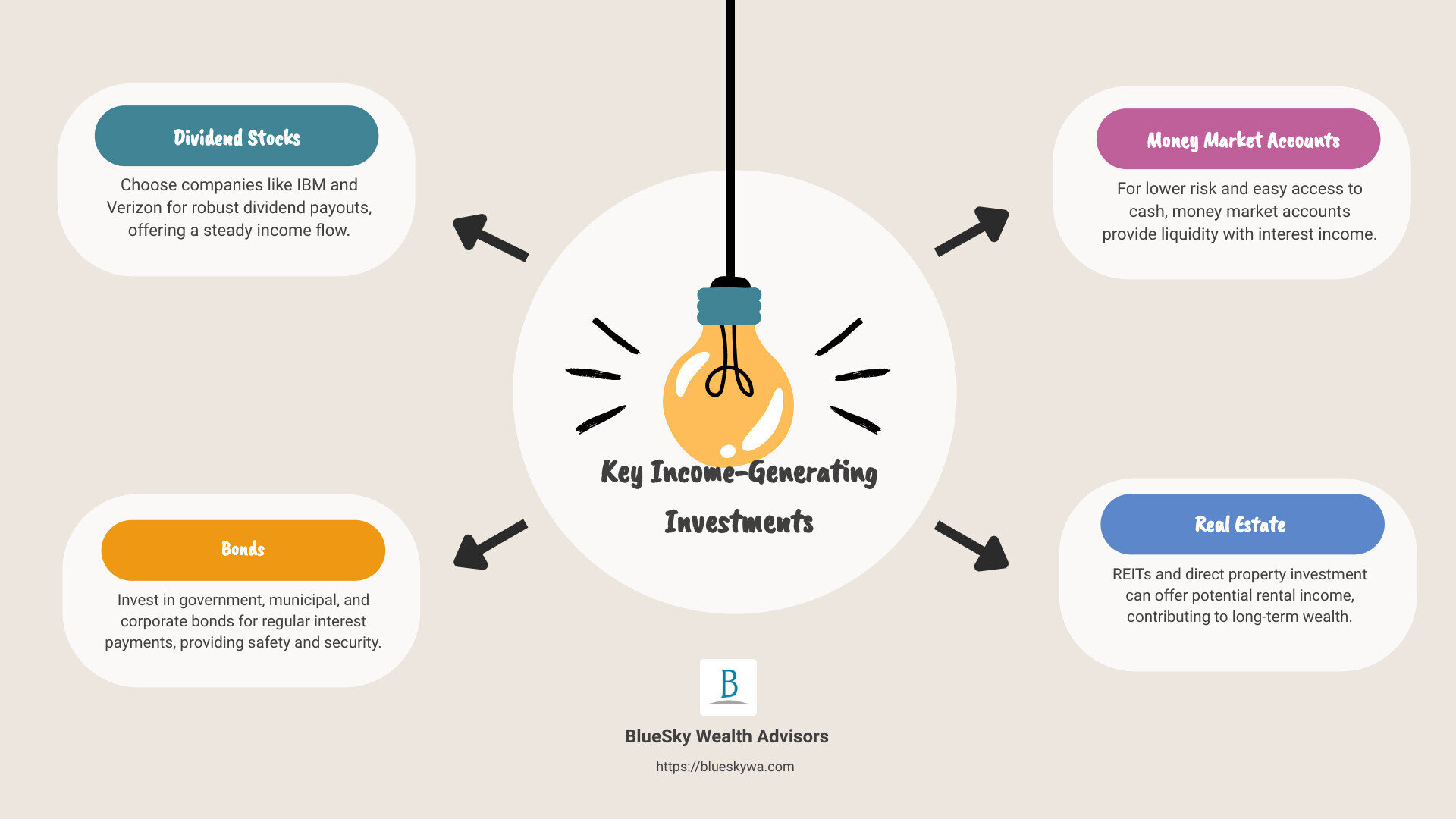
Here’s a quick overview: – Focus on Dividend Stocks: Choose companies known for their robust dividend payouts. – Invest in Bonds: Government, municipal, and corporate bonds offer regular interest payments. – Explore Money Market Accounts: For lower risk and easy access to your cash. – Consider Real Estate: Through REITs or direct property investment for potential rental income.
Investing for income aligns well with a variety of financial goals, from saving for retirement to establishing a fund for future generations. The beauty of this strategy lies in its ability to provide both security and growth potential.
In short, income investing is a powerful tool for anyone looking to enhance their financial well-being, offering a path to achieve financial goals through a steady stream of passive income.
Understanding Income Investing
Income investing is a strategy focused on generating a steady stream of income from your investments. This income usually comes from dividends, interest payments, or rental income. It’s like planting a garden where the plants regularly produce fruits or vegetables you can harvest without having to replant each season.
Passive Income: The Key to Financial Freedom
Passive income is money you earn without actively working for it at the moment of receiving it. Imagine owning a machine that makes money while you sleep, spend time with family, or enjoy hobbies. That’s what passive income does. It provides financial support without requiring daily effort, creating opportunities for financial freedom and stability.
Cash Flow: The Lifeblood of Income Investing
Cash flow is the amount of money moving in and out of your pocket. In income investing, we aim to increase the money coming in without significantly increasing the money going out. Positive cash flow means you’re earning more from your investments than what you’re spending to maintain them. It’s crucial for managing living expenses, especially during retirement, or for reinvesting to grow your wealth further.
Why Income Investing?
Stability: Regular income streams can offer financial stability in uncertain markets.
Growth Potential: Reinvesting the income can lead to compound growth over time.
Flexibility: You can adjust your portfolio based on changing financial needs and goals.
How to Get Started
Dividend Stocks: Companies like IBM and Verizon Communications offer dividends, which are shares of their profit paid to shareholders. These can provide a regular income.
Bonds: Lending money to governments or corporations through bonds can earn you interest payments.
Real Estate: Investments in REITs or rental properties can generate rental income.
Challenges and Considerations
While attractive, income investing requires careful planning and consideration of risks like interest rate changes, market volatility, and the financial health of dividend-paying companies. Diversification, or spreading your investments across different assets, can help manage these risks.
In Summary
Income investing is about building a portfolio that brings in regular income. It’s a way to achieve financial stability and growth, offering a path to financial independence. With the right strategy, you can enjoy the fruits of your investments without constant hands-on effort. Whether you’re planning for retirement or looking to supplement your current income, understanding the principles of income investing is a crucial first step.
Types of Income-Generating Investments
Investing for income is like planting a garden. You want a variety of plants that will bloom at different times, so you have a steady supply of fruits and vegetables. Similarly, a diverse investment portfolio can provide you with a consistent income stream. Let’s dig into the types of investments that can help you achieve this.
Dividend Stocks
Think of dividend stocks as the perennial plants in your garden. They provide you with regular “harvests” in the form of dividends. Companies like IBM, Exxon Mobil, Verizon Communications, AT&T, and Walgreens Boots Alliance are known for their consistent dividend payouts. The SPDR® S&P 500 ETF Trust is another option, offering exposure to the broader market’s dividends.
When picking dividend stocks, look for companies with a history of stable and increasing dividends. This indicates financial health and a commitment to returning value to shareholders.
Bonds
Bonds are the garden beds of your investment garden, providing structure and stability. They come in various types, including government bonds, municipal bonds, corporate bonds, as well as ETFs and bond funds. Bonds are essentially loans you give to the issuer in exchange for regular interest payments, making them a cornerstone of income investing.
Government and municipal bonds are generally considered safer but offer lower returns. Corporate bonds can yield more but carry a higher risk. Diversifying across different types of bonds can help balance risk and reward.
Money Market Accounts
Money market accounts are like the watering system for your garden, providing liquidity and stability. They offer higher interest rates than traditional savings accounts, making them a safe place to park your cash. The interest rates, liquidity, and low risk associated with money market accounts make them an essential part of an income-focused portfolio.
Real Estate
Investing in real estate is akin to having a greenhouse. It requires more upfront work and maintenance but can yield substantial rewards. REITs (Real Estate Investment Trusts) and Real Estate Limited Partnerships (RELPs) allow investors to earn rental income without having to buy property directly. These investments can provide both regular income and the potential for capital appreciation.
REITs, in particular, are required to distribute at least 90% of their taxable income to shareholders, often resulting in higher dividend yields. Investing in real estate through these vehicles offers a way to diversify your income streams further.
Just as a well-tended garden offers a variety of produce throughout the season, a well-constructed portfolio can provide a steady income stream over time. By incorporating dividend stocks, bonds, money market accounts, and real estate into your investment strategy, you can build a diversified portfolio tailored to your financial goals and risk tolerance. The key to successful income investing is not just in choosing the right assets, but in how you combine them to work together harmoniously.
Pros and Cons of Income Investing
When it comes to investing for income, it’s like picking a path through a forest. Some trails might be smooth and easy, offering a peaceful walk with little to no obstacles. Others might be rocky, requiring careful steps and a keen eye to avoid stumbling. Let’s explore the ups and downs of this journey.
Supplemental Income
The beauty of income investing is that it can act like a river, steadily flowing cash into your pocket. Imagine having a small stream in your backyard that you could dip into whenever you needed a bit of extra money. That’s what income investing can offer. It’s a way to build a financial reservoir to draw from, whether for daily expenses, saving up for a vacation, or padding your retirement fund.
Capital Stock Growth
Not only does income investing offer the chance of regular cash flow, but there’s also the potential for your investments to grow in value over time. Think of it as planting a tree. Initially, you enjoy the shade, but as it grows, it adds more value to your property. Similarly, stocks or real estate investments might increase in value, providing you with a nice profit if you decide to sell down the line.
Income Fluctuation
However, not every day is sunny in income investing. Just like weather patterns, income from investments can fluctuate. Dividend payments from stocks can vary based on company profits, and interest rates on bonds can change, affecting what you earn. It’s like relying on a stream that might run bountifully in the rainy season but dries up a bit in the drought. This unpredictability is something to be prepared for.
Investment Risks
Here’s where the path gets a bit rocky. Every investment carries some level of risk. The stock market can be as unpredictable as a sudden storm, and real estate markets have their ups and downs too. Investing in a single company or property can be like putting all your eggs in one basket and hoping it doesn’t fall. That’s why it’s crucial to wear a sturdy pair of boots — in the investment world, this means diversifying your portfolio to spread out the risk.
In Summary
Income investing offers a world of opportunities to generate a steady stream of cash, which can act as a supplementary source of income or even lead to capital growth. However, it’s not without its challenges, such as income fluctuation and the inherent risks associated with any investment. By carefully navigating these paths, with an eye on both the sunny days and potential storms, you can work towards building a portfolio that not only sustains but also grows over time.
Next, we’ll delve into strategies for successful income investing, focusing on how to create a balanced portfolio that aligns with your financial goals and risk tolerance. Stay tuned as we continue to explore the forest of investment opportunities together.
Strategies for Successful Income Investing
Investing for income is like planning a journey where the destination is financial stability and peace of mind. To navigate this path successfully, understanding and applying certain strategies are crucial. Let’s break these down into manageable steps.
Creating a Balanced Portfolio
A balanced portfolio is your financial safety net. It’s about not putting all your eggs in one basket, but rather spreading them across several baskets to minimize risk. Here’s how you can do it:
Diversify Across Asset Classes: Mix different types of investments like stocks, bonds, and real estate. Each behaves differently over time, balancing out the ups and downs in your portfolio.
Equity and Bonds: Include a mix of equity (for growth potential) and bonds (for income). Investment-grade bonds offer lower risk, while high-yield bonds can offer higher income but come with increased risk.
Consider Your Risk Tolerance: Not everyone can handle the same level of risk. Your mix should reflect how much volatility you can stomach. Can you sleep at night if your investments dip 10% in a week?
Investment Horizon Matters: Your time frame affects your strategy. If you’re investing for income in retirement, you might lean more towards bonds. If you’re younger, you might take on more equities for growth.
Regular Reviews and Adjustments: The market changes, and so will your life circumstances. Regularly reviewing and adjusting your portfolio ensures it stays aligned with your goals.
Utilizing Financial Tools and Platforms
Several tools and platforms can help you manage your income investing strategy more effectively. Here are a few worth considering:
TradeStation: A platform for those who want to take a hands-on approach to manage their investments. It offers robust analysis tools to help you make informed decisions.
WiserAdvisor: If you prefer a guided approach, WiserAdvisor matches you with financial advisors tailored to your needs, helping you craft a personalized income investing strategy.
Realty Mogul: Interested in real estate? Realty Mogul offers a way to invest in high-quality real estate projects without needing to buy a whole property yourself.
M1 Finance: For those who like customization and automation, M1 Finance allows you to build a portfolio of stocks and ETFs and automatically maintains the balance for you.
J.P. Morgan Self-Directed Investing: A great option for those who want to manage their investments directly, with the backing of a trusted financial institution.
By combining a thoughtful, balanced portfolio approach with the right tools and platforms, you’re setting a strong foundation for your income investing journey. The goal is not just to reach your destination but to enjoy the journey without losing sleep over market swings.
We’ll answer some frequently asked questions about investing for income, helping to clear any clouds of doubt and make your investment journey as smooth as possible.
Frequently Asked Questions about Investing for Income
When it comes to investing for income, many questions arise. Let’s dive into some of the most common queries to help you navigate your investment journey more confidently.
What is the best type of investment for steady income?
The best type of investment for a steady income often includes dividend stocks, bonds, money market accounts, and real estate investments. Each of these options has its own set of benefits:
Dividend Stocks: Companies like IBM and Verizon Communications offer dividends, which are regular payments made to shareholders out of the company’s profits. These can provide a consistent income stream.
Bonds: Whether it’s government, municipal, or corporate bonds, they pay interest over a fixed period, offering a predictable income.
Money Market Accounts: These accounts offer interest on your deposits and are known for their high liquidity and low risk.
Real Estate: Investing in REITs or rental properties can generate regular rental income, making it a solid choice for steady income.
How can I minimize risks in income investing?
Minimizing risk is crucial in any investment strategy. Here are a few ways to do so:
Diversification: Don’t put all your eggs in one basket. Spread your investments across different types of assets.
Research: Understand what you’re investing in. Look into the company’s or bond’s financial health and the real estate market trends.
Consult a Financial Advisor: Working with professionals like those at BlueSky Wealth Advisors can provide tailored advice based on your financial situation and goals.
Risk Tolerance: Be honest about your risk tolerance. It will help you choose investments that won’t keep you up at night.
What role does diversification play in income investing?
Diversification is key in reducing risk and achieving a more stable income. By investing in a mix of asset types, you can protect yourself against significant losses if one investment underperforms. For example, while dividend stocks offer growth potential, bonds can provide a cushion during market volatility. Real estate and money market accounts add another layer of diversification, each with unique benefits and risks.
The idea is to create a portfolio that can withstand market fluctuations, ensuring a steady income stream without putting your capital at undue risk.
By addressing these frequently asked questions, we hope to have shed light on how to approach investing for income effectively. With a clear understanding and the right strategies, you can work towards building a portfolio that not only meets your income needs but also aligns with your long-term financial goals.
Conclusion
Investing for income is a journey, not a sprint. It’s about finding the right balance between risk and reward, and ensuring your investments align with your long-term financial goals. At BlueSky Wealth Advisors, we understand that each investor’s journey is unique. That’s why we’re committed to providing personalized advice and strategies tailored to your specific situation.
We believe that a well-structured income-generating portfolio can offer you the financial stability and peace of mind you seek. Whether you’re drawn to dividend stocks, bonds, real estate, or a mix of various assets, our team is here to guide you through the complexities of income investing. Our approach is rooted in understanding your needs, assessing your risk tolerance, and crafting a diversified portfolio designed to provide a steady income stream.
The key to successful income investing lies in diversification, informed decision-making, and continuous portfolio evaluation. By partnering with us, you gain access to our expertise and resources, helping you navigate the ever-changing financial landscape with confidence.
As we conclude this guide, we invite you to explore further how BlueSky Wealth Advisors can assist you in achieving your income investing goals. Whether you’re just starting out or looking to refine your existing portfolio, we’re here to help every step of the way.
Investing for income is more than just a strategy; it’s a path to financial freedom and security. Let us be your guide on this journey, helping you unlock the potential of your investments and achieve the financial future you envision.
In today’s digital world, the concept of income-producing digital assets, often referred to as Digital Gold, is an exciting avenue for securing financial independence and nurturing a lasting legacy. These assets, ranging from cryptocurrencies like Bitcoin to innovative platforms hosting e-books or online courses, offer a gateway to passive income—a highly sought goal for many.
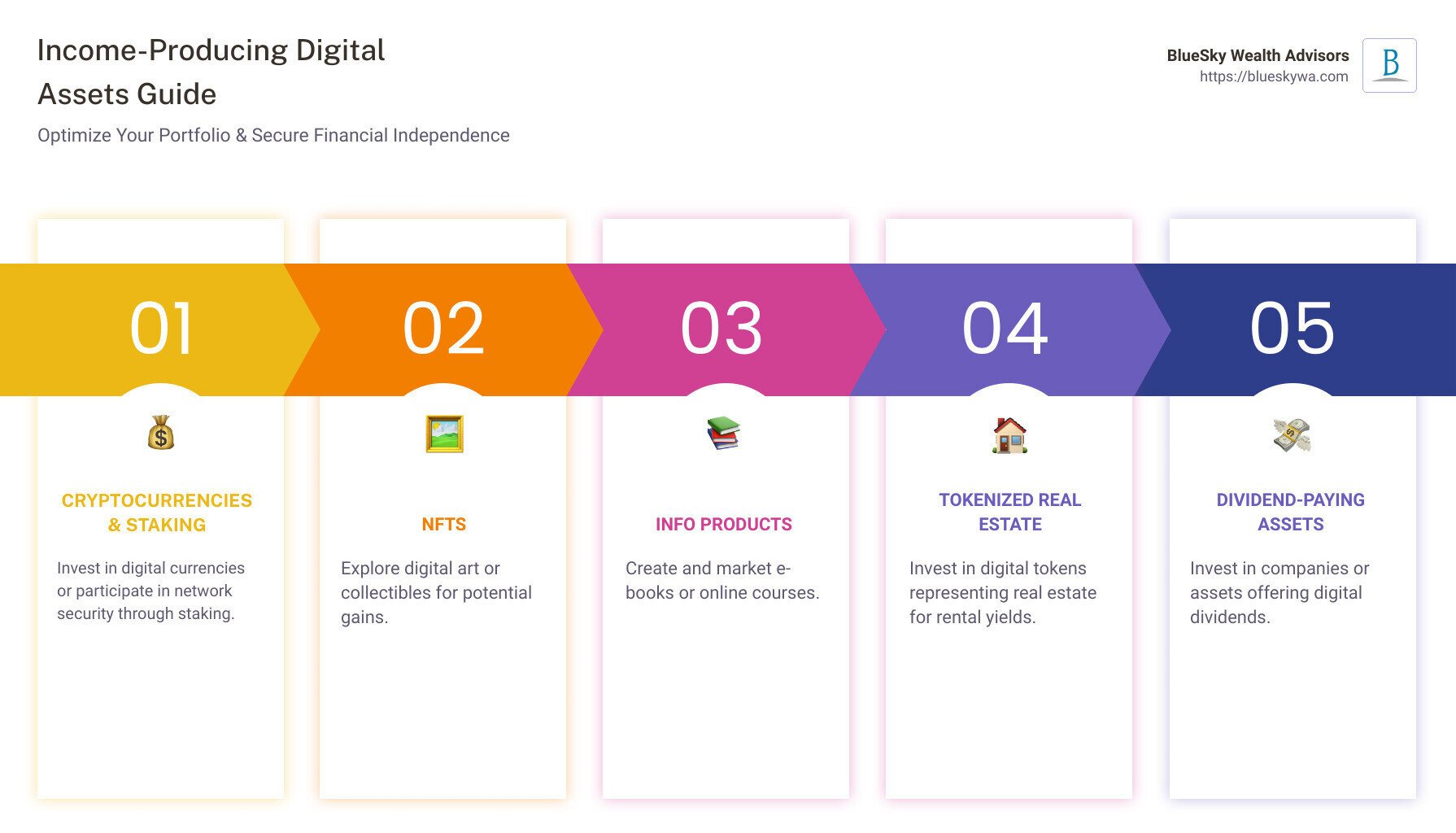
For those of you exploring digital options for generating income, here’s a quick guide to set you on the right path: – Cryptocurrencies & Staking: Invest in digital currencies or participate in staking on Proof-of-Stake networks. – NFTs: Venture into digital art or collectibles for potential capital gains. – Info Products: Create and sell e-books, online courses, or other educational materials. – Tokenized Real Estate & Dividend-Paying Assets: Invest in digital tokens representing real estate or companies offering digital dividends.
With these assets, you can diversify your portfolio beyond traditional stocks and bonds, often benefitting from global trends and technological advancements.
As we delve deeper into understanding these digital options, we’ll explore how they not only serve as income streams but also offer novel ways to optimize your tax situation and establish a meaningful financial legacy.
Understanding Digital Assets
In the realm of income-producing digital assets, there’s a whole world beyond the traditional stock market that can help you grow your wealth. Let’s break down some of these digital options: cryptocurrencies, NFTs, eBooks, and online courses.
Cryptocurrencies
Cryptocurrencies like Bitcoin and Ethereum are the digital gold of the internet era. They’re not just digital money; they’re platforms for building applications, contracts, and other digital assets. Bitcoin, for instance, has been a rollercoaster ride for investors, showing significant gains in 2023. Ethereum, on the other hand, powers a vast ecosystem of decentralized applications.
Cryptocurrencies offer a way to earn through methods like staking in Proof-of-Stake networks, where you can earn additional tokens for holding and supporting the network. This is akin to earning interest in a savings account but in the digital world.
NFTs
NFTs, or Non-Fungible Tokens, represent ownership of unique digital items like digital art or collectibles. They’ve exploded in popularity, turning digital art into a significant income source for artists and collectors alike. NFTs can include anything from a tweet to a piece of digital art, and their uniqueness comes from blockchain technology, ensuring the item’s ownership and originality are always verifiable.
Creators can earn through NFT royalties, meaning every time the NFT changes hands on the secondary market, the original creator gets a percentage of the sales price. This has opened up new revenue streams for digital artists and content creators.
eBooks and Online Courses
The rise of self-publishing platforms and e-learning platforms has made it easier than ever to create and sell digital products like eBooks and online courses. These platforms allow creators to reach a global audience, share their knowledge, and generate income.
Creating an eBook or online course can be a lucrative way to earn passive income. Once the initial effort of creating the product is completed, it can be sold repeatedly without much additional work. Platforms like Amazon for eBooks and Udemy or Coursera for online courses have made it simple for creators to get their products to market and start earning.
The beauty of these digital assets is their potential for passive income. Whether it’s earning through staking cryptocurrencies, selling NFT art, or creating educational content, these assets can generate revenue around the clock without the creator having to actively manage them.
The next section will dive into the top income-producing digital assets in more detail, exploring how you can leverage these digital options to build and grow your wealth.
The digital world is vast and ever-changing, offering numerous opportunities to those willing to explore and innovate.
Top Income-Producing Digital Assets
In the journey towards financial independence, understanding and leveraging income-producing digital assets can be a game-changer. Let’s explore some of the most promising avenues.
Staking in PoS Networks
Proof-of-Stake (PoS) networks offer a unique way to earn passive income. By staking your digital assets, you essentially lock up your cryptocurrencies to support network security and operations. In return, you receive new tokens as rewards, akin to earning interest in a savings account. It’s a win-win; you help maintain the network’s integrity while growing your digital wallet.
DeFi Yield Farming
Decentralized Finance (DeFi) has revolutionized how we think about financial services. Yield farming, a core component of DeFi, allows you to provide liquidity to a platform and earn rewards in the form of governance tokens or interest. Think of it as planting seeds (your digital assets) in a field (the DeFi platform) and harvesting crops (rewards). It requires a bit more active management but can be significantly rewarding.
Cryptocurrency Lending
Similar to traditional lending but in the digital realm, cryptocurrency lending involves lending your digital assets to others through a platform. In return, you earn interest on these loans. Platforms facilitate these transactions and ensure security for both lenders and borrowers. It’s a straightforward way to earn passive income with your digital assets without selling them.
Tokenized Real Estate Investments
Real estate has always been a staple in investment portfolios, but it’s traditionally been a high barrier-to-entry market. Tokenized real estate breaks down these barriers, allowing you to buy tokens representing shares of real-world properties. You earn rental yields and benefit from property value appreciation, all without the headaches of being a landlord.
Dividend-Paying Cryptocurrencies
Some cryptocurrencies offer dividends or additional tokens just for holding them. These dividend-paying cryptocurrencies operate much like stocks that pay dividends. By holding these tokens, you receive a share of the project’s profits, providing a steady income stream. It’s an attractive option for those looking to benefit from the success of a particular project or platform.
Each of these income-producing digital assets offers a unique set of opportunities and risks. Staking and yield farming can provide significant returns but require active management and understanding of the platforms. Cryptocurrency lending and tokenized real estate offer more passive income streams, with real estate bringing the additional benefit of a tangible asset. Dividend-paying cryptocurrencies, while potentially lucrative, depend heavily on the success of the underlying project.
As we continue to navigate the digital economy, these assets represent innovative ways to generate income and build wealth. However, it’s crucial to conduct thorough research, consider diversification to manage risk, and possibly consult with a financial advisor to tailor these opportunities to your financial goals and risk tolerance.
Next, we’ll delve into how to create and monetize your own digital assets, further expanding your potential for generating passive income in the digital age.
Creating and Monetizing Your Digital Assets
In the digital world, creating and monetizing assets can be a smart way to generate income. Let’s dive into some of the most promising methods.
Automated Trading Bots
Automated trading bots use algorithms to buy and sell cryptocurrencies based on market trends. This can be a hands-off way to potentially profit from the volatile crypto market. By setting parameters that match your risk tolerance and strategy, these bots can work around the clock, capitalizing on opportunities even when you’re asleep. However, it’s important to research and understand the risks involved, as market conditions can change rapidly.
Initial Staking Offerings (ISOs)
Initial Staking Offerings (ISOs) are a newer concept where you can stake your digital assets in early-stage blockchain projects for potential rewards. It’s like getting in on the ground floor, offering both early access and the chance to support projects you believe in. While the rewards can be significant, so can the risks, as not all projects succeed.
Crypto Affiliate Marketing
With crypto affiliate marketing, you can earn commissions by promoting crypto products or platforms. Whether it’s through a blog, social media, or email newsletters, sharing referral links can lead to passive income whenever someone signs up or makes a purchase through your link. The key is to build a trusted presence and audience interested in cryptocurrency.
NFT Royalties
For artists and creators, NFT royalties offer a way to earn income. When you create and sell an NFT (Non-Fungible Token), you can embed royalties so that you receive a percentage of sales whenever your NFT is sold on the secondary market. This means ongoing income from your digital creations, providing a new model for artists to sustain their work.
Masternode Operations
Operating a masternode is another way to earn passive income. Masternodes support the network by performing specific tasks and, in return, receive token rewards. Setting up a masternode requires a significant upfront investment and technical knowledge, but for those who are able, it can be a steady source of income.
In Summary:
Automated Trading Bots can trade for you based on algorithms.
ISOs offer a chance to stake in new projects for potential rewards.
Crypto Affiliate Marketing lets you earn commissions by promoting crypto services.
NFT Royalties provide ongoing income from secondary sales of your digital art.
Masternode Operations reward you for supporting a network’s infrastructure.
Creating and monetizing digital assets offers various paths to generating income. Whether you’re a creator, investor, or tech enthusiast, the digital world has opportunities for you. As always, do your homework, understand the risks, and consider how these options fit into your overall financial strategy.
Up next, we’ll explore how to market and sell your digital products effectively, turning your digital gold into tangible rewards.
Marketing and Selling Digital Products
In the journey of turning your digital assets into income, creating them is only the first step. The next crucial phase is marketing and selling these products. This can be done through various channels, but primarily through marketplaces and self-hosted platforms. Additionally, employing effective promotion strategies is key to reaching potential customers.
Selling through Marketplaces
Marketplaces like Amazon, Smashwords, Udemy, and Coursera offer a vast audience ready to discover and purchase digital products. These platforms handle much of the heavy lifting, including payment processing and customer service. However, they also take a percentage of your sales as a fee. While this might seem like a drawback, the exposure and ease of use can make it worth the cost, especially for those new to selling digital products.
Amazon is a powerhouse for eBooks, with Kindle Direct Publishing (KDP) making it simple for authors to publish and sell their books.
Smashwords caters to eBook authors who wish to distribute their work across multiple platforms.
Udemy and Coursera are prime spots for selling online courses, offering a built-in audience specifically looking for educational content.
Self-hosted Platforms
For those seeking more control over their brand and profits, self-hosted platforms such as Shopify, Thinkific, and Disco provide an excellent alternative. These platforms allow you to create a personalized storefront, control pricing, and keep a larger portion of your sales. While they require more effort in terms of setup and marketing, the potential for higher profits and brand building is significant.
Shopify is ideal for sellers of digital downloads, offering a Digital Downloads app to facilitate sales.
Thinkific allows creators to build and sell online courses under their brand.
Disco supports community-driven courses and memberships, offering flexible pricing options.
Promoting Your Digital Products
Regardless of where you choose to sell, promotion is key. Here are three effective strategies:
Social Media Marketing: Platforms like Facebook, Instagram, and Twitter are powerful tools for building an audience and promoting digital products. Engaging content and targeted ads can drive traffic to your marketplace listings or self-hosted store.
SEO: Optimizing your product pages for search engines can significantly increase visibility. Use relevant keywords in your product titles and descriptions to improve your rankings in search results.
Email Marketing: Building an email list allows you to communicate directly with potential customers. Use it to announce new products, offer discounts, and keep your audience engaged with valuable content.
Influencer Partnerships: Collaborating with influencers can help you reach a broader audience. Look for influencers whose followers match your target market and explore partnerships that can promote your digital products effectively.
By leveraging these strategies, you can increase your digital products’ visibility and attract more customers. Each product and audience is unique, so experiment and find what works best for you. Keep refining your approach, and you’ll find success in the digital marketplace.
We’ll dive into some frequently asked questions about income-producing digital assets, providing you with the knowledge you need to make informed decisions in this exciting space.
Frequently Asked Questions about Income-Producing Digital Assets
As we delve into digital wealth, questions abound. Let’s tackle some of the most common queries related to income-producing digital assets, simplifying the complex in the process.
What are digital assets?
In the simplest terms, digital assets are any form of content or media in digital format that you own or have the right to use. This broad category includes everything from photos, videos, and music to more complex items like eBooks, online courses, cryptocurrencies, and NFTs (non-fungible tokens). Essentially, if it exists in digital form and holds value, it’s a digital asset.
How can I make money from digital assets?
Making money from digital assets can be approached in several ways, depending on the type of asset you’re dealing with. Here are a few methods:
Selling or licensing your digital creations, such as eBooks, music, or digital art.
Investing in cryptocurrencies like Bitcoin or Ethereum and benefiting from their value appreciation.
Earning dividends from dividend-paying cryptocurrencies or tokens.
Staking in Proof-of-Stake (PoS) networks to earn additional tokens as rewards for participating in the network’s security.
Yield farming in DeFi (Decentralized Finance) platforms by providing liquidity to earn interest or governance tokens.
Lending your cryptocurrencies on platforms to earn interest from borrowers.
Collecting royalties from NFTs you’ve created whenever they’re sold in the secondary market.
What are some proven strategies for making money from digital assets?
Success in the digital asset space often requires a mix of knowledge, timing, and strategy. Here are some proven strategies:
Diversification: Just like with traditional investments, spreading your assets across various digital assets can help manage risk.
Research and Education: Stay informed about the latest trends and technologies in the digital asset space to make knowledgeable decisions.
Utilize Platforms and Marketplaces: Platforms like Gumroad for digital products or OpenSea for NFTs can significantly expand your reach.
Engage in Communities: Whether it’s cryptocurrency forums or NFT artist collectives, being part of a community can provide invaluable insights and opportunities.
Marketing: Use social media, SEO, and email marketing to promote your digital assets effectively.
Monitor and Manage: Keep an eye on the performance of your digital assets and adjust your strategies as needed.
By understanding the basics of what digital assets are, how you can make money from them, and applying proven strategies to your efforts, you’re well on your way to tapping into this modern goldmine. The digital asset landscape is changing, so continuous learning and adaptation are key to success.
to experiment and find what works best for you. Keep refining your approach, and you’ll find success in the digital marketplace.
Conclusion
In our journey through the realm of income-producing digital assets, we’ve explored a variety of avenues that can lead to financial independence and growth. From staking in PoS networks to the innovative world of NFT royalties, the digital landscape offers numerous opportunities for those willing to dive in and explore. However, venturing into this digital goldmine requires more than just knowledge of the assets themselves; it necessitates a strategic approach to managing and growing your digital wealth.
This is where BlueSky Wealth Advisors steps in. Our team is dedicated to providing personalized financial solutions tailored to meet the unique needs of each client. We understand that digital assets can be complex and overwhelming, which is why we’re here to guide you through every step of your financial journey.
With a focus on tax reduction strategies, we aim to maximize your returns and minimize your liabilities. By leveraging our expertise in both traditional and digital assets, we can help you craft a comprehensive financial plan that incorporates income-producing digital assets into your broader investment strategy.
At BlueSky Wealth Advisors, we’re not just advisors; we’re partners in your quest for financial independence. Whether you’re new to digital assets or looking to optimize your existing portfolio, we’re here to provide the insights and support you need to achieve your financial goals.
Discover how we can help you navigate the digital finance landscape and unlock the full potential of your investments. Explore our personalized financial solutions and learn more about our tax reduction strategies at BlueSky Wealth Advisors. Let’s embark on this journey together, turning digital possibilities into tangible outcomes.
Peer-to-Peer Lending: Lend your money through platforms and earn interest as borrowers repay.
Create and Sell an eBook: Turn your expertise into an income-generating eBook.
Embarking on the journey to secure financial independence through passive income and tax optimization requires a well-informed strategy to discover and leverage income-producing assets. Whether you’re just starting or seeking to diversify your portfolio, understanding the types of assets that can generate regular, reliable income is fundamental. This guide aims to demystify the process of identifying and investing in income-producing assets, catering specifically to individuals who value expert guidance while managing a busy lifestyle. From real estate and dividend-paying stocks to innovative online ventures like e-books, we will cover a broad spectrum of opportunities suitable for different investment goals and capital sizes.
Getting started doesn’t have to be overwhelming. With a clear focus on assets known for their income-producing capabilities, you can begin to build a portfolio that not only supports your current lifestyle but also secures your financial future. Let’s dive deeper into income-producing investments and how to find the ones that fit best with your financial goals and lifestyle aspirations.
Understanding Income-Producing Assets
When we talk about how to find income producing assets, we’re looking for ways to make our money work for us. These assets are like little workers, putting money into our pockets even when we’re not actively doing anything. Let’s break down what these assets are and how they can benefit you.
Income Streams
Income-producing assets provide you with regular payments. These can come in many forms, such as rent from a property, dividends from stocks, or interest from bonds. The key here is regularity, giving you a predictable flow of cash.
Cash Flow
The money that flows from these assets into your bank account is called cash flow. It’s the lifeblood of income investing. Positive cash flow means you’re earning more from the asset than it costs to maintain it.
Rental Properties
Real estate is a classic way to generate income. Whether it’s a single-family home, an apartment building, or commercial property, tenants pay rent, which can create a steady income stream. Location and property management are crucial for success here.
Dividend-Paying Stocks
Some companies share their profits with stockholders through dividends. Investing in these companies can provide you with a slice of their earnings regularly. Look for stable companies with a history of paying dividends.
Bonds
When you buy a bond, you’re lending money to an issuer (like a government or corporation) in exchange for regular interest payments. At the bond’s maturity, you get your initial investment back. Bonds are often seen as safer than stocks but usually offer lower returns.
Mutual Funds
These are investment vehicles that pool money from many investors to purchase a diversified portfolio of stocks, bonds, or other securities. Some mutual funds focus on generating income through dividends or interest.
Real Estate Investment Trust (REIT)
REITs allow you to invest in real estate without owning physical property. They pay out most of their taxable income as dividends to shareholders. It’s a way to get into real estate investing with less capital and complexity.
Certificate of Deposit (CD)
A CD is a time-bound deposit offered by banks with a fixed interest rate. It’s a low-risk investment but locks up your money for a period. The longer the term, the higher the interest rate you’ll usually earn.
Index Fund
An index fund is a type of mutual fund with a portfolio constructed to match or track the components of a financial market index, like the S&P 500. They provide broad market exposure and low operating expenses.
Private Equity
This involves investing directly in private companies. It’s a way to potentially earn high returns, but it’s riskier and requires more capital and expertise.
Cryptocurrency
Digital or virtual currencies that use cryptography for security. Some people invest in cryptocurrencies like Bitcoin or Ethereum for their potential to increase in value, but they’re highly volatile and risky.
Understanding these assets is the first step in building a diversified portfolio that can provide you with a steady income stream. Each has its own set of risks and rewards, so it’s important to do your research and consider your financial situation and goals before investing.
As we explore further, keep in mind that diversification is key. Don’t put all your eggs in one basket. By spreading your investments across different types of income-producing assets, you can reduce risk and increase the potential for steady returns.
Now, let’s move on to how you can start with minimal capital and gradually build a portfolio of income-generating assets.
How to Start with Minimal Capital
Starting your journey towards generating income through assets can seem daunting, especially if you’re starting with minimal capital. However, it’s entirely possible to begin with a small amount and grow your investments over time. Let’s explore how to find income producing assets with a focus on methods suitable for those with limited initial funds.
Raising Capital
The first step is to assess your current financial situation. Look for ways to cut unnecessary expenses and increase your savings rate. Simple changes in daily habits can free up more money than you might expect. Consider selling items you no longer need or use, or taking on a side job to boost your initial investment funds.
Fundraising for Investments
While traditionally associated with businesses, individuals can also engage in fundraising efforts. Crowdfunding platforms can be a resourceful way to gather small amounts of capital from a large number of people. This approach might be more suitable for those looking to start a business or invest in larger projects with others.
Savings Accounts and CDs
Begin with the basics. High-yield savings accounts and Certificates of Deposit (CDs) are straightforward, low-risk ways to start growing your capital. While the returns might not be substantial, they offer a risk-free way to accumulate more funds that can later be invested in higher-yield assets.
Low Minimum Investments
Search for investment opportunities with low entry points. Many online platforms now allow you to invest in stocks, bonds, and even real estate with as little as $10. This democratization of investing makes it easier than ever to start building a diverse portfolio without needing a large sum of money upfront.
Online Courses and E-books
Investing in knowledge can yield high returns. Online courses and e-books on financial literacy, investing strategies, and specific asset classes can empower you with the skills needed to make informed investment decisions. Sometimes, the best asset you can invest in is yourself.
Starting Small
The key is to start small and scale gradually. Consistency and patience are your allies. Even small, regular contributions to your investment accounts can grow significantly over time thanks to the power of compounding interest.
By focusing on these accessible starting points, you can begin your journey towards building a robust portfolio of income-producing assets, even with minimal capital. As your funds and experience grow, you can explore more diverse and potentially lucrative investment opportunities.
Next, we’ll dive into the top income-generating assets suitable for beginners, laying the groundwork for a solid investment strategy that can help achieve financial independence.
Top Income-Generating Assets for Beginners
Embarking on the investment journey can feel like navigating a vast ocean. Let’s simplify the voyage by focusing on five key assets that cater well to beginners. These assets provide a foundation for building a diversified portfolio that can grow with you over time.
Rental Real Estate
Owning rental property is a tangible way to generate income. Property management is crucial here; it involves finding reliable tenants and maintaining the property. While it requires effort, the potential for price appreciation makes it a worthwhile endeavor. Real estate can appreciate in value over time, providing not just income but also a valuable asset that can be sold later, often at a profit.
Dividend-Paying Stocks
Investing in stocks that pay dividends is like getting a paycheck from your investments. Look for companies in the S&P 500 or Dividend Aristocrats, which have a history of increasing dividends over time. ETFs (Exchange-Traded Funds) focusing on dividend stocks are also a great choice, offering diversification and reducing the risk associated with individual stocks.
Bonds and Bond Index Funds
Bonds are essentially loans you give to corporations or the government, and in return, they pay you interest. Treasury bills and corporate bonds are more stable, while high-yield bonds offer higher returns but come with increased risk. Bond index funds can offer a good mix, spreading out potential risks across various bonds.
Real Estate Investment Trusts (REITs)
REITs allow you to invest in real estate without owning physical property. They’re companies that own, operate, or finance income-generating real estate. You can choose between publicly-traded REITs, which are bought and sold on the stock market, and private REITs, which are not. Commercial properties are a common focus, offering the potential for significant income through rent and property appreciation.
Peer-to-Peer Lending
Platforms like Lending Club connect borrowers with investors directly. You can lend money to individuals or businesses and receive payments with interest. It’s important to conduct risk assessment to choose loans that match your risk tolerance. The interest rates on these loans can be higher than traditional savings accounts or CDs, reflecting the higher risk level.
Choosing the right mix of these assets depends on your financial goals, risk tolerance, and investment horizon. Diversification across different types of assets can help mitigate risks and provide a steadier income stream. Investing is a marathon, not a sprint. Patience and continuous learning are your best allies on this journey.
Next, we’ll explore how diversifying your portfolio with these and other income-producing assets can further enhance your financial stability and growth potential.
Diversifying Your Portfolio with Income-Producing Assets
Diversifying your investment portfolio is like planting a garden with different types of plants. Some will flourish in the sun, others in the shade, but together, they create a vibrant and resilient ecosystem. In investing, this means spreading your investments across various assets to reduce risk and potentially increase returns. Let’s dive into how you can diversify your portfolio with income-producing assets.
Real Estate
Real estate is a cornerstone of many diversified portfolios. Whether you’re investing in rental properties, commercial real estate, or land, the key is to find properties that will appreciate over time and generate rental income. Location is everything. A well-chosen property in a growing area can provide both steady income and significant appreciation.
Stocks
Dividend-paying stocks are a great way to receive regular income from your investments. Companies that pay dividends tend to be more stable and less volatile. Look for stocks with a history of consistent dividend payments and consider diversifying across sectors to mitigate risk.
Bonds
Bonds are essentially loans you give to a corporation or government, in exchange for regular interest payments. They are generally considered safer than stocks but offer lower returns. Diversifying your bond investments by type (government, municipal, corporate) and maturity can help manage risk and provide steady income.
REITs
Real Estate Investment Trusts (REITs) allow you to invest in real estate without having to buy property directly. They often offer high dividend yields and can be a more liquid alternative to physical real estate. Diversifying across different types of REITs (e.g., commercial, residential, healthcare) can enhance your portfolio’s resilience.
Farmland
Investing in farmland might seem unconventional, but it can be a stable income-producing asset. Farmland has shown to be relatively immune to economic downturns, and with the growing demand for food, it can be a solid long-term investment.
Annuities
Annuities are insurance products that can provide a steady income stream in retirement. They can be complex and come in various forms, so it’s crucial to understand the terms before investing. Annuities can be a part of a diversified retirement strategy, providing peace of mind with guaranteed income.
Websites
Digital real estate, such as websites or online businesses, can generate significant income through advertising, affiliate marketing, or selling products/services. The initial investment can be low, but it requires time and effort to grow. Diversifying across different niches or business models can reduce risk.
Money Market Accounts
Money market accounts offer higher interest rates than traditional savings accounts and are FDIC insured, making them a safe place to park your cash. They can provide liquidity and a modest income, serving as a good counterbalance to more volatile investments.
Royalties
Investing in royalties means receiving a percentage of the revenue from intellectual property, like music, patents, or mineral rights. This can be a way to earn passive income from assets that require little to no maintenance.
Building a Business
Starting or investing in a business can be one of the most rewarding ways to generate income. Whether it’s a brick-and-mortar store, an online venture, or a partnership, owning a business puts you in control of your financial future. Diversification can come from investing in different industries or business models.
Cryptocurrency DeFi
Decentralized Finance (DeFi) platforms offer innovative ways to earn income through cryptocurrency. From yield farming to staking, DeFi can offer high returns but comes with high risk, including volatility and security issues. It’s essential to do thorough research and consider it a small part of a diversified portfolio.
In Summary, diversifying your portfolio across various income-producing assets can help mitigate risks and provide a steadier income stream. Each asset class comes with its own set of risks and rewards, so it’s crucial to do your homework and possibly consult with a financial advisor. The goal is to build a portfolio that aligns with your financial objectives, risk tolerance, and time horizon.
Keep in mind that diversification is not just about spreading your investments but also about understanding and actively managing them to achieve your long-term financial goals.
Frequently Asked Questions about Income-Producing Assets
When it comes to how to find income producing assets, there are several questions that frequently come up. Here’s a straightforward breakdown to help guide you through the maze of options available.
What are the safest income-producing assets?
The term “safe” can be subjective, but generally, the safest income-producing assets are those with lower volatility and a consistent track record of returns.
Bonds and Bond Index Funds: Government and high-quality corporate bonds are considered some of the safest investments. They provide regular interest payments, and the principal is returned at maturity.
Certificates of Deposit (CDs): Insured by the FDIC up to $250,000, CDs offer a fixed interest rate over a specified term. They’re a low-risk way to earn a return on your cash.
Real Estate Investment Trusts (REITs): Publicly-traded REITs offer liquidity and income through dividends. They invest in a diversified portfolio of income-generating real estate.
How can I generate passive income with little money?
Generating passive income with a small initial investment is entirely possible. Here are a few ways to get started:
Dividend-Paying Stocks: Some companies pay dividends to shareholders. You can start investing in these stocks with a relatively small amount of money through a brokerage account.
Peer-to-Peer Lending: Platforms like Lending Club allow you to lend money to individuals or small businesses online, earning interest as they repay their loans.
REITs and Crowdfunding Platforms: Some real estate crowdfunding platforms and REITs have low minimum investment requirements, making it easier to start investing in real estate.
What are the best income-producing assets for long-term growth?
For long-term growth, consider assets that not only provide income but also have the potential for capital appreciation.
Real Estate: Whether through direct ownership or crowdfunding platforms, real estate can offer rental income and price appreciation over time.
Stocks and Index Funds: Investing in the stock market or low-cost index funds can provide dividends and significant growth potential over the long term.
Cryptocurrency and DeFi: For those with a higher risk tolerance, certain cryptocurrency-based income streams, such as staking or yield farming, can offer high returns.
The key to successful investing in income-producing assets is research, diversification, and a clear understanding of your risk tolerance. Whether you’re starting with a small amount of capital or looking to grow your portfolio for the long term, there are numerous options to explore. Always consider consulting with a financial advisor to align these investments with your overall financial goals.
As we delve into more specific strategies and considerations for selecting the right income-producing assets for your portfolio, keep these FAQs in mind as a foundation for your investment journey.
Conclusion
As we wrap up our journey through income-producing assets, it’s clear that the path to financial security and passive income is both diverse and accessible. From real estate to REITs, from bonds to dividend-paying stocks, there are numerous avenues to explore, each with its own set of risks and rewards. However, navigating this landscape requires more than just knowledge; it demands a strategic partner who can guide you through the complexities of investment options, aligning them with your personal financial goals and risk tolerance.
This is where BlueSky Wealth Advisors steps in. Our approach to investment isn’t just about picking the right assets; it’s about crafting a holistic financial plan that supports your life’s ambitions. We understand that every investor’s journey is unique, and there are no one-size-fits-all solutions. Whether you’re starting with minimal capital or looking to diversify an already robust portfolio, our team is dedicated to providing personalized advice that considers every aspect of your financial picture.
Our philosophy is grounded in the belief that a well-diversified portfolio, balanced between aggressive and conservative investments, is key to achieving long-term financial success. We prioritize assets that not only generate income but also contribute to the stability and growth of your portfolio over time. By focusing on a globally-diversified passive mix of assets, keeping portfolio expenses low, and employing tax efficiency strategies, we aim to maximize your returns while minimizing risks.
In conclusion, the journey to finding and investing in income-producing assets is an exciting venture that can significantly impact your financial future. At BlueSky Wealth Advisors, we’re committed to helping you navigate this journey, offering expert advice and tailored strategies to ensure your investment choices align with your broader financial objectives.
For more insights and guidance on how to find income producing assets and to learn more about our services, visit our passive income category page. Let us help you build a financial foundation that not only meets your needs today but also secures your legacy for tomorrow.
Investing in income-producing assets is a powerful step toward financial independence and security. With the right approach and a trusted advisor by your side, the possibilities are endless. Thank you for reading, and here’s to your success on the investment journey ahead.
Businesses continuously need to raise capital to finance their operations, and one way they do this is by issuing stocks. When you invest in a stock, you become a part-owner of the company, and as such, you are entitled to a share of its profits. This profit-sharing is known as dividends.
Dividend investing is an investment strategy focusing on earning passive income from dividend-paying stocks. So, how do you get started with dividend investing? Can this strategy provide a steady stream of revenue for the long term? In this article, we will explore the concept of dividend investing and how it can be a viable option for generating passive income. Keep reading to learn more!
What is Dividend Investing
Dividend investing involves strategically acquiring shares in companies with a consistent track record of distributing a portion of their profits to shareholders through dividends. In contrast to growth stocks that focus on reinvesting earnings back into the company for expansion, dividend-paying companies tend to be well-established entities with reliable revenue streams.
This stability allows them to consistently reward shareholders, making them an appealing option for those seeking to generate passive income. By holding onto these stocks, investors can enjoy regular dividend payouts without selling their shares. For example, if a company pays out $0.50 per share quarterly and an individual owns 100 shares, they can expect to receive $200 in dividends annually, building a steady income stream over time.
Benefits of Dividend Investing
Dividend investing has several advantages, making it a popular choice for those seeking to generate passive income. Some of the key benefits include:
Passive Income
One of the most compelling advantages of dividend investing is its ability to generate a stable stream of passive income. This approach suits investors who prefer a less hands-on tactic while still reaping financial rewards. Once you’ve established a diversified portfolio of dividend-paying stocks, you can earn money without the day-to-day involvement typically required in other forms of active investing.
For example, Johnson & Johnson is renowned for its consistent dividend income investing. An investor holding shares in Johnson & Johnson benefits from the company’s solid fundamentals and market position and enjoys regular dividend payments. Often made quarterly, these payments can accumulate over time, providing a cushion of income that can be relied upon in retirement or reinvested to take advantage of compound interest.
Diversification
Another significant advantage of dividend investing is the concept of diversification, which plays a crucial role in effective risk management. Diversification involves spreading investments across various sectors or asset classes geographically to minimize the impact of volatility in specific regions. With their consistent payouts, dividend-paying stocks are precious for investors looking to build a stable company’s earnings.
This variety in dividend stocks offers investors a well-rounded portfolio allocation that can enhance stability and reduce risk exposure. For example, carefully selecting dividend-paying stocks from different sectors and regions can create a balanced mix that ensures a more resilient investment approach, especially during market uncertainty.
Potential for Long-Term Growth
In addition to generating stable passive income and offering diversification, dividend investing also presents a significant potential for long-term growth. This growth is not solely based on the appreciation of mutual funds over time. Still, it is also enhanced by reinvesting dividends back into the market, thereby compounding earnings and increasing the value of an investment. For example, Coca-Cola has a long history of paying dividends.
If you bought shares in Coca-Cola decades ago and consistently reinvested, the dividends would now own a more significant number of shares than initially purchased, thanks to the effects of compounding. This increase in share volume, combined with the overall appreciation of the stock price and the incremental increase in annual dividend payouts, exemplifies how dividend investing can contribute to wealth building over the long term.
Building a Dividend Investing Portfolio
Building a well-diversified dividend investing portfolio requires careful selection and monitoring of stocks. Some essential considerations when constructing your portfolio include:
Company Fundamentals
A thorough understanding of the company’s fundamentals is essential when evaluating potential dividend-paying stocks for your portfolio. This involves exploring its financial health, profitability metrics, and the reliability of its revenue streams. A reputable company typically showcases a strong balance sheet with manageable debt levels, steady earnings, and a successful history of navigating economic downturns.
Additionally, analyzing the company’s dividends is vital. This metric represents the portion of earnings distributed to shareholders as dividends. This ratio needs to be sustainable. An excessively high payout ratio might suggest that the company needs to reinvest more adequately in its growth, potentially endangering future dividend payments. For example, a company with an 80% payout ratio could struggle to maintain dividends during financial hardship.
Dividend Yield
The dividend yield is critical in evaluating potential additions to your dividend portfolio. It demonstrates the annual dividend payment in relation to the stock’s price, offering a gauge of the investment’s income potential versus its cost. Although a high dividend yield may appear appealing, it can sometimes signal underlying problems, such as a declining stock price driven by operational difficulties.
Companies that maintain stable yields often manage consistent growth, effectively balancing the scale. Take, for instance, a telecom company renowned for its regular dividends, an asset to your investment portfolio. If the stock is priced at $100 per share with an annual dividend of $4, the dividend yield stands at 4%. This figure provides an immediate insight into the income you can expect in proportion to your investment.
Historical Dividend Growth
Historical dividend growth holds immense importance in-stock selection for dividend investors, serving as a vital indicator of a company’s financial well-being and how they pay dividends. Sustained dividend growth signifies a robust business model and a dedication to shareholder rewards over time.
Additionally, it suggests the company’s earnings are stable and growing, allowing for sustained dividend payments and potential increases in the future. For example, Apple Inc., despite being a relatively late entrant to the dividend scene in 2012, has consistently increased its company’s dividend yield yearly. This growth pattern in dividends mirrors the company’s overall financial growth and market expansion, showcasing its ability to generate excess cash and return value to shareholders.
Tax Considerations in Dividend Investing
An essential aspect to remember when investing in dividends is the tax implications of dividend income. Dividends are considered taxable income, and the tax rate depends on the type of dividends received. These are the two types of dividends paid out by companies:
Qualified Dividends
Qualified dividends are among the most favorable types of income for investors, primarily due to their tax-efficient nature. These dividends are paid by U.S. companies or foreign companies listed on major U.S. exchanges and meet specific holding period criteria set by the IRS. Unlike ordinary dividends, which are taxed at the investor’s standard income tax rate, qualified dividends benefit from a lower tax rate, akin to long-term capital gains.
This distinction can lead to significant tax savings, especially for those in higher tax brackets. For example, if you own shares in a multinational corporation like Microsoft, which regularly pays dividends. If you’ve held these shares for more than 60 days within the 121-day period that begins 60 days before the ex-dividend date, the dividends received from Microsoft would be considered qualified. Consequently, instead of being taxed at your regular income rate, which could be as high as 37%, these dividends could be taxed at a maximum of 20% (depending on your overall taxable income).
Ordinary Dividends
Ordinary dividends, often known as non-qualified dividends, form the majority of dividend payouts for many investors. Unlike qualified dividends, ordinary dividends are subject to the investor’s standard income tax rate, which varies significantly depending on the individual’s tax bracket. These dividends are treated as typical income, similar to wages, and therefore do not benefit from the reduced tax rates applied to qualified dividends or long-term capital gains.
This differentiation is crucial for investors when developing their investment strategy and evaluating the potential net returns on their dividend investments. For example, if you are an investor in the 24% tax bracket who receives $1,000 in ordinary dividends from a company that does not meet the criteria for qualified dividends. You would owe $240 in taxes on this dividend income (24% of $1,000), contrasting sharply with what might be owed if those dividends were qualified and taxed at a lower rate.
Potential Risks Associated with Dividend Investing
While dividend investing offers a compelling avenue for generating income and growing wealth over time, investors must approach this strategy with a comprehensive understanding of its accompanying risks. Some potential risks of dividend investing to keep in mind include:
Dividend Cuts or Suspensions
One risk associated with dividend investing is when a company cuts or suspends its dividend payments. This action is often triggered by declining profits, cash flow challenges, or the necessity to reinvest earnings into the business. Such occurrences can lower the investor’s income and result in a drop in the stock price as the market reacts to the company’s altered financial prospects.
For example, during economic crises like the 2008 financial downturn, even reputable financial institutions like Wells Fargo, known for their consistent dividend payouts, had to reduce dividends significantly. This move affected investors who depended on these payments and shook investor trust, resulting in a sharp decline in stock values.
Limited Diversification
Emphasizing dividend-investing strategies excessively can often lead to inadequate diversification, concentrating risk in certain sectors or types of companies renowned for their high dividend yields, like utilities or real estate investment trusts (REITs). Although these sectors may provide appealing dividend returns, they are typically sensitive to market shifts affecting interest rates, including changes in economic policy or inflationary pressures.
Such sensitivity can increase portfolio volatility, undermining a key advantage of dividend investing: stability. For instance, during the financial uncertainties triggered by the COVID-19 pandemic, sectors such as retail REITs faced considerable challenges. Enforcement of lockdowns and social distancing measures globally led to a decline in rent collections, adversely affecting these REITs’ capacity to sustain their customary dividend payments. Investors disproportionately invested in these high-dividend-yielding sectors encountered unexpected reductions in income and losses in principal, underscoring the paramount importance of pursuing broader diversification beyond merely seeking high dividend yields.
Interest Rate Risk
Interest rate risk is a pivotal factor for investors holding dividend-paying stocks, as it directly influences the appeal and value of these assets. Like fixed-income securities like bonds, dividend stocks can lose value when interest rates climb. Higher interest rates make newly issued bonds more appealing due to their superior yields, enticing investors to shift their focus away from stocks.
Take, for instance, a scenario where the Federal Reserve hikes interest rates to curb inflation. Suppose you’re an investor with holdings in dividend-paying stocks within the telecommunications sector, renowned for its high dividend yields. In that case, you might witness your stocks’ value depreciation. This depreciation occurs as investors might opt to liquidate their dividend stocks in favor of the safer, more lucrative bond market, thus driving down the stock prices.
Future Trends in Dividend Investing
While dividend investing has long been a popular strategy among income-oriented investors, the recent market environment and evolving corporate policies have led to notable trends. These include:
Increased Focus on Sustainable and Responsible Dividends: This approach aims to balance providing attractive dividend yields for investors while ensuring that the company remains financially strong and can sustain its dividend payments over the long term. With growing investor awareness and concern for environmental, social, and governance (ESG) issues, companies have increasingly incorporated ESG factors into their dividend policies.
Alternative Dividend Structures: While traditional dividends are typically paid out in cash, some companies have started exploring alternative means of rewarding shareholders while preserving their cash flow. These include stock dividends, where shareholders receive additional shares instead of cash, and dividend reinvestment plans (DRIPs), allowing shareholders to automatically reinvest their dividends into purchasing more company stock.
Technology-Driven Innovations: The rise of technology-driven platforms like robo-advisors and online brokerages has made stock dividend investing more accessible and cost-effective for retail investors. These platforms offer more streamlined and efficient ways to research, select, and monitor dividend-paying investments, making it easier for investors to build diversified portfolios.
Changes in Tax Policies: With changes to tax policies, such as the qualified dividend tax rates mentioned earlier, investors may see changes in their after-tax returns on dividend investments. For example, the proposed increase in income taxes for high earners could result in higher dividend tax rates than current levels.
Impact of Interest Rates: Dividend stocks typically compete with other income-generating investments, such as bonds, which can be affected by changes in interest rates. As interest rates rise or fall, dividend investing strategies may need to adapt and adjust to changing dynamics.
Conclusion
Dividend investing remains a fundamental strategy for income-oriented investors, providing a potential source of steady income and the opportunity for capital appreciation. However, as we have discussed, it comes with risks and challenges, including dividend cuts or suspensions, limited diversification, and interest rate risks. Investors must conduct thorough research, consider diversification to lessen risks, and stay informed about market trends and economic indicators influencing dividend-paying stocks.
The evolving landscape of dividend investing, characterized by sustainable and responsible dividends, alternative dividend structures, and technology-driven innovations, presents new opportunities and considerations for investors. By staying adaptive and informed, investors can effectively navigate the complexities of dividend investing and potentially enhance their investment outcomes in a changing economic environment.